October 23, 2026

A beard can seem to stop growing even while its hairs continue through natural growth cycles. If you’re wondering what to do about a beard growth plateau, first distinguish slower-looking progress from a true limit: depending on genetics, each beard hair’s active growth phase can last from a few months to several years. Since hairs follow their own cycles, apparent maximum length reflects both growth cycles and the way your beard’s texture sits.
It’s frustrating when the mirror looks unchanged, especially when you’re giving your beard time to develop. But day-to-day appearance can hide gradual progress: dry or coarse hairs may obscure length, and frequent trimming can make growth harder to track. This guide explains how age and hormones influence beard development, how the hair-growth cycle works, and why terminal length can make a beard seem stuck. You’ll learn how to assess what’s changing, what may be your beard’s natural limit, and when persistent lack of change merits closer attention.
Key Takeaways
- A beard can seem to stall without its follicles stopping; growth cycles and each hair’s natural terminal length shape how much length you see.
- Beard density can keep developing into the mid-thirties, so your current coverage may not reflect its mature pattern.
- Genetics influence how long facial hairs stay in their active growth phase, while hormones help shape facial hair development.
- Dryness, coarse texture, and frequent trimming can disguise progress. Track changes over time rather than judging by how your beard looks or feels from day to day.
- If little changes after a consistent routine for six or more months, consider discussing the pattern with a doctor or dermatologist.
When Does Beard Growth Typically Peak?
Beard growth typically reaches mature peak thickness in a man’s late twenties to early thirties. Testosterone levels peak during the early twenties, but beard density doesn’t necessarily peak at the same time. Most men reach their peak beard-growth potential by their early thirties, although facial hair can continue to mature.
Genetics shape how many follicles produce visible facial hair, where they’re located, and how evenly they fill an area. One man may develop strong cheek coverage early, while another’s cheeks remain sparse as his chin and moustache fill in. These differences reflect individual growth patterns, not the consistency of someone’s grooming routine. Genetics also influence each follicle’s response to hormones, so similar hormone levels don’t produce identical beards.
Hormones help activate facial hair development, but they aren’t a simple switch for a full beard. Inherited follicle sensitivity matters: neighboring follicles can respond differently, creating uneven growth across the cheeks, jaw, or chin. That’s why raising hormone levels isn’t a reliable way to change beard density. Age, inherited follicle traits, and the timing of maturation all contribute to the beard you see.
A beard that no longer looks longer may have reached the terminal length of its hairs. Genetics influence how long each follicle’s active growth phase lasts, so some areas can grow longer than others before hairs shed and renew. Shaving or trimming doesn’t change follicle count or growth rate; a blunt cut can simply make short hairs feel coarser. Trimming your cheeks, for example, won’t cause new follicles to appear there.
A medical evaluation can help assess persistent patchiness. Minoxidil is one option to discuss with a medical professional. Treatment costs depend on whether care involves an assessment, medication, or follow-up, as well as on the treatment plan. There’s no single cost that applies to every case.
Minoxidil is described as the only clinically proven way to stimulate hair growth where there was none before. The available information doesn’t establish its safety for every person or its use on facial hair, so consult a medical professional before trying it. A conversation can consider your health, the application area, and possible risks rather than treating it as a routine beard product.
A nutrient-rich diet containing biotin, zinc, and protein supports healthier facial hair growth. Vitamins A, C, and E and biotin appear in supplements marketed for growth, but that doesn’t establish that extra supplements will improve a beard. Supplements can carry risks, so discuss them with a doctor or pharmacist, especially before combining products or taking high doses.
Consider seeing a doctor or dermatologist if a consistent routine brings little to no change after six or more months. A professional can assess the pattern and whether an underlying issue needs attention. Note where growth is sparse and whether the change is new; these details help explain what you’ve observed.
Age-related changes in beard density
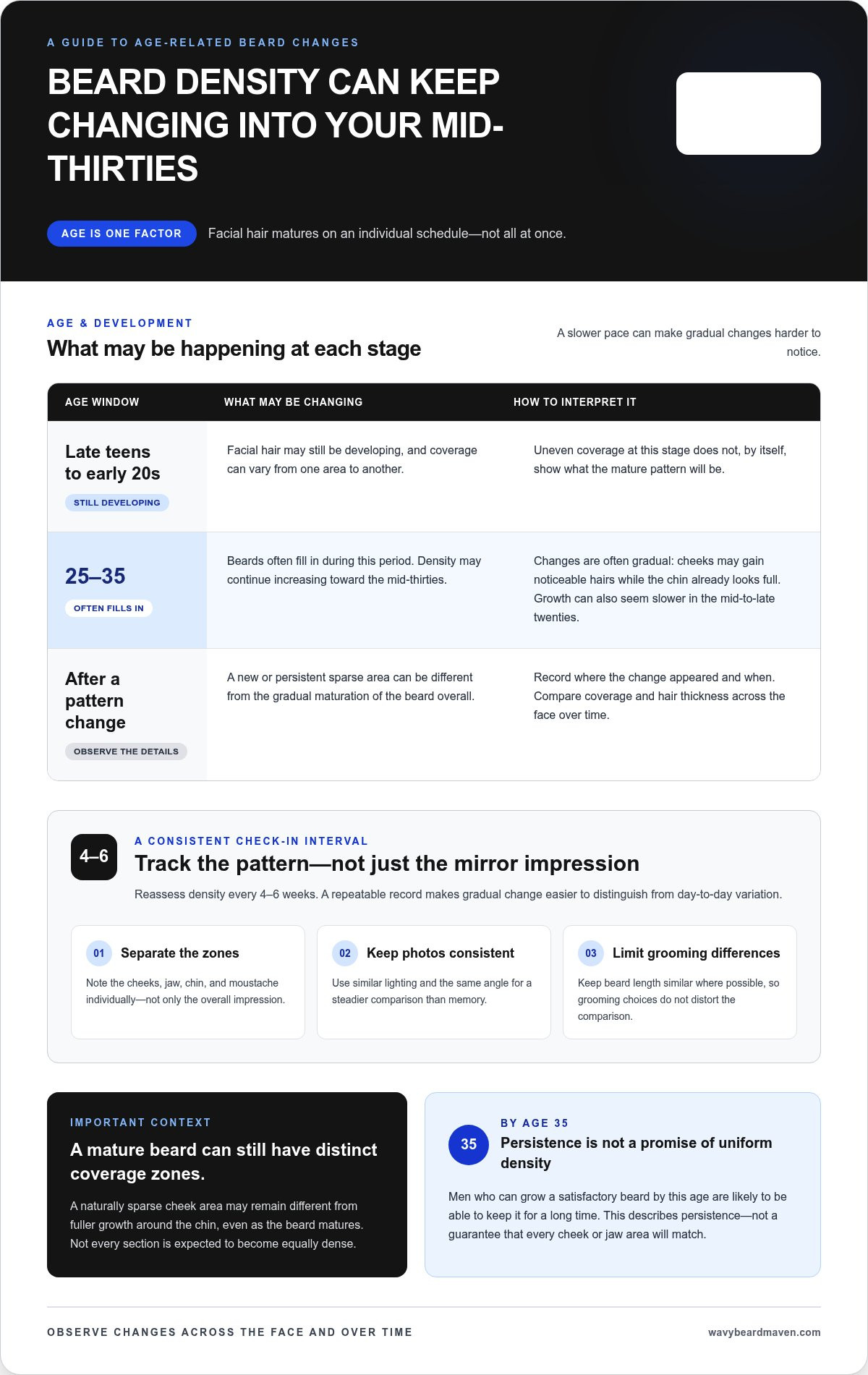
Beard density can continue increasing until the mid-thirties. A beard that looks uneven in the late twenties may still gain coverage as facial hair matures. Beards often fill in between ages 25 and 35, but development doesn’t follow one schedule for every man. Compare the pattern across your face, not just the overall impression in the mirror.
Age-related changes often appear as gradual thickening rather than a sudden transformation. New hairs may become noticeable on the cheeks, for example, while the chin already looks full. Growth may also slow during the mid-to-late twenties, making changes harder to spot. A slower pace doesn’t mean every area has reached its mature density.
Use a consistent record to separate real change from day-to-day variation. Reassess density every 4-6 weeks, noting the cheeks, jaw, chin, and moustache separately. A photo taken in similar lighting gives you a steadier comparison than memory. Keep the same angle and beard length where possible, so grooming choices don’t distort the pattern.
Age alone can’t explain every patch. A naturally sparse cheek area may remain different from fuller growth around the chin, even as the beard matures. Look for changes in coverage and hair thickness across repeated assessments. If one area stays unchanged while others develop, note that difference rather than labeling the entire beard stalled.
- Late teens to early twenties: facial hair may still be developing, with coverage varying by area.
- Ages 25 to 35: beards often fill in, and density may continue increasing toward the mid-thirties.
- After a change in pattern: note where and when it appeared, rather than relying on a general impression.
By age 35, men who can grow a satisfactory beard are likely to be able to keep it for a long time. This describes persistence, not a promise that every cheek or jaw area will become equally dense. A mature beard can still have distinct coverage zones. Set grooming expectations around the pattern you actually have, rather than waiting for every section to match.
Keep beard care focused on healthy-looking hair and skin while density develops. A regular grooming routine can help you maintain a deliberate shape, but it can’t alter the age at which your beard matures. If you’re refining a wavy beard as it fills in, use a consistent beard care routine to keep your grooming habits organized.
Hormones and facial hair growth
Hormones are part of facial hair development, but they don’t dictate beard density alone. Many people notice facial hair thickening from their late teens to early 30s. Most adolescent boys first notice facial hair between ages 13 and 16. That broad timeline reflects biology in motion, not a single age when every follicle responds or every beard fills evenly.
Testosterone levels peak during men’s early twenties, but beard growth doesn’t necessarily peak then. Hair follicles vary in their sensitivity to hormones, so one person may develop strong cheek coverage while another sees more growth around the chin. Hormone levels and visible coverage aren’t interchangeable measures. A sparse area alone doesn’t establish that hormone levels are low.
Think of hormones as one influence in a larger process. Genetics affect how follicles respond, and age shapes when facial hair matures. Two men of the same age can have different patterns despite being at a similar stage of development. Since the timing and distribution of growth depend on individual biology, comparing your cheeks with someone else’s can mislead.
Grooming habits can improve how facial hair looks and feels, but they don’t reset its hormone response. Trimming, shaving, brushing, or applying beard care products won’t create new follicles or make them produce hair through a hormonal shift. Hydrating beard hair can make it easier to manage, but it won’t change the underlying growth pattern.
Use the timeline as context, not a diagnosis. If your beard is still changing through your late teens, twenties, or early 30s, developing density can be part of normal maturation. Track specific areas, such as the cheeks and jaw, rather than deciding from one overall glance. A consistent record helps distinguish gradual change from a genuinely new shift in coverage.
Pay attention to changes that differ from your usual pattern. If facial hair becomes newly sparse or changes noticeably, note where the change occurred and when you first observed it. A doctor can assess that history alongside other relevant health details. Don’t try to raise testosterone or take hormone-related products solely to change beard growth: grooming and hormone treatment aren’t interchangeable approaches.
For everyday beard care, focus on comfort and manageability while your pattern develops. Choose grooming habits that suit your texture, and assess progress over time rather than judging your beard just after a trim. Hormones influence development, but age, genetics, and follicle response together shape the facial hair you see.
Natural beard growth cycles and growth rate
Beard hair doesn’t grow continuously at a steady pace. Each follicle moves through an active growth phase, then a resting phase, before shedding and starting again. Because follicles aren’t synchronized, some hairs can lengthen while others rest or shed. This cycle can make the beard look unchanged even as individual hairs continue developing.
Depending on genetics, the active anagen phase can last from a few months to several years. A longer active phase lets a hair grow longer before it sheds. That helps explain why one man can grow a long beard while another reaches a shorter natural limit. Testosterone influences facial hair development, but it doesn’t set every follicle’s cycle or guarantee the same result across the face.
Beard hair commonly grows close to .5 inches a month during anagen. Another reported average is 0.27 mm per 24 hours. These are population-level averages, not a schedule for each cheek, chin, or moustache hair. Growth also becomes difficult to judge when curled hairs overlap or trimming repeatedly removes visible length.
Set expectations around the whole growth cycle, not a few days in the mirror. The awkward phase often appears between weeks 2 and 6. Many beards start filling in between 6 and 12 weeks, while thin or slow-growing beards may take 3-6 months. Thicker beards may take shape within 2-3 months, and most men need 2-6 months to grow a full beard.
- Early growth: The first significant beard growth usually occurs between ages 18 and 25.
- Growth window: A 90-day grow without trimming or shaving can reveal your natural pattern.
- Ongoing turnover: Resting and shedding follicles mean every hair won’t reach its maximum length together.
Adult men typically have thousands of beard hairs, each with its own cycle. A few shed hairs don’t mean the entire beard has stopped growing. Shaving also doesn’t change follicle count or growth rate; cutting hair at skin level simply changes its visible length. Don’t expect beard hair to behave like scalp hair, since its growth cycle and texture differ.
Use trimming to shape your beard, not as a growth strategy. To assess progress, let it grow through a consistent period and compare its outline under similar conditions. A short interval can hide changes; comparing over a longer period reveals more about which areas continue growing and where terminal length may set a limit.
Perceived beard growth plateaus and terminal length
A beard can seem stuck when hairs grow unevenly, curl back, or reach their natural terminal length. If you’re searching “beard growth plateau what to do,” begin by comparing visible length over time rather than relying on how your beard feels.
Recognizing a Perceived Growth Plateau
A perceived plateau is a period when the beard looks unchanged, though individual hairs may still be growing or cycling. Terminal length is the limit a hair reaches before its growth cycle ends. Telling these apart matters: dry or coarse texture can hide added length, and frequent trims can remove evidence of growth before you notice it.
Take comparison photos in similar lighting and keep the same camera angle. One reported example involved a beard grown for about 6 months, with side hairs left untrimmed for 3 months and measuring about 2-3 cm. That records the beard at one moment; it doesn’t prove every follicle has stopped. Track separate zones, such as cheeks, chin, and jaw, to see where appearance changes.
If patchy coverage draws attention, a uniform length of 2-4 mm can make a beard appear fuller. Reassess density every 4-6 weeks, using the same view and lighting. Brush hairs into place rather than pulling them straight. These grooming choices can make the outline look more even, though they don’t change follicle count or terminal length.
Time to Reach Terminal Length
Terminal length has no single timeline: depending on genetics, the active growth phase can last from a few months to several years. A hair reaches its limit when that phase ends, and each follicle follows its own cycle. If you’re asking “beard growth plateau what to do,” distinguish limited visible progress from hairs reaching their individual limit.
Reduce frequent trimming if you’re trying to observe length, and compare your beard at consistent intervals. Keep hair conditioned so dryness doesn’t obscure its shape. Washing 2-3 times per week and brushing daily can support a manageable routine, while a few drops of beard oil each day can condition the hair. Oil won’t create new follicles or extend terminal length.
Choose grooming steps for presentation, not to force a different growth cycle. A neckline two fingers above the Adam’s apple can sharpen the outline, while an even trim can help patchy areas look balanced. If a consistent routine brings little to no change after 6 or more months, consider an assessment with a doctor or dermatologist. Build a consistent beard care routine around comfort and the style you want to maintain.
Wavy Beard Maven: Beard Oils
Wavy Beard Maven offers beard oils to help maintain a comfortable, conditioned beard while you track its natural growth. Beard oil can help manage dryness and make coarse or wavy hairs easier to groom, but it won’t create follicles or extend terminal length. For a routine suited to your texture, pair beard oil with a beard brush, beard butter, or beard balm as needed.
Turn to these grooming essentials when dryness, flyaways, or uneven texture distract from your beard’s actual length. Keep expectations clear: care supports appearance and manageability, while biology shapes growth patterns.
Explore the grooming guidance and offerings at Wavy Beard Maven when you’re ready to refine your beard care routine.
Make Your Next Beard Move Deliberate
Your next step doesn’t have to be chasing a different growth pattern. Choose a grooming goal you can control, such as keeping your beard comfortable, shaping its outline, or making daily care more consistent. If you’re deciding what to do about a beard growth plateau, focus on a routine that supports the beard you have while you choose the style that suits you.
Beard oils and butters can be part of your care routine, while a beard brush helps you work with your beard’s shape. These tools support grooming, not changes to follicle activity. Keep your approach consistent, notice what works for your texture, and refine your style with patience.
Wavy Beard Maven offers these grooming essentials for men maintaining wavy beard styles. Contact Wavy Beard Maven to explore beard care options and take your next step with confidence.
Frequently Asked Questions
Can a Beard Actually Stop Growing?
Individual beard hairs stop gaining length when their active growth phase ends, then shed and renew. That can make your beard seem stuck even as other follicles continue their cycles. To understand what’s happening, compare the same areas under similar lighting and note whether hairs are shedding or staying similar in length. A uniform appearance doesn’t necessarily mean every follicle has stopped producing hair.
Can beard oil (or topicals) grow a beard?
Beard oil can condition existing hair, but it can’t create new follicles. Topical minoxidil is described as the only clinically proven way to stimulate growth where hair was previously absent; consult a medical professional before using it on facial hair. If dry hairs look rough or feel wiry, for example, oil may improve manageability, but it won’t change the number of follicles or your natural growth pattern.
Ready to Nudge Your Beard Out of Its Plateau?
Focus on a care routine that improves how your beard feels and sits, not one that promises new growth. Beard oil can condition the hair, while a beard brush helps arrange its shape. Wavy Beard Maven offers these grooming essentials alongside beard butter. For guidance on maintaining your beard style, explore Wavy Beard Maven’s educational resources and choose a routine that fits your grooming goals.
What is the 3 month beard rule?
The 3 month beard rule means growing your beard for 90 days without trimming or shaving, so its natural pattern has time to show. Use that period to observe which areas fill in, how your hairs sit, and where the outline naturally forms. It’s an assessment approach, not a promise that every patch will fill or that your beard will reach a particular length.
Does beard growth naturally plateau, and at what age?
There isn’t one universal age when every beard reaches a fixed plateau. Beard growth commonly reaches mature peak thickness in the late twenties to early thirties, and density can continue increasing until the mid-thirties. Those ages describe broad development, not a precise cutoff. If your appearance seems unchanged, assess specific areas over time rather than treating a birthday or brief lull as proof of a permanent limit.
Can genetics or hormones affect beard growth and length?
Yes. Genetics influence follicle distribution, density, and how long hairs remain in their active growth phase. Hormones also contribute to facial hair development, but follicles vary in their response. Two people with similar hormone levels, for example, may have different cheek coverage or beard length. A patchy area alone doesn’t show that hormone levels are low; a doctor can assess new or concerning changes in context.
What treatments are available for persistent patchy beard growth, and how much do they cost?
A doctor or dermatologist can assess persistent patchiness, and minoxidil is an option to discuss with a medical professional. Costs depend on whether care includes an assessment, medication, or follow-up, and on the treatment plan.