August 31, 2026
A patchy beard isn’t a genetic dead end; it’s an unrefined canvas waiting for the right discipline. Most men look in the mirror and see visible skin or inconsistent cheek growth as a reason to reach for the trimmer. You’ve likely felt that sting of frustration when your facial hair refuses to fill in the gaps, leaving you with a look that feels unfinished and lacking in authority. It’s time to stop viewing those thin spots as a failure and start seeing them as a challenge for elite texture management.
You can achieve a uniform, high-density look by mastering beard waves for patchy beard growth, which acts as the ultimate “cheat code” for facial hair. By training your hair into a rhythmic, overlapping pattern, you physically bridge the gaps that straight hair cannot hide. This guide provides the systematic blueprint to transform your grooming from a chore into a cultural practice. You’ll discover how to implement the 7-Day Beard Wave Starter Routine™ Checklist, the role of high-quality Beard Oils in softening your texture, and how a dedicated brushing routine builds a deep, connected pattern that commands respect.
Key Takeaways
- Learn how to redefine patchiness as a texture opportunity by training your follicles to lay in a rhythmic, overlapping pattern that creates the illusion of full density.
- Discover the specific mechanical techniques required for beard waves for patchy beard growth to bridge gaps on the cheeks and chin.
- Master the science of compression by using a specialized Beard Brush and Beard Oils to realign hair cuticles and maximize texture pliability.
- Implement a 4-to-6 week “wolfing” cycle to grow your facial hair past its usual length, providing the depth necessary to mask thin spots effectively.
- Establish a disciplined grooming habit with the 7-Day Beard Wave Starter Routine™ Checklist to ensure your wave connections remain deep and consistent.
Can You Get Beard Waves with a Patchy Beard?
Achieving elite texture isn’t a privilege reserved for those with perfect genetics. You can absolutely develop beard waves for patchy beard growth, and in many ways, the wave pattern is the most effective tool for men struggling with inconsistent density. We define patchy beard waves as the intentional training of hair follicles to lay in a rhythmic, overlapping pattern. Instead of fighting against your natural growth, you’re commanding the hair to move in a way that serves your aesthetic goals. This isn’t about hiding; it’s about mastering the landscape of your face through discipline and precision.
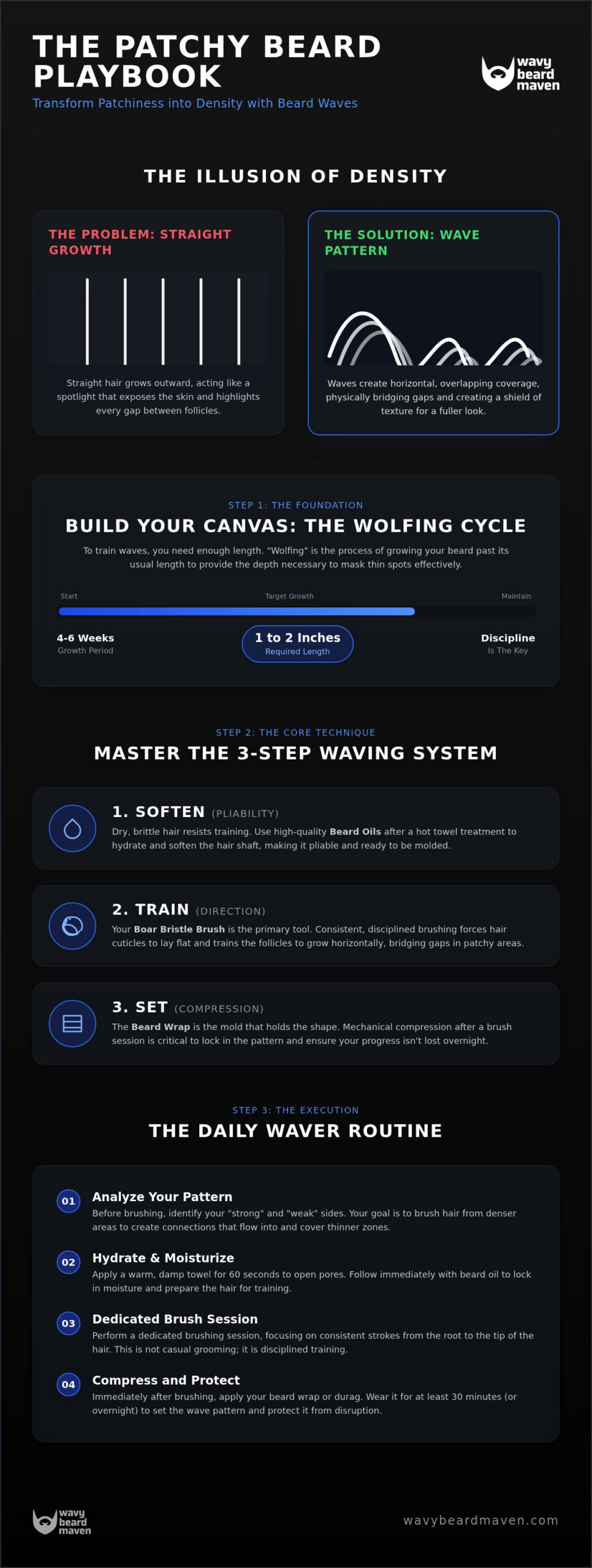
Patchiness shouldn’t be viewed as a barrier to style. It’s actually a unique opportunity to lean into texture. When hair grows straight, it tends to stand away from the skin, highlighting every gap and thin spot. By introducing a wave, you create horizontal coverage. This mechanical shift allows the hair to lay across vertical gaps, essentially borrowing density from stronger areas to support the weaker ones. To start this process, you need a foundation. While you don’t need a massive “wizard beard,” stubble won’t suffice for training. Aim for a length of 1 to 2 inches, which typically requires 4 to 6 weeks of dedicated growth. Understanding the biology of beard growth helps you realize that while follicle distribution is fixed, the way you direct those hairs is entirely within your control.
The Illusion of Density
Straight hair acts like a spotlight on your skin. Because it grows outward, it leaves the spaces between follicles exposed. The wave curve changes the physics of your beard by forcing the hair to lay flat and move in a unified direction. This overlapping effect creates a shield of texture that masks the underlying skin. Visual Density is the primary goal for every patchy waver, defined as the strategic manipulation of hair direction to minimize skin exposure and maximize apparent fullness.
Assessing Your Patchy Pattern
Before you pick up your Beard Brush, you must analyze your current growth pattern. Identify your “weak side” and “strong side” early. Most men have one cheek that grows slower or thinner than the other. Your training routine should focus on directing hair from the strong side to create connections that flow into the weaker zones. Determine if your hair is coarse or medium; coarse hair often takes to training faster but requires more Beard Oils to remain pliable. Set realistic expectations for 2026. Your first few weeks won’t produce deep 360 waves, but they will produce a uniform look that commands far more respect than a neglected, patchy mess.
The Science of Compression and Texture
Elite texture isn’t an accident; it’s the result of applied physics and consistent mechanical training. When you’re pursuing beard waves for patchy beard growth, you aren’t just styling your hair; you’re fundamentally changing its behavior. A Beard Brush with natural boar bristles is your primary tool for this transformation. These bristles are designed to realign the hair cuticles, forcing them to lay flat against the skin rather than standing outward. This repeated action creates a physiological shift over time, training the follicle to grow at a specific angle. By directing the growth horizontally, you bridge the gaps that naturally occur in patchy areas, creating a unified surface that looks significantly denser than it actually is.
The science of waving relies heavily on making the hair pliable enough to accept this new direction. Natural sebum often fails to reach the ends of your beard hair, leaving it stiff and resistant to training. This is where the intersection of chemistry and mechanics happens. By introducing supplemental moisture, you break down the hair’s natural resistance, allowing the brush to dictate the flow. This isn’t a “quick fix” for a night out; it’s a long-term commitment to reshaping your facial hair’s DNA through disciplined routine and the right equipment.
Laying the Foundation with Beard Oils
Dry hair is the greatest enemy of a disciplined wave pattern. Brittle fibers are stubborn; they resist the brush and accentuate every patch by standing in different directions. You must integrate high-quality Beard Oils to soften these coarse fibers and make them moldable. Before you start your brush session, use the “hot towel” method. Apply a warm, damp towel to your face for 60 seconds to open the pores and hydrate the hair shaft. Once the hair is softened, apply your oil to lock in that moisture. This creates a surface that responds to the brush with precision rather than friction, making your patches easier to navigate.
The Role of Mechanical Compression
If the brush is the sculptor, the Beard Wrap is the mold that holds the shape. Mechanical compression is the secret weapon for patchy spots because it forces the hair to lay flat over “bald” areas, effectively hiding them. While men with full beards use compression for definition, you use it for structural coverage. The “overnight lock” technique is essential for this. After your evening brush session, secure a Beard Wrap to maintain the pattern while you sleep. This prevents the hair from reverting to its natural, standing state. Consistent use of professional tools from Wavy Beard Maven ensures that your hard-earned progress is protected, forcing the hair to stay in its new, overlapping pattern 24 hours a day.
Wolfing for Patchy Beards: The Growth Strategy
Wolfing is a term rooted in wave culture that describes the intentional practice of growing your hair past its usual “neat” length to build depth and volume. For those pursuing beard waves for patchy beard growth, wolfing is the most critical phase of the journey. You aren’t just letting your hair grow wild; you’re building the raw material necessary to create the horizontal coverage discussed in earlier sections. Without sufficient length, the hair lacks the mass required to curl back on itself and form a visible wave. This extra bulk is what eventually bridges the gaps in your cheek line, transforming a disconnected look into a unified, textured pattern.
A standard wolfing cycle for a patchy beard should last between 4 to 6 weeks. This timeframe is specific because it allows the slower-growing follicles in your patches to finally catch up with the stronger areas. During this period, you must maintain your neckline and cheek lines with surgical precision. If the edges are sharp, the added bulk on your face looks like a choice rather than neglect. This discipline separates the master practitioner from the amateur. You’re essentially “stacking” layers of hair that will eventually be compressed into a deep, connected pattern.
Managing the “Awkward Phase”
The middle of a wolfing cycle often brings an “awkward phase” where hair feels unruly and patches may temporarily look more prominent. You must use Beard Balms during this stage to provide the necessary weight and hold to keep flyaways in check. While your instinct might be to trim the moment a few stray hairs appear, you must resist. Trust the process. The psychological discipline of not trimming too early is what earns you the density later. You’ll know your wolf is ready for a professional line-up once the hair is long enough to lay flat under a Beard Wrap without springing back up.
Brushing Through the Wolf
As your hair gains length, your brushing routine must evolve. A soft brush will no longer reach the skin or the base of the follicle, which is where the training actually happens. You need to transition to a medium-hard Beard Brush to penetrate the new depth of your growth. Increase your brush sessions to at least three times a day, focusing extra strokes on your known thin areas. This increased mechanical tension forces the longer hairs to lay in the direction of your wave pattern, ensuring that as the beard gets thicker, the connections remain deep and organized. Consistency here is non-negotiable if you want the “patchy” look to disappear permanently.
The Daily Patchy Waver Routine
Discipline is the foundation of elite texture. If you want to master beard waves for patchy beard growth, your grooming must transition from a casual task to a rigorous cultural practice. The “Wash and Style” method is your primary tool for instant wave activation, using the weight of water and the slip of product to set your pattern in place. You must follow a 360-degree brushing philosophy, ensuring that every angle of your face is addressed with equal intensity. This systematic approach ensures that your connections are uniform, preventing the disconnected look that often plagues beginners with inconsistent growth.
Strategic product layering is the secret to maintaining this pattern throughout the day. You should always follow the order of Oil, then Butter, and finally Balm. This progression ensures that you are treating the skin first, softening the hair second, and providing a final structural seal to hold the waves in place. Without this specific order, your hair will likely remain too stiff to respond to the brush, especially in areas where the growth is thin or coarse.
The Morning Activation
Step 1: Start by lightly dampening your beard with warm water to increase elasticity. Apply Beard Oils directly to the skin under the patches to ensure the foundation is hydrated and the hair is pliable. Step 2: Commit to a 15-minute intensive brush session, following the natural grain of your hair with steady, deliberate strokes. Step 3: Seal in the moisture and provide a light hold by applying Beard Butters. This morning ritual sets the tone for your texture, forcing the hair to lay flat from the moment you start your day.
The Evening Compression
Your evening routine is about preservation and long-term training. Step 4: Perform a light reset brush to realign any stray hairs that moved during the day. Step 5: Secure a high-compression Beard Wrap before you go to sleep to lock the pattern against your face. Step 6: Use the 7-Day Beard Wave Starter Routine™ Checklist as your roadmap to ensure every session is executed with precision. Consistent compression is what eventually trains the follicle to grow at the wave angle permanently.
Targeted Brushing for Patchy Spots
Precision is required for stubborn gaps that refuse to connect. Use the “Cross-Grain” technique by brushing at a slight diagonal angle to pull hair from denser areas over the thin spots. Utilize the tip of your Beard Brush to reach the skin in these zones, forcing the follicles to comply with your desired flow. You must commit to the 100-stroke rule for your most stubborn patches to ensure they receive the concentrated mechanical tension needed to build visible density. To get started with the professional tools required for this level of mastery, visit Wavy Beard Maven today.
Mastering the Pattern with Wavy Beard Maven
The transition from a beginner to an elite waver isn’t just about length; it’s about the precision of your connections. When you commit to beard waves for patchy beard management, you’re joining a collective of men who value self-respect and cultural expression through meticulous grooming. This isn’t a hobby. It’s a systematic refinement of your image. By following our expert-led approach, you move from a state of covering up flaws to a state of projecting mastery. Every brush stroke is a step toward a more disciplined version of yourself.
The journey to elite texture is a test of character. While many attempt to develop beard waves for patchy beard growth using generic combs or plastic brushes, they quickly realize that mastery requires specialized equipment. You cannot achieve deep, connected patterns with luck or half-hearted efforts. Wavy Beard Maven is built on the philosophy that aesthetic excellence is earned through unwavering discipline. Transitioning to elite status means moving beyond just “hiding patches” and toward creating a disciplined, cultural statement that radiates confidence.
Essential Tools for the Patchy Waver
A premium boar bristle Beard Brush is non-negotiable for this transition. Unlike synthetic bristles, natural boar hair has the structural integrity to reach the skin and stimulate the follicles while distributing product evenly. You must also understand the tactical difference between your products. Use Beard Butters for daily softness and elasticity, but reach for Beard Balms when you need the heavy-duty hold required to lock a specific pattern in place. The 7-Day Beard Wave Starter Routine™ Checklist serves as your daily audit, ensuring you don’t skip the sessions that build long-term memory in your hair fibers.
Final Steps to Connectivity
As your pattern matures, you’ll encounter “forks,” which are points where the wave lines break, split, or run into each other. These are the final hurdles to a perfect, unified flow. To fix a fork, you must isolate the area and adjust your brushing angle by a few degrees, forcing the disconnected lines to merge over several sessions. Once your patches are fully covered by the overlapping texture, your focus shifts to maintenance and depth. This is the stage where you’ve earned your status in the movement. You no longer see a patchy beard in the mirror; you see a disciplined work of art. To begin your own transformation and master the craft, download the 7-Day Beard Wave Starter Routine™ Checklist and start your journey today.
Command Your Aesthetic Future
Your journey from visible skin to elite texture is a matter of discipline, not luck. You now understand that patchiness isn’t a permanent flaw but a canvas for horizontal coverage. By implementing a strategic wolfing cycle and mastering the science of compression, you can bridge gaps and build the illusion of unmatched density. Achieving beard waves for patchy beard growth requires the right tools and a commitment to the 360-degree brushing philosophy. You’ve learned how specialized Beard Wraps and targeted product layering transform stubborn follicles into a unified, rhythmic pattern.
Thousands of elite wavers have already used our expert-led education to reclaim their confidence and master their craft. It’s time for you to join this movement of self-improvement and precision. Stop settling for an inconsistent look and start earning the texture you deserve through systematic maintenance. Start Your Journey: Download the 7-Day Beard Wave Starter Routine™ Checklist today and lock in your pattern with professional-grade compression. Your transformation is waiting; pick up your brush and lead the way.
Frequently Asked Questions
Can I get beard waves if my beard is naturally thin?
Yes, you can achieve beard waves for patchy beard growth even if your follicles are naturally thin. The wave pattern is actually the most effective solution for thin beards because it forces the hair to lay flat and overlap. This mechanical training creates a “shield” of hair that masks the skin underneath. While straight hair stands out and reveals gaps, a disciplined wave pattern bridges those empty spaces through strategic horizontal coverage.
How long does it take to see waves in a patchy beard?
You will typically begin to see the first signs of wave definition after 4 to 6 weeks of consistent training. This timeline coincides with the recommended wolfing period, which allows your hair to reach the 1 to 2 inch length required for a curl pattern to form. Results depend entirely on your discipline. If you follow the 7-Day Beard Wave Starter Routine™ Checklist without skipping sessions, you’ll notice a significant shift in texture within the first month.
Does brushing a patchy beard make it grow faster?
Brushing does not biologically change the speed of hair growth, but it is essential for the health of your beard. The firm bristles of a Beard Brush stimulate blood flow to the skin surface, which can support healthier follicle function. More importantly, brushing trains the hair to grow in a specific direction. This makes your beard appear fuller and more organized long before it reaches its maximum natural density, giving you immediate visual results.
What is the best brush for a patchy beard trying to get waves?
The best tool for a patchy waver is a premium boar bristle Beard Brush. Synthetic brushes often lack the structural integrity to reach the skin or move coarse facial hair effectively. You should start with a softer bristle to avoid irritating thin areas, then transition to a medium-hard brush as you enter the wolfing phase. This ensures you maintain enough tension to keep the waves connected as the hair gets deeper and more difficult to manage.
Should I use a durag or a beard wrap for my patchy beard?
You should always choose a specialized Beard Wrap over a standard durag. While durags are excellent for scalp hair, they aren’t shaped to provide the specific compression needed for the jawline and cheeks. Our Beard Wraps are engineered to lock in your pattern overnight, ensuring that the work you put in during your brush sessions isn’t lost while you sleep. Proper compression is the only way to flatten stubborn patches effectively and build depth.
Can I get 360 waves on my beard if the cheeks are empty?
Achieving a full 360-degree pattern is possible, but it requires more patience if your cheeks have significant gaps. You must focus on pulling hair from your stronger “connection” points, such as the chin or sideburns, toward the empty zones. By using the “Cross-Grain” brushing technique, you can eventually train the surrounding hair to migrate over the patches. This creates a continuous flow that gives the appearance of a complete, connected pattern across your entire face.
What products help hide patches while training waves?
Strategic product layering is key to masking patches. Start with Beard Oils to hydrate the skin, then apply Beard Butters to add volume and softness to the hair fibers. Finally, use Beard Balms to provide the heavy hold necessary to keep the overlapping hairs in place. This combination creates a dense, matte finish that minimizes light reflection off the skin, making your beard waves for patchy beard look deeper and more consistent throughout the day.
How often should I wash my beard during the wolfing phase?
During the wolfing phase, you should limit washing to once or twice a week. Over-washing strips away the natural sebum and the Beard Oils you’ve applied, leaving the hair brittle and resistant to training. When you do wash, use the “Wash and Style” method to keep your waves set. Always follow up with a fresh application of Beard Butters and a 15-minute brush session to reset the pattern while the hair is damp and pliable.