October 18, 2026
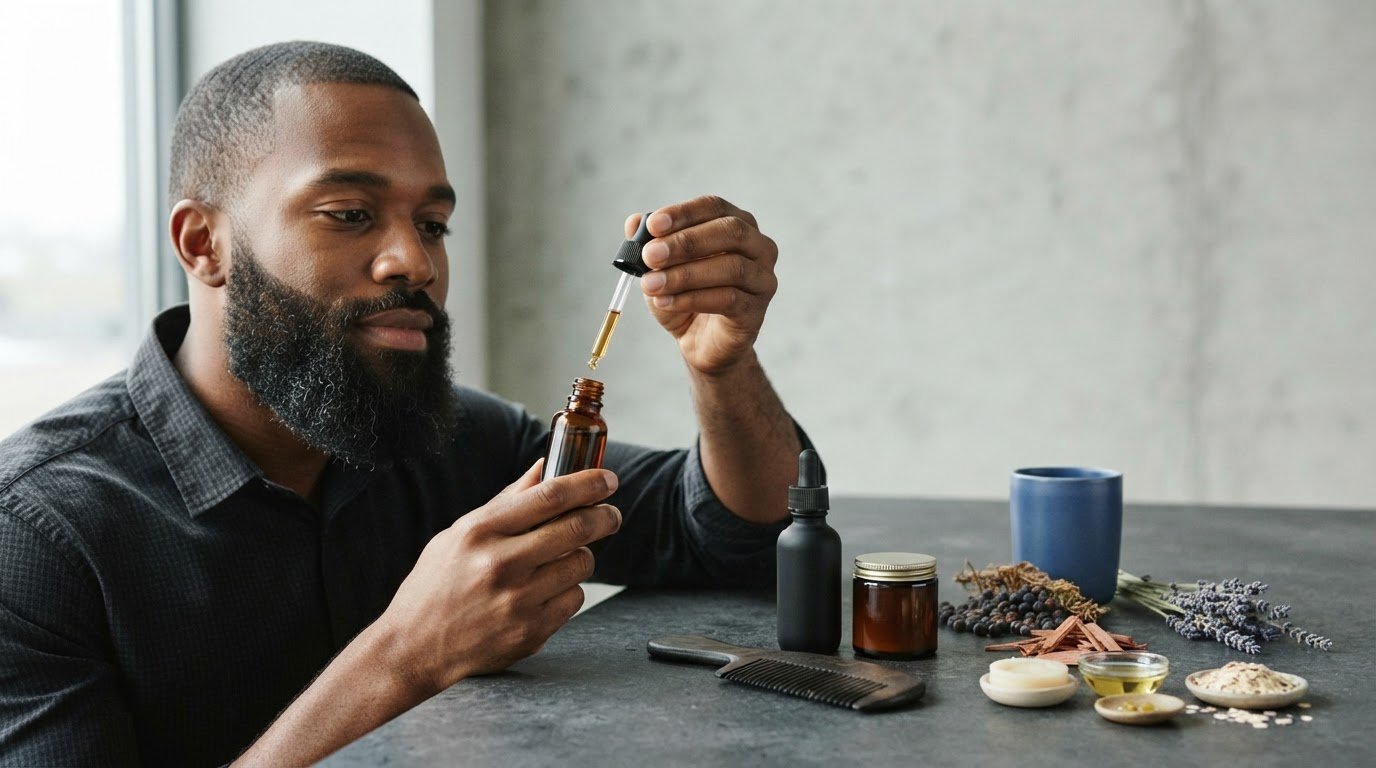
What if an ingredient you’ve been warned to avoid isn’t automatically a problem for your beard? Searching for ingredients to avoid in beard products can turn up long blacklists, but a name on a label doesn’t tell the whole story. It’s understandable to feel unsure when ingredient names are unfamiliar, especially if a product leaves your beard or the skin beneath it feeling uncomfortable.
Use context, not viral claims, to guide your choices. The same ingredient can matter differently depending on the formula, how you use it, and how your skin responds. This guide will help you identify ingredients that may be relevant to your personal sensitivities, separate reasonable caution from blanket warnings, and read labels with a clearer eye.
We’ll look at common sources of irritation, practical ways to assess a product before adding it to your routine, and what to do when discomfort shows up. Whether you’re comparing beard oils, butters, or balms, make deliberate choices and keep track of what works for you.
Key Takeaways
- Assess ingredients to avoid in beard products in context: consider the formula, how often you use it, and how your skin responds, rather than relying on a blacklist alone.
- Track fragrance and essential oils if your skin is sensitive, without assuming they affect everyone the same way.
- Separate reasonable ingredient concerns from claims that parabens or silicones are automatically dangerous.
- Review labels consistently and change one product at a time to make potential triggers easier to identify.
- Match oils, butters, and balms to your grooming goals, then keep your routine simple enough to notice what suits you.
What “Ingredients to Avoid in Beard Products” Really Means
The phrase ingredients to avoid in beard products can sound like a universal warning, but a label alone rarely tells you whether a formula will bother your skin. An ingredient may be a concern for one person and cause no noticeable issue for another. The useful question isn’t simply “Is this ingredient bad?” It’s “Could this ingredient be a problem for me, in this product, used this way?”
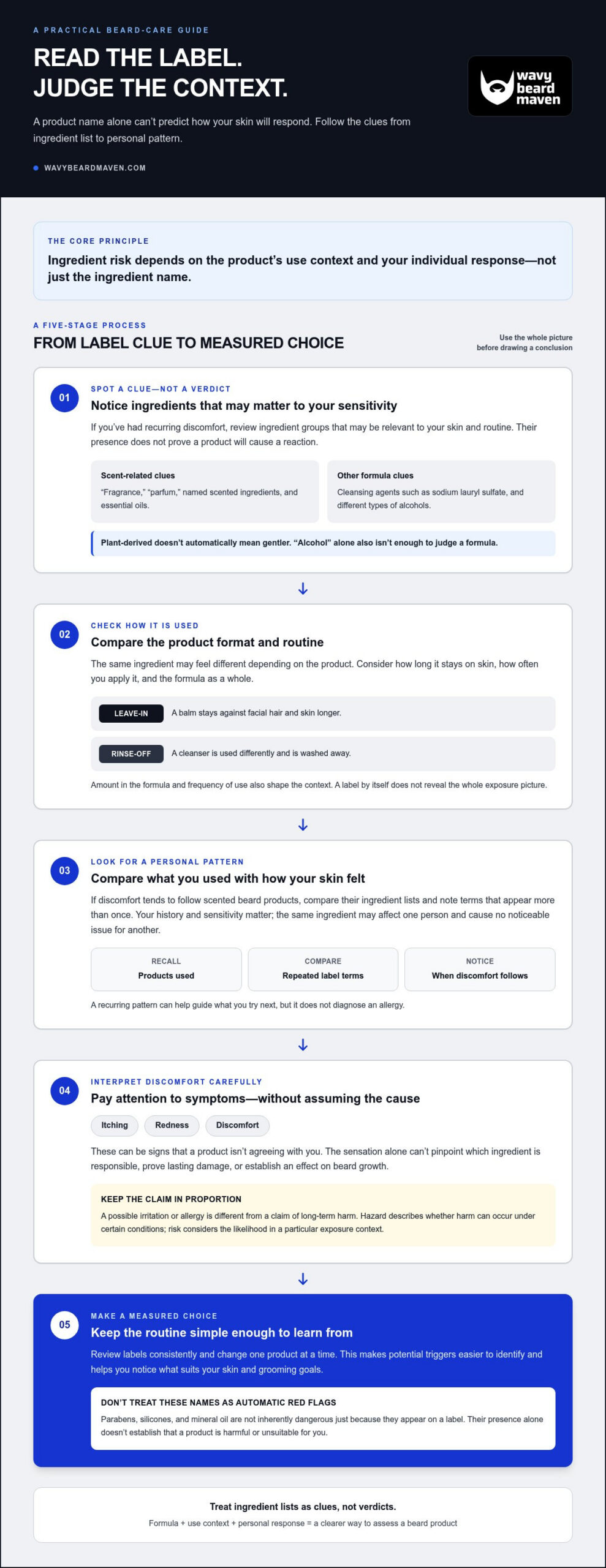
Quotable definition: Ingredient risk depends on the product’s use context and your individual response, not just the ingredient name.
Several factors shape that context: your skin’s sensitivity, the amount of an ingredient in the formula, whether the product is rinsed off or left on, and how often you apply it. A leave-in balm stays against facial hair and skin longer than a wash-off cleanser. That doesn’t make one unsafe; it helps explain why the same ingredient may feel different across products and routines.
It also helps to distinguish a possible irritation or allergy from a claim of long-term harm. Redness, itching, or discomfort can be signs that a product isn’t agreeing with you, but they don’t establish that an ingredient causes lasting damage or impairs beard growth. Broad overviews such as Cosmetics ingredients and regulation offer background on the variety of ingredients used in cosmetics. Your experience with a specific product still needs careful interpretation.
Why the skin beneath your beard matters
Beard products coat more than hair. Oils, butters, and balms can also reach the skin beneath your beard, where sensitivity may show up as itching, redness, or discomfort. A product that feels unpleasant deserves attention, but the sensation alone can’t pinpoint the cause. Note when it started, where it appears, and which products you’ve used rather than concluding that one ingredient is responsible.
Why an ingredient blacklist can mislead
A long “avoid at all costs” list may feel decisive, but it can flatten important differences. The same ingredient can appear in a rinse-off product or a leave-on formula, and each product may combine it with different ingredients. Contact time, frequency of use, and the formula as a whole all matter. So does your personal history: a label can prompt a closer look, but it can’t predict everyone’s response.
Keep hazard and everyday risk distinct. Hazard describes whether a substance can cause harm under certain conditions; risk considers the likelihood of harm in a particular exposure context. A warning about a possible effect doesn’t, by itself, show that ordinary use of every beard product containing that ingredient will cause it. Treat ingredient lists as clues, not verdicts. Use them to compare products, notice patterns, and make measured choices instead of rejecting a formula based on a name alone.
Which Beard-Product Ingredients May Be More Relevant for Sensitive Skin?
There isn’t one universal list of ingredients to avoid in beard products. Instead, focus on ingredient groups that may matter for your skin and routine. Fragrance, essential oils, cleansing agents, and certain solvents can be useful clues if you’ve noticed a recurring reaction, but their presence doesn’t prove a product will cause discomfort.
“May irritate some users” is not the same as “harmful to everyone.” Consider the product type, how long it stays on your skin, how often you use it, and what you already know about your sensitivities.
Fragrance, parfum, and essential oils
Fragrance can make a product appealing to use, but fragrance-related ingredients may matter if you’ve had sensitivity to scented products. Labels may use terms such as “fragrance” or “parfum,” while individual scented ingredients may also appear by name. Essential oils can contribute scent too, and they aren’t automatically gentler simply because they come from plants.
Look for patterns rather than drawing conclusions from a single ingredient name. If discomfort tends to follow use of scented beard products, compare the ingredient lists of products you’ve used and note which terms appear more than once. That won’t diagnose an allergy, but it can help you choose what to try next and describe the pattern clearly to a healthcare professional if needed.
Cleansers, solvents, and other formula components
Some cleansing agents can leave skin or hair feeling dry for certain people, depending on the overall formula and how often the product is used. Sodium lauryl sulfate is one example of a cleansing agent; its presence alone doesn’t show how a finished product will feel. A rinse-off cleanser and a leave-in beard product have different uses, so consider the format and directions alongside the ingredient list.
Alcohols also differ. Some short-chain alcohols may feel drying for some users, while fatty alcohols such as cetyl alcohol serve different purposes in formulas. The word “alcohol” by itself isn’t enough to judge a product. Pay attention to how your skin responds and whether the product is designed to be rinsed away or left on.
Parabens, silicones, and mineral oil shouldn’t be treated as inherently dangerous just because they appear on a label. Their presence alone doesn’t establish that a product is harmful or unsuitable for you. When comparing beard oils, butters, or balms, keep your routine simple so you can track what you use and how your skin feels. Explore beard-care product categories as you build a routine around your grooming goals.
How to Separate Ingredient Red Flags from Beard-Care Myths
Ingredient claims can sound definitive: one label name is branded dangerous, while another is praised as clean. Slow the judgment down. Ask what the ingredient is, what the claim actually supports, and whether it fits your own experience. That approach helps you assess ingredients to avoid in beard products without treating every online warning as proven fact.
An ingredient name alone cannot predict every person’s reaction. Use this comparison to separate a reasonable question from a conclusion the label can’t establish:
| Concern or claim | What can reasonably be said | What the claim does not establish |
|---|---|---|
| Parabens appear on the label | They’re a category of preservatives used in some cosmetics. Their presence may prompt a question about your preferences or sensitivities. | Presence alone doesn’t prove the finished product is dangerous or will irritate your skin. |
| Silicones appear in the formula | They may serve a function in a cosmetic formula, and people can choose products based on how they prefer a formula to feel. | The name alone doesn’t show that a product blocks beard growth or causes harm. |
| A product is described as “natural” or “clean” | These words may communicate a brand’s positioning or ingredient preferences. | They don’t guarantee low irritation, suitability for sensitive skin, or a particular safety outcome. |
| A product claims to block growth or cause long-term damage | That’s a broad effect claim and deserves scrutiny of the evidence and conditions behind it. | A label ingredient, by itself, doesn’t demonstrate that the claim applies to ordinary beard-product use. |
What an ingredient name can and cannot tell you
An ingredient declaration can help you identify what’s in a product, but it can’t tell you whether you personally will react. Seeing an ingredient also doesn’t reveal its concentration, how it interacts with the rest of the formula, or how your use pattern affects exposure. Treat claims about impaired growth or lasting damage with care: look for evidence that supports the specific claim, not just a list of ingredient names.
How to assess “natural” and “free-from” claims
Natural-origin ingredients can still trigger irritation or an allergic reaction. Likewise, a “free-from” badge only tells you about the ingredients a product claims to exclude. It doesn’t explain what replaced them or whether the full formula suits you. Read the ingredient declaration, consider the product’s purpose, and compare it with your own response instead of letting one marketing phrase make the decision.
Keep your standard consistent. A familiar-sounding ingredient isn’t automatically gentle, and a chemical-sounding name isn’t automatically a red flag. Compare products as complete formulas, note what you’ve used and how your skin felt, and avoid changing several parts of your routine at once. That gives you a clearer basis for deciding what deserves attention and what may be beard-care noise.
How to Review Beard-Product Labels and Handle Reactions
Make label reading a repeatable routine. A simple record can help you connect a product with your experience, but it can’t diagnose an allergy or skin condition. Use it to organize what you know, make one change at a time, and share clear details with a healthcare professional if symptoms need attention.
A practical label-review sequence
- Identify the product type. Note whether it’s a beard oil, butter, balm, cleanser, or another format. Record whether it stays on your beard or is rinsed away, along with how often you use it.
- Scan for known personal sensitivities. Start with ingredients you already suspect or know you react to. Compare the full ingredient lists of products you’ve used instead of relying only on front-label terms such as “natural” or “gentle.”
- Keep a product record. Write down the product name, its ingredient list, the date you applied it, where you used it, and any changes you noticed. Include when symptoms began and whether they eased after you stopped using the product.
- Change one thing at a time. If you’re trying a different beard product, avoid switching several items in your routine together. Comparing one formula change at a time makes patterns easier to interpret, though it still can’t confirm which ingredient caused a reaction.
Ingredient lists and label conventions can vary by product and market. For current information about United States cosmetic labeling, consult the FDA’s cosmetic labeling guidance rather than relying on assumptions about what a label must show. A label is a useful record of declared ingredients, not a personal sensitivity test.
What to do when your skin reacts
If a product appears to trigger a reaction, stop using it instead of repeatedly applying it to see whether the same response happens again. Keep the label or take a clear photo, and note the timing and symptoms. Those details may help a clinician assess whether irritation or an allergy is possible; guessing from an ingredient name alone can’t reliably tell the difference.
Seek medical advice for symptoms that persist, feel severe, or concern you. A healthcare professional can assess the reaction and advise on appropriate next steps. Don’t use an ingredient list to diagnose a condition or choose a treatment, and don’t assume that every reaction points to a single ingredient. Your notes are a practical starting point, not a substitute for professional assessment.
Once you’ve established a careful routine for reviewing labels, use the same method to compare beard oils, butters, and balms against your grooming needs and personal sensitivities.
Choose Beard Products That Fit Your Skin and Grooming Goals
Once you know how to read labels, make your next choice around two separate questions: what do you want the product to do for your beard, and how does your skin respond to it? A product may suit your desired finish but not feel comfortable on your skin, or it may feel fine while offering a different styling effect than you want. Neither result makes an ingredient universally good or bad. The goal is to find a fit you can assess with care.
Match oils, butters, and balms to the job
Start with the product’s purpose and directions, then compare its full label with your personal sensitivities. Beard oil may suit a routine focused on texture and definition, while balm may better match a routine focused on hold and styling. Use the beard oil guide for waves and the beard balm guide for hold and styling to explore those product-specific goals.
Beard butter is another format to consider, but don’t add it just because your routine feels incomplete. Identify the task first, such as shaping, managing texture, or choosing your preferred finish. Then assess skin comfort separately. If a product gives you the style you want but your skin feels irritated, that’s useful feedback. If it feels comfortable but doesn’t meet your grooming goal, reconsider the format or how it fits into your routine. No single ingredient profile is right for every beard.
Keep the routine deliberate and consistent
Introduce one new product at a time, and keep a clear record of what you used and how your beard and skin felt. If you switch your oil, balm, and butter all at once, it becomes harder to tell which change may be connected to a new sensation or finish. A short note with the product name and date of use can make comparisons more useful than memory alone.
Keep those notes focused on your experience: comfort, visible changes in your skin, and whether the product supports your grooming goal. Don’t let an online fear list dictate every choice, and don’t assume that “natural” or “free-from” means a product will suit you. Use label details to compare thoughtfully, then stay consistent long enough to understand your routine, unless a product appears to trigger a reaction. In that case, stop using it and seek medical advice if symptoms are severe, persistent, or concerning.
Choose with purpose, observe your response, and refine your routine one step at a time. For a straightforward next step, explore beard-care essentials and consider which format best fits your grooming goals.
Build a Routine You Can Trust
Let your next grooming choice be guided by what you want your beard routine to do, not by pressure to find a perfect formula. Keep a short record of products that suit your preferences and any ingredients you’ve learned to watch for. Over time, that personal reference can make shopping feel more focused and help you choose with greater confidence than a generic list of ingredients to avoid in beard products.
Make the process part of your craft. Choose one product for a clear purpose, pay attention to how it fits into your routine, and refine from there. Wavy Beard Maven shares educational resources focused on beard-wave care and grooming, alongside beard oils, butters, and balms to help you shape a routine around your goals.
Explore beard-care essentials and take your next step with intention. Consistency starts with choices that make sense for you, so keep learning, stay attentive, and own your grooming journey.
Frequently Asked Questions
Is “fragrance-free” the same as “unscented”?
No, not necessarily. “Unscented” can mean a product has little noticeable scent, and fragrance-related ingredients may be used to mask odors. “Fragrance-free” generally signals a different formulation goal, but wording and rules matter. Read the full ingredient declaration and consider your known sensitivities. Before treating either phrase as a guarantee, consult current FDA cosmetic-label guidance; a marketing term alone can’t confirm how your skin will respond.
Can beard products cause acne or clogged pores?
Some people notice breakouts after using a grooming product, but that doesn’t identify a specific ingredient as the cause. Application amount, your skin, the formula, and other routine changes may all be relevant. If breakouts recur, simplify your routine and stop using the suspected product. Note what changed, including other products you started around the same time. For persistent or severe symptoms, seek medical advice rather than diagnosing the cause from a label.
Do beard products need preservatives?
It depends on the formula, including whether it contains water and how it’s made and packaged. Preservatives can help protect some products, so seeing one on a label isn’t automatically a reason to avoid it. A “preservative-free” claim doesn’t prove a product is safer, either. Assess the complete formula and follow its storage and use directions. If a product’s appearance, smell, or texture changes, don’t rely on the ingredient list alone to judge it.
How long should I stop using a beard product after irritation?
Stop using a product that appears to trigger irritation, and don’t keep applying it to uncomfortable skin as a test. There isn’t one waiting period that fits every person or reaction. Avoid restarting while symptoms are active. If the reaction is severe, persistent, or worrying, seek medical advice; a healthcare professional can advise whether trying the product again is appropriate. Keep the label or a photo of it for the appointment.
Can natural essential oils cause an allergic reaction?
Yes. “Natural” describes an ingredient’s origin, not whether every person will tolerate it. Essential oils and other fragrance materials may affect people with particular sensitivities. If scented products have bothered you before, compare full ingredient declarations and introduce a new product cautiously, without changing several parts of your routine at once. Stop using it if a concerning reaction develops, and seek medical advice for severe or persistent symptoms.
What is the difference between irritation and an allergic reaction?
Irritation and allergy can have overlapping signs, so symptoms alone may not reveal which is happening. Irritation relates to how a product affects the skin, while allergic contact dermatitis involves an immune response. If a beard product causes a reaction, stop using it and record when it began and where it appeared. A dermatologist or other qualified clinician can assess recurring reactions and may recommend appropriate testing. Don’t use an ingredient list to diagnose the cause.