October 8, 2026

Beard oil can make your hair feel softer without making it grow faster. That distinction matters when you’re sorting through claims about natural ingredients for beard growth. Oils can condition existing hair and improve its appearance, but conditioning isn’t the same as stimulating new growth.
Promises about rosemary, peppermint, saw palmetto, and supplements can be hard to assess. Patchy or slow growth can be frustrating, but it doesn’t automatically mean something is wrong, and no natural ingredient can override your individual growth pattern.
This guide separates ingredients that may support healthier-looking beard hair from those claimed to affect growth, and explains where evidence is limited. You’ll learn how to use topical products carefully, when dietary support may be relevant, and how to avoid irritation and wasted effort. Build a steady routine, allow time to assess it, and focus on caring for the beard you have rather than expecting overnight change.
Key Takeaways
- Learn how natural ingredients for beard growth differ in purpose and evidence, so you can distinguish conditioning benefits from follicle-growth claims.
- Compare jojoba, argan, coconut, and castor oils to choose a conditioning approach that suits your beard-care goals.
- Understand when protein, iron, zinc, and vitamin D matter for overall health, and why supplements aren’t a shortcut to a fuller beard.
- Use a simple routine to review ingredient claims, test skin tolerance, and track comfort before making a product part of regular care.
- Build a consistent grooming practice with realistic expectations, using education and wave training to care for the beard you have.
Natural ingredients for beard growth: what they can and cannot do
Sparse cheeks, uneven coverage, or slow progress can make bold ingredient claims sound like a tempting shortcut. But “natural” describes an ingredient’s origin, not proof that it stimulates beard follicles. In practical beard care, natural ingredients for beard growth are best viewed as supportive care: they may condition hair or improve skin comfort, but that doesn’t make them proven growth treatments.
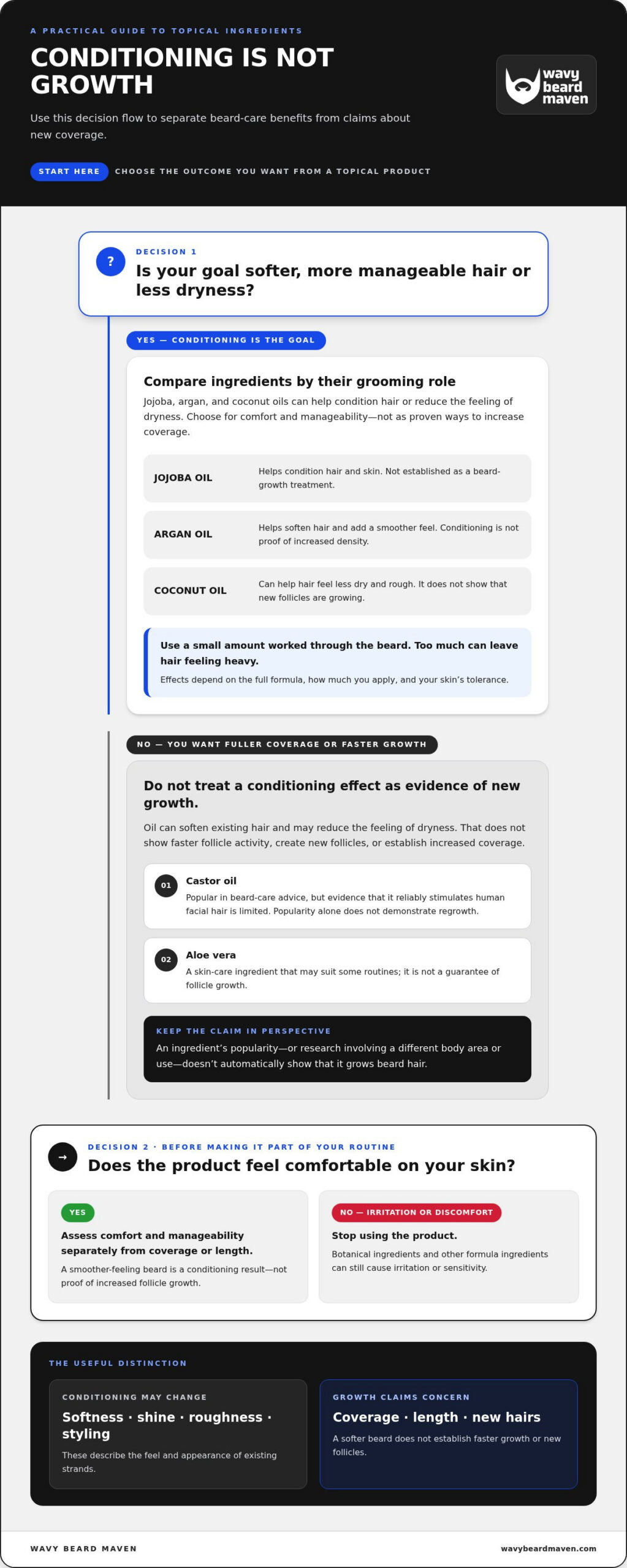
Separate what you see from what you feel. Hair length and coverage reflect visible growth; softness, shine, reduced roughness, and easier styling reflect the condition and appearance of existing strands. A beard can feel smoother after you apply oil without gaining new hairs or changing its growth pattern. Conditioning can improve how existing beard hair feels and looks; it isn’t proof of increased follicle growth.
Set a clear goal before choosing an ingredient. If you want less dryness or more manageable waves, a conditioning product may suit your routine. If you expect it to fill sparse areas, that claim requires stronger evidence than a softer beard can provide.
Does beard oil make facial hair grow faster?
Beard oil can coat and soften hair, and it may help reduce the feeling of dryness on the skin beneath it. These are grooming benefits, not evidence that oil speeds follicle activity. Less dryness or breakage may help preserve the length of strands already growing, but it doesn’t create new follicles or establish faster growth.
Judge claims about oils by the evidence for the specific outcome being promised. An ingredient’s popularity, or research involving a different body area or use, doesn’t automatically show that it grows beard hair. Use oil for conditioning if it suits your skin and routine, then assess comfort and manageability separately from coverage or length. Stop using it if it causes irritation.
Why genetics and biology shape beard growth
Each hair grows from a hair follicle, and follicles aren’t distributed or active in the same way across every person’s face. Individual biology influences where facial hair appears, how dense it looks, and how its pattern develops. That’s why two people can follow similar grooming routines yet see different coverage.
Beard oils, butters, and other grooming products can care for the hair and skin you have, but they can’t change inherited follicle distribution. A patch or slower-growing area doesn’t, by itself, explain why growth differs. Don’t treat a cosmetic product as a way to rewrite your biology. Instead, choose a goal you can assess fairly: track how your beard feels, looks, and styles over time while keeping expectations grounded in your own growth pattern.
Topical natural ingredients: conditioning benefits versus growth claims
Once you’ve separated follicle-growth claims from everyday conditioning, compare topical ingredients by the job they can reasonably do. Jojoba, argan, and coconut oils are used to soften hair and reduce the feeling of dryness. Castor oil is often promoted for growth, while aloe vera appears in skin-care products. These uses don’t establish that any of the ingredients increases beard density or activates dormant follicles.
Jojoba, argan, and coconut oil for beard conditioning
These oils can act as emollients, helping beard hair feel smoother and skin feel less dry. Their effects depend on the full formula, how much you apply, and your skin’s tolerance. A small amount worked through the beard may be enough; too much can leave hair feeling heavy. Choose them for comfort and manageability, not as proven ways to increase coverage.
Ingredient | Realistic grooming role | Evidence caveat
Jojoba oil | Helps condition hair and skin. | Not established as a beard-growth treatment.
Argan oil | Helps soften hair and add a smoother feel. | Conditioning isn’t proof of increased density.
Coconut oil | Can help hair feel less dry and rough. | Doesn’t show that new follicles are growing.
Castor oil | A popular oil used in beard-care routines. | Popularity isn’t strong evidence of beard regrowth.
Aloe vera | A skin-care ingredient that may suit some routines. | Not a guarantee of follicle growth.
Castor oil and other ingredients with bold growth claims
Castor oil has a strong reputation in online beard advice, but popularity alone doesn’t demonstrate regrowth. Evidence that it reliably stimulates human facial hair is limited. Aloe vera may be included for skin care, but that role shouldn’t be turned into a promise about follicles. Be cautious with any ingredient promoted as a guaranteed fix, especially when the claim doesn’t explain what evidence supports it.
Skin response matters, too. A botanical ingredient can still cause irritation or sensitivity, and a formula’s other ingredients can affect how it feels. Try a new product cautiously and stop using it if you notice discomfort or a reaction. The American Academy of Dermatology Association outlines varied causes of hair loss. That broader information is useful context, but it doesn’t establish that an oil can address beard-growth concerns.
Keep the goal clear: choose topical care for conditioning, then judge it by comfort and manageability rather than new coverage. For a consistent approach to caring for existing beard hair, explore a beard-conditioning routine alongside your wave-training practice.
Dietary nutrients and supplements: when they may matter for beard health
A balanced diet provides nutrients your body needs for normal functions, but adding a supplement isn’t a shortcut to a denser beard. Protein, iron, zinc, and vitamin D all have roles in overall health. That doesn’t mean taking extra amounts will make facial hair grow faster or fill sparse areas. Nutrition is one part of general wellbeing, not a way to rewrite your individual beard pattern.
Extra nutrients don’t guarantee thicker facial hair, especially when your body isn’t lacking them. This is the key distinction between meeting a nutritional need and pursuing a cosmetic result. The phrase natural ingredients for beard growth can make a supplement sound like a targeted fix, but a nutrient’s role in the body isn’t proof that taking more improves beard density.
Can biotin, zinc, or vitamin D improve beard growth?
Biotin, zinc, and vitamin D are often highlighted in hair-focused supplements. If a deficiency or another clinical need is present, a healthcare professional may recommend addressing it. Without an established need, however, there’s no reliable reason to expect supplementation to improve beard growth. A label emphasizing hair or beard support can’t establish that a product will change facial-hair coverage.
More isn’t always better. High-dose biotin can interfere with some laboratory test results, while excessive intake of other nutrients may carry health risks or affect treatment. Tell a qualified healthcare professional about supplements you take, especially before lab testing or starting a new supplement. If you suspect a deficiency, discuss your concerns rather than trying to diagnose or treat it with a high-dose product on your own.
Food-first habits and realistic expectations
Build steady habits before looking for a single “beard nutrient.” Choose varied meals that include sources of protein, such as beans, eggs, fish, or other foods that fit your preferences. A varied eating pattern can also provide iron, zinc, and vitamin D. Individual needs differ, so this isn’t a prescription or a reason to restrict foods or follow a special beard diet.
Use this simple check before buying a supplement:
- Identify the reason: Are you addressing a known deficiency or hoping for a cosmetic change?
- Review your situation: Consider your diet, health needs, and any medications or supplements you already take.
- Get qualified guidance: Discuss suspected deficiencies and supplementation with a healthcare professional.
Keep expectations grounded. Adequate nutrition supports normal body functions; it doesn’t establish that beard density will increase. If a supplement is appropriate for your health, follow professional guidance and judge it by that purpose, not by promises of a fuller beard. Pair sensible wellness habits with a consistent grooming routine, and assess beard care separately from nutrition. This disciplined approach can help you avoid spending on products that promise more than they can show.
How to assess natural beard ingredients and use them carefully
Before adding a new oil, balm, or other ingredient to your routine, follow a simple process: identify your goal, inspect the ingredients and claims, test a small area, then track how your skin feels. This keeps the trial focused. If you’re aiming for softer hair, judge softness and manageability. Don’t treat those changes as evidence of new growth.
How to read beard-product ingredient claims
Start with the ingredient list and the specific benefit the product promises. “Natural” describes an ingredient category, not proof of safety or effectiveness, while words like “miracle” don’t show that a product affects follicles. Look for a clear distinction between cosmetic benefits, such as softer hair or a more comfortable skin feel, and claims of actual growth. Testimonials can describe personal experiences, but they don’t establish that an ingredient changes follicle activity.
Ask what a claim means in practical terms. Does it refer to shine, reduced dryness, or easier styling? Or does it promise fuller coverage or faster growth? Those are different outcomes and require different kinds of evidence. A long ingredient list also doesn’t prove that a formula will deliver its advertised result. When assessing natural ingredients for beard growth, look beyond the name on the front of the package and evaluate the exact claim.
How to patch-test a new beard ingredient
Before applying a product across your beard area, use a small amount on a discreet patch of healthy skin, following the product directions. Watch for redness, itching, burning, swelling, or other discomfort before wider use. Don’t test it on broken or already inflamed skin. A patch test can help you notice a reaction, but it can’t guarantee irritation won’t appear later or with repeated use.
Keep the trial controlled. Introduce one new product at a time, and note what you used and how your skin and beard felt afterward. If you add several new products together, it can be harder to identify what caused a reaction. Stop using a product if irritation develops or persists. Seek medical advice if symptoms are severe, continue after stopping, or concern you.
- Identify the goal: Decide whether you want conditioning, improved skin comfort, or another specific benefit.
- Inspect the claim: Separate appearance-focused promises from claims of follicle growth.
- Test tolerance: Patch-test according to directions before broader application.
- Track comfort: Note changes and discontinue use if irritation appears.
A careful ingredient trial tests comfort and grooming benefits in a controlled way; it doesn’t promise new growth. Use that standard to keep your routine disciplined and your expectations realistic. For step-by-step support with consistent beard care, start a disciplined beard-care routine.
Build a realistic beard-care approach with Wavy Beard Maven
A strong beard-care practice starts with a clear job for each product. Conditioning can help existing beard hair feel softer and more manageable, while wave training helps you shape and maintain its pattern. Neither is a cure for sparse growth. Treat natural ingredients for beard growth claims as a reason to check the evidence, then choose grooming support for the results it can reasonably deliver.
Use conditioning products for the job they can do
Beard oils are for conditioning: choose one to support softness and manageability, not because you expect it to stimulate follicles. The formula matters, so read its ingredient list and follow its directions. For more context on conditioning wavy facial hair, explore this beard oil guide for waves. If hold is your goal, remember that styling is a separate role for beard balm.
Then bring training into the picture. A brush, wrap, and repeatable technique can help you work with the beard pattern you have, rather than chase a promise of instant density. The complete beard wave training guide offers direction for practicing pattern training with patience and consistency.
Keep progress grounded in consistency, not miracle claims
Measure progress by practical signs: does your beard feel comfortable, look more controlled, or respond better to your styling approach? Those changes can make grooming more satisfying without implying that new follicles have appeared. Give a consistent approach time, and avoid changing several products or techniques at once if you want to understand what suits your beard.
Keep the process simple:
- Choose a clear goal: Decide whether you’re working on conditioning, styling, or wave definition.
- Use products purposefully: Match oils, butters, balms, brushes, or wraps to their grooming role.
- Practice with patience: Focus on comfort and manageability instead of expecting sudden density changes.
Education turns ingredient literacy into a more disciplined practice. Wavy Beard Maven’s guides and step-by-step tutorials help you train and maintain wavy beards, and its shop offers oils, butters, balms, brushes, and wraps for beard care. For hair loss that’s sudden, persistent, or concerning, seek advice from a qualified healthcare professional rather than relying on a grooming product to explain or address it.
Build your practice around realistic care and steady technique. Explore Wavy Beard Maven’s beard-care guides and grooming essentials to keep refining how you care for the beard you have.
Make your next grooming step a consistent one
Let ingredient knowledge guide your choices instead of pressuring you to chase every new promise. Set one practical goal for your beard, choose care that fits that goal, and give your approach room to become a steady habit. Natural ingredients for beard growth are only part of the conversation; the next step is learning how to care for your own texture with patience and intention.
Wavy Beard Maven brings education about growing and maintaining wavy beard styles together with grooming guidance. Start with the free 7-Day Beard Wave Starter Routine™ Checklist to give your practice some structure, then build from there at a pace that feels right for you.
Explore Wavy Beard Maven’s beard-care guides and tools and keep refining your approach. Stay consistent, trust the process, and take pride in caring for the beard you have.
Frequently Asked Questions
Does rosemary oil help beard growth?
Rosemary oil hasn’t been shown to reliably grow beard hair. A 2015 study examined rosemary oil for scalp hair loss, but its findings don’t establish an effect on facial hair, and the study had limitations. If you’re considering a rosemary product, use it only as directed and test cautiously: essential oils can irritate or sensitize skin. Stop if you develop burning, redness, itching, or swelling.
Can natural oils fill in patchy beard areas?
No oil can reliably fill sparse areas by creating follicles or changing inherited growth patterns. Oils may make existing hair feel softer and help skin feel less dry, improving how your beard looks and feels without adding coverage. If a patch appears suddenly, changes noticeably, or comes with other symptoms, seek medical advice instead of relying on natural ingredients for beard growth.
Does shaving make your beard grow back thicker?
No. Shaving cuts hair at the skin’s surface; it doesn’t increase follicle number, change growth rate, or make each strand thicker. As shaved hair grows back, its blunt tip can feel rougher than a naturally tapered strand, creating a temporary impression of coarseness. Trimming can help shape your beard, but it won’t change its underlying density or growth pattern.
How long does it take to see beard growth results from natural ingredients?
There’s no dependable timeline for new beard growth from natural ingredients, and many ingredients haven’t been proven to increase facial-hair growth. Conditioning effects, such as a softer feel or improved manageability, may be noticeable sooner, but they’re not evidence of new hair. Track comfort and appearance separately, and avoid judging growth by day-to-day changes. Set expectations around your own pattern, not marketing promises.
Is it safe to apply essential oils directly to a beard?
Use caution: concentrated essential oils can irritate skin, so don’t apply them undiluted unless the product directions specifically say to. Choose products formulated for their intended use and follow the label, including any dilution instructions. Test a small area first, and keep the product away from eyes and lips. If redness, itching, burning, or swelling develops, stop using it and seek medical advice if the reaction persists or concerns you.
Can a vitamin deficiency affect beard growth?
A nutrient deficiency can affect health and may affect hair, but it doesn’t automatically explain a particular beard pattern or a sparse patch. Don’t start supplements based only on an assumption; excess intake can carry risks, and some supplements may affect lab tests or treatment. If you’re concerned about a deficiency, discuss your symptoms, diet, and any supplements with a qualified healthcare professional before making changes.
Should I use beard oil if my skin is sensitive?
You may be able to, but check the full ingredient list and test a small amount on a discreet area of healthy skin before applying it across your beard. Fragrance and other ingredients can bother some people, and sensitivities vary. Follow the product directions, and stop if irritation appears. If a reaction persists or keeps returning, pause use and seek professional advice before trying another formula.