October 10, 2026

What if the beard you envy isn’t the benchmark you need? Dealing with beard envy can be tough when someone else’s facial hair looks thicker, longer, or more defined while your own progress feels slow. It’s easy to turn every mirror check or social media scroll into a scorecard, especially when you’re putting effort into grooming and aren’t sure what’s changing.
That frustration makes sense. Beards can feel tied to identity, so comparing density, texture, or shape can affect your confidence. Facial hair varies from person to person, largely because of genetics, and someone else’s growth doesn’t measure your masculinity or your potential. Your routine deserves a benchmark that reflects your beard, not somebody else’s highlight reel.
This guide will help you spot what triggers beard envy, replace discouraging comparisons with realistic personal benchmarks, and build confidence through consistent grooming choices. You’ll learn how to focus on your own progress, choose a grooming path that suits your beard, and make practice feel purposeful, even when change takes time.
Key Takeaways
- Recognize beard envy as a response to a trait you admire, not a verdict on your beard or your worth.
- Separate style inspiration from comparison by noticing when another beard becomes a scorecard.
- For dealing with beard envy, name the trigger, choose one detail to work toward, and track progress against a goal that fits your beard.
- When a post or encounter sparks discouragement, pause and decide whether it offers a useful idea or is pulling you into an unfair comparison.
- Build a grooming routine around your preferred shape, comfort, or wave definition, and let consistency guide your practice.
What Beard Envy Feels Like, and Why It Does Not Define Your Beard
You notice a man with a dense cheek line, a clean wave pattern, or the length you’ve been waiting to grow. You admire the look, then catch yourself wondering why your beard doesn’t match. That reaction is human, not a sign that you’re weak or ungrateful for your own appearance.
Beard envy is the uneasy feeling that your beard falls short when you compare it with a trait you admire in someone else’s. Admiration can give you ideas about grooming or styling; comparison turns another person’s beard into a verdict on your own. The distinction matters. Social comparison is a familiar way people evaluate themselves, as described in Social Comparison Theory, but it doesn’t have to set your standards. Dealing with beard envy starts with recognizing the feeling and making room for your own preferences.
How to recognize beard envy without judging yourself
Notice where your attention goes. Are you fixating on another person’s density, shape, length, or wave pattern? Do you keep checking the same feature in your reflection, or feel behind because your beard isn’t progressing at the pace you hoped? Those thoughts can pull focus away from what you want, such as a comfortable shape or a wave pattern that suits your natural texture.
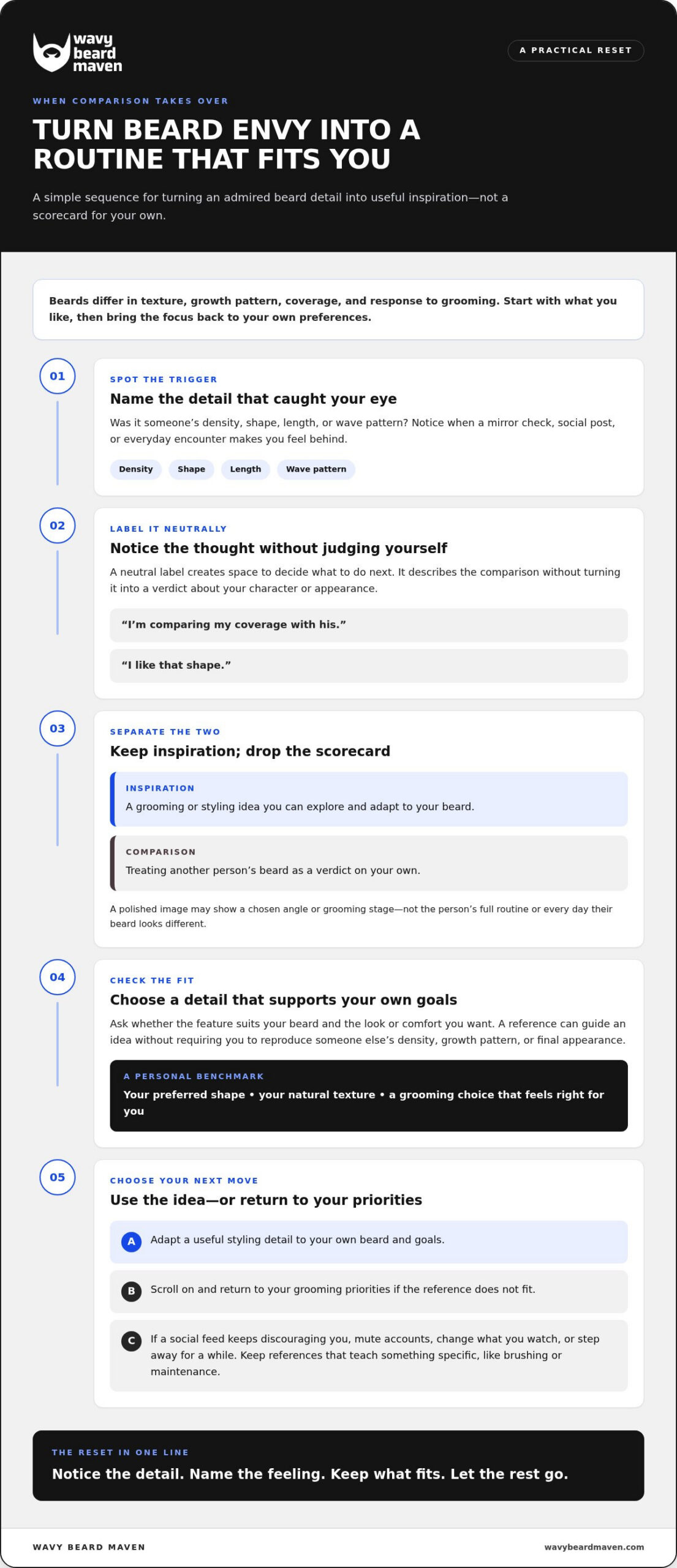
Name the feeling neutrally: “I’m comparing my coverage with his,” or “I like that shape.” Avoid turning the observation into a judgment about your character. A neutral label gives you a moment to choose what happens next: take inspiration from a styling detail, return to your grooming priorities, or scroll on.
Why another man’s beard is not a fair measuring stick
Beards vary in texture, growth pattern, coverage, and the way they respond to grooming. Two men can use similar techniques and still end up with different results. A particular wave, density, or outline may not be something your beard can reproduce, and that difference doesn’t make your grooming efforts pointless. Your own features are the right starting point for choices about shape and maintenance.
A photograph or polished post is also a selected view. It may show a carefully arranged angle, a particular stage of grooming, or simply the image its creator chose to share. It doesn’t show the person’s full routine or every day their beard looks different. Treat the image as inspiration, not a complete standard you’re expected to meet.
Try this quick reset when comparison starts to take over:
- Notice the detail that caught your eye.
- Separate what you admire from what you’re criticizing in yourself.
- Choose one preference that genuinely fits your beard and grooming goals.
This isn’t about dismissing envy or forcing confidence. It’s about seeing the feeling clearly, respecting natural differences, and bringing your attention back to a path you can shape through consistent practice.
Why Beard Comparisons Hit Harder Than a Passing Style Inspiration
A beard photo can start as a useful reference, then quietly become a standard you feel you have to meet. That shift is more likely when the feature you notice is one you’re already uncertain about: perhaps your cheek coverage, wave definition, or progress toward a preferred shape. The image isn’t the only influence. If you haven’t decided what you want from your own grooming, someone else’s look can seem to answer that question for you.
This is a pattern to notice, not a diagnosis or a rule that applies to everyone. Body image can influence self-esteem and how people feel about themselves; the federal Office on Women’s Health explores these themes in its Body Image and Mental Health resource. If a comparison starts to feel personal, pause and ask what standard you’re using and whether it reflects your priorities.
Social feeds can make exceptional beards feel like the standard
Instagram and TikTok can put polished grooming photos and videos in front of you repeatedly. Those posts may show a carefully chosen angle or finished look, not ordinary growth stages, daily maintenance, or how the beard changes from one day to the next. Frequent exposure to standout examples can make them feel more typical than they are. Notice your response: does the feed give you ideas, or does it leave you repeatedly discouraged?
Use that reaction as information, not a reason to criticize yourself. You can mute accounts, change what you watch, or step away for a while if the content keeps turning your routine into a comparison exercise. Keep references that teach you something specific, such as how a shape is brushed or maintained.
The difference between wanting a style and wanting someone else’s results
Before changing your routine, identify the detail you admire. Is it the outline, the length, the wave pattern, or the way the beard is styled? A specific feature can be a useful reference. Wanting the other person’s exact density, growth pattern, and final appearance is different, and may not fit your beard or preferences.
Inspiration is a direction to explore, not a verdict on your personal worth. Let a reference point toward an idea, then adapt it to your own goals. A style image can help you describe what you like without requiring you to reproduce every detail.
- Name the feature: Identify the one detail that caught your attention.
- Check the fit: Ask whether it supports your preferred look and comfort.
- Keep your agency: Adapt the idea, or let it go if it doesn’t suit your beard.
If you’re shaping your personal routine, explore beard-wave grooming guidance for ideas to practice with intention. A reference should help you make choices, not make those choices for you.
How to Turn Beard Envy into Personal Progress You Can Actually Track
Use the feeling as a cue to get specific. Instead of asking, “Why doesn’t my beard look like his?” turn your attention to what you want to develop for yourself. A simple process can move you from comparison to a clear grooming goal, then help you notice the choices and changes that matter to you. This is the practical side of dealing with beard envy: measure your own direction, not someone else’s finish line.
Personal benchmarks are more useful than one-off comparisons because they show how your beard is changing in relation to your own goals. Try this sequence:
- Name the trigger. Identify what sparked the comparison, such as a photo, a conversation, or a moment when you checked your reflection.
- Identify the admired detail. Get precise. Is it the shape, the wave definition, the styling, or the way the beard looks maintained?
- Choose a personal goal. Decide what you want to explore based on your preferences and your beard.
- Review your progress. Note what you practiced and what you notice, without setting a deadline for a particular appearance.
Choose a beard goal that belongs to you
Before changing your routine, ask what you want your beard to do for your look and daily comfort. Maybe you’d like a neater outline, more intentional styling, or to explore the wave definition your beard naturally supports. Keep the aim concrete enough to guide your choices, but flexible enough to respect your texture and growth pattern. You can also decide a trend isn’t for you. That’s a valid grooming preference, not a missed opportunity.
Track your own changes without demanding identical results
Keep a brief record of your routine, the appearance you prefer, and any changes you notice. Photos can help, too. Take them under similar lighting and from a similar angle, with your beard in a comparable state, so you’re not mistaking a different setup for a change in your grooming. Review your notes or photos occasionally, rather than judging progress by one mirror check or a comparison with somebody else.
Your record might show that your routine feels easier, a shape suits you better, or your wave pattern looks more defined to your eye. It might also help you adjust what you’re practicing. These observations aren’t promises of a specific result; they’re information you can use to decide what feels worthwhile and sustainable. If you choose to work on wave training, the complete beard-wave training guide can help you approach the practice with a structured routine.
Keep the standard personal: what you tried, what you prefer, and what you want to continue. Consistency gives you a clearer view of your own path, even when the outcome doesn’t match anyone else’s beard.
Dealing With Beard Envy Online and in Everyday Life
A comparison can catch you off guard while scrolling, getting ready, or talking with someone whose beard you admire. You don’t have to argue with the feeling or let it steer your next choice. Pause, identify what set it off, and decide whether it offers useful information or is pulling you into self-judgment. That small reset can bring your attention back to the moment.
A quick reset for comparison moments
Try this sequence when envy shows up. Keep it simple and neutral:
- Pause. Take a breath before reacting or changing your routine.
- Name the trigger. Was it someone’s beard in a post, a comment, or a feature you noticed in person?
- Identify the thought. Put it into words, such as “I wish my beard had that wave pattern.”
- Ask what you genuinely like. Consider what appeals to you apart from the pressure to match that person.
- Choose a small next step. Save a useful styling idea, return to what you were doing, or move on from the post.
The aim isn’t to force a positive reaction. It’s to create enough space to decide what deserves your attention. If the comparison doesn’t offer a practical idea, you can let it pass without turning it into a judgment about your beard.
Build a healthier inspiration circle
Choose grooming creators and communities that share techniques without shaming different textures, coverage, or growth patterns. If certain accounts repeatedly leave you discouraged, mute or unfollow them, or take a break from the platform. Curating your feed isn’t giving up on inspiration. It’s choosing what you let shape your expectations.
Reddit can offer a place to read about other people’s grooming experiences, but advice and results vary from person to person. Treat suggestions as perspectives to assess, not instructions your beard must follow. Look for practical detail, and consider whether a tip suits your goals and routine before adopting it.
Community can also mean talking about grooming without making another man a rival. Ask what someone enjoys about his routine, share a technique that’s working for you, or celebrate progress without ranking beards. Respectful exchanges make room for different styles and outcomes. You can appreciate another person’s look while staying grounded in your own choices.
If comparison begins affecting your mood, relationships, or daily wellbeing, consider speaking with a qualified mental health professional. You deserve support if the feeling becomes difficult to manage, and asking for help doesn’t diminish your grooming journey.
For a practical way to focus on your own beard-wave routine instead of someone else’s results, use the 7-Day Beard Wave Starter Routine™ Checklist as a structured starting point.
Build Beard Confidence Through Practice, Not Perfect Comparisons
Confidence doesn’t come from making your beard match somebody else’s. It grows as you make grooming choices that reflect what you actually want, then practice them with patience. Dealing with beard envy doesn’t require you to stop admiring other beards; it means you can appreciate a look without making it the measure of your own.
Consistency can give your routine structure and help you notice what feels right for your beard. It isn’t a guarantee of a particular shape, texture, or appearance. Growth patterns differ, and a worthwhile routine is one you can adapt to your goals, not a promise that your beard will become someone else’s.
Create a grooming routine that supports your own direction
Start with your goal, then choose only the steps that support it. If you’re exploring wave definition, learn how each part of your routine fits that aim. A beard oil guide for waves can help you consider oil as one part of wave-focused grooming. If brushing is relevant to your preferred style, use the beard brush mastery guide to explore brushing practice.
Keep the routine manageable. You might focus on a shape you like, a grooming step that feels comfortable, or a styling habit you want to practice consistently. You don’t need to adopt every technique or product category. A simple routine you understand and can maintain may serve your goals better than a complicated one built around someone else’s results. Beard oils, butters, balms, brushes, and wraps are among the grooming options available through Wavy Beard Maven’s shop; choose only what supports the routine you want.
Let community and discipline reinforce confidence
Grooming is a learned practice, not a contest with one ideal result. Educational guides can offer structure and technique, while a community can make room for different textures, coverage, and styles. Take what supports your direction, adapt it, and leave behind standards that don’t fit. Your progress may look different from another man’s, and it can still be meaningful to you.
Discipline here means returning to choices you’ve made for yourself, not criticizing your beard into changing. Pay attention to whether a routine feels useful and aligned with your preferences. Adjust it when your goals or needs shift. That steady process can support confidence without guaranteeing any particular outcome.
If a little structure would help you get started, Wavy Beard Maven’s educational guides and free 7-Day Beard Wave Starter Routine™ Checklist offer an optional place to begin. Explore it at your own pace, and keep only the practices that make sense for your goals. Self-respect doesn’t depend on matching a trend or another beard. It belongs to you, across every texture and growth pattern.
Choose Your Next Step with Confidence
Your next grooming choice doesn’t need to prove anything to anyone. Let it reflect what you want to explore, whether that’s a small adjustment to your routine or simply giving your beard time and care as it is. Dealing with beard envy can become a cue to return to your own direction, not a reason to chase a standard that doesn’t fit.
Pick one manageable practice to carry into your next grooming session. Keep it because it feels useful to you, and give yourself room to adjust as your preferences become clearer. Wavy Beard Maven’s step-by-step beard-wave education offers guidance grounded in discipline, confidence, and community, without requiring one ideal result.
For a simple structure to guide your next step, explore the free 7-Day Beard Wave Starter Routine™ Checklist. Start at a pace that feels right, and keep building a grooming path you can be proud of.
Frequently Asked Questions
Is beard envy normal?
Yes, beard envy can happen when you notice a feature you wish your own beard had. Feeling it doesn’t mean you’re shallow or ungrateful; it’s a reaction, not a character flaw. Pay attention to how often it comes up and whether it affects your mood or choices. If it feels persistent or begins interfering with daily life, consider talking with a qualified mental health professional.
How do I stop comparing my beard to other men’s beards?
You may not stop every comparison, but you can make it less influential. Try replacing “Whose beard looks better?” with a question you can act on, such as “What do I want to feel comfortable with today?” Then choose one practical grooming decision, like keeping your current shape or taking a break from checking the mirror. This shifts attention from ranking appearances to making choices that fit you.
Can beard envy motivate me to improve my grooming routine?
It can point you toward a style or technique you want to explore, as long as you treat it as a prompt rather than pressure. If a beard inspires you, identify one manageable element, such as brushing direction or a more defined outline. Change one routine step at a time and notice whether it suits your beard and preferences. You don’t need to add products or practices simply because someone else uses them.
Why do I feel jealous of men with fuller beards?
Fullness is easy to notice, and you may connect it with traits like maturity or masculinity. But beard coverage and density vary, and facial hair growth is primarily influenced by genetics and how facial hair follicles respond to androgens. A fuller beard isn’t proof that someone is more masculine or has greater personal worth. If fullness is the feature you admire, consider what you like about its appearance without treating it as a measure of yourself.
What should I do if social media makes me feel bad about my beard?
Make your feed work for you. Unfollow or mute accounts that repeatedly leave you feeling worse, and use platform controls to see less similar content. You could also set a personal boundary, such as checking grooming posts only when you’re looking for a specific technique. If you leave a scroll feeling discouraged, close the app and shift to an activity that brings your attention back to your day.
Can every beard develop waves or the same pattern?
No. Beards differ in natural texture, growth direction, and coverage, so they won’t all develop the same wave pattern or appearance. Grooming practices can help you work with the hair you have and influence how it’s arranged, but they can’t guarantee another person’s results. If you want to explore waves, approach it as a styling practice and assess what works for your beard rather than expecting an identical pattern.
How can I feel more confident while growing my beard?
Give your beard a purpose beyond reaching a particular length. Decide what you want the growing stage to look or feel like, then choose a manageable way to care for it, such as keeping it comfortable or maintaining a shape you enjoy. Confidence can grow through making deliberate choices, even before your beard reaches a preferred look. If your preferences change, you can adjust your plan without treating that as failure.