September 1, 2026
Beard waves aren’t a gift of genetics; they’re a hard-earned reward for your daily discipline. You’ve likely spent weeks brushing only to find your pattern vanishes the moment you hit the pillow or struggles to connect from your chin to your cheeks. It’s frustrating when your hair feels too coarse to cooperate, but that’s exactly where the training begins. If you’re ready to learn how to get beard waves that stay deep and connected, this 2026 training guide is your expert-led blueprint for success.
We’ll help you master the art of texture management through a repeatable routine that turns grooming into a cultural practice. By following this systematic approach, you’ll transform a wild beard into a masterpiece of fluid, visible definition. We’re going to dive deep into the foundations of hydration, the precision of directional brushing, and the essential role of compression. You’ll move from basic maintenance to true mastery, ensuring your waves don’t just appear, but they thrive. Let’s start the process of refining your look and building the confidence that comes with a perfectly trained beard.
Key Takeaways
- Understand the science of the hair cuticle and how strategic hydration allows you to reshape coarse beard texture into organized, flat-laid patterns.
- Identify the essential tools for your kit, including why a firm boar bristle Beard Brush and a compression Beard Wrap are non-negotiable for building deep connections.
- Master a disciplined 4-step blueprint on how to get beard waves through a cycle of priming, directional brushing, and strategic compression.
- Learn to troubleshoot common pattern disruptions such as “forks” and manage the over-wolfing phase to maintain control over your beard’s thickness.
- Establish a repeatable morning and evening grooming session that transforms your style from a chore into a cultural practice of self-improvement.
The Science of Beard Waves: Training Your Texture
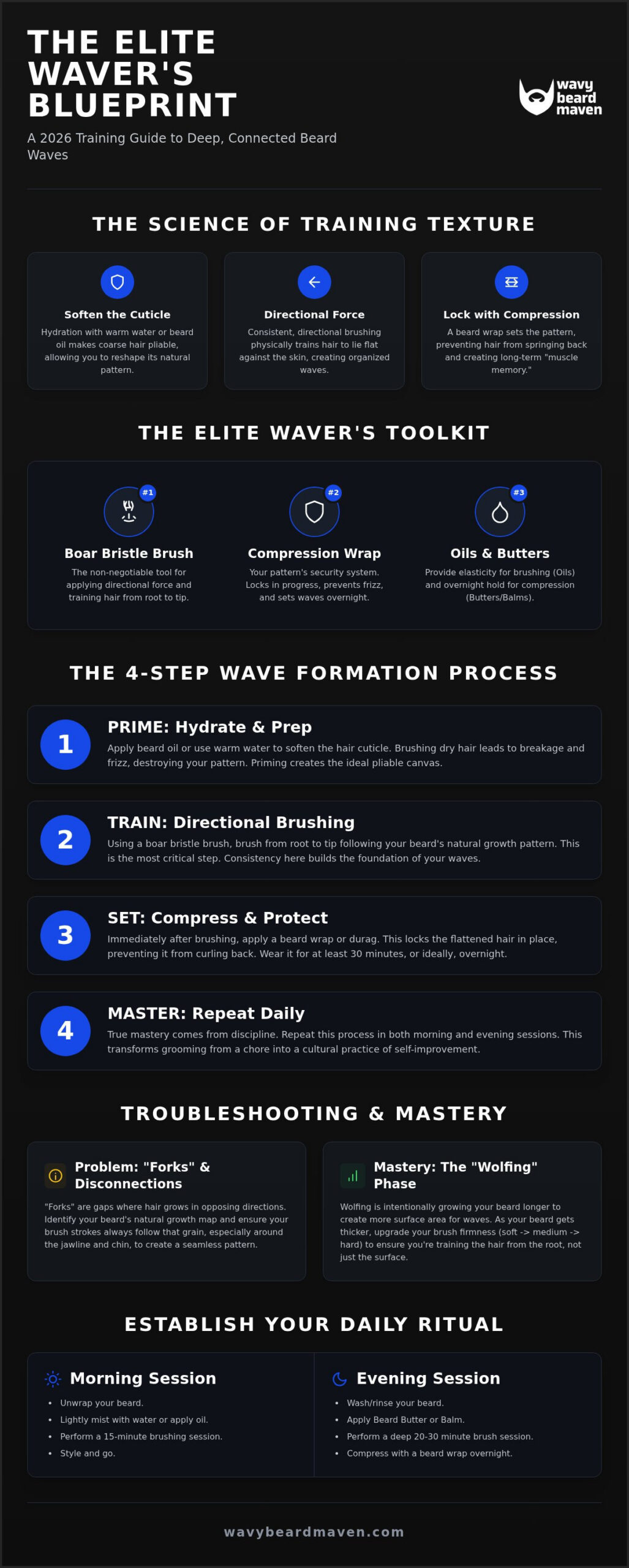
Beard waves are more than just a style; they represent a commitment to grooming as a cultural practice. By definition, waves are a pattern of organized curls that have been trained to lie flat against the skin through consistent, directional pressure. This isn’t a result of luck. It’s biology. Your hair’s outer layer, the cuticle, acts like a shield. When you introduce hydration through Beard Oils or warm water, that cuticle softens, allowing the hair to become pliable enough to be reshaped. This is the fundamental secret of how to get beard waves. You aren’t changing your DNA; you’re simply teaching your hair a new way to sit.
Coarse and coily hair types are the elite candidates for this process. While some might view thick hair as a hurdle, it’s actually the perfect canvas because the natural curl diameter allows for tighter, more defined patterns. To achieve this, you must embrace “wolfing.” This is the intentional practice of letting your beard grow longer than usual. More length provides the surface area necessary for the pattern to develop depth. Without that extra growth, your waves will look shallow and disconnected. Consistency during this growth phase is what separates a master from a beginner. If you’re just getting started on this journey, understanding how to start beard waves with the right foundational approach will save you weeks of frustration and set you on the fastest path to visible results.
Why Compression Matters
Compression is the stage where the pattern you’ve brushed into your hair becomes permanent. Think of it as a physical “save” button for your progress. After a deep brushing session, your hair naturally wants to return to its springy, curled state. Using a Beard Wrap prevents this. It physically sets the hair into a flat position, forcing the follicles to adapt to a new direction. Over time, this creates memory. Your hair won’t just lie flat because you forced it; it will lie flat because that’s the new standard you’ve established through disciplined maintenance. To ensure you’re getting the most out of this critical step, a dedicated guide on choosing the right beard durag for waves will help you select the ideal compression gear for maximum pattern retention and moisture lock.
Identifying Your Natural Growth Direction
You cannot train what you do not understand. Before diving into the 7-Day Beard Wave Starter Routine™ Checklist, you must map your grain. Your beard doesn’t grow in a single straight line. It swirls, pivots, and changes direction, especially near the jawline. Brushing against this natural path causes frizz and destroys your connectivity. Spend time observing your beard in a mirror to identify where the hair naturally flows. Mapping allows you to align your brush strokes with your biology, ensuring that the transition between your cheeks and chin is seamless. This is a vital step in learning how to get beard waves that actually connect across your entire face.
Essential Tools for the Elite Beard Waver
Mastery requires precision. You can’t just pick up any comb and expect results. To understand how to get beard waves, you must invest in tools designed for texture management. The cornerstone of your kit is a firm boar bristle Beard Brush. Unlike synthetic alternatives, natural boar bristles carry natural oils from your skin to the ends of your hair while providing the tension needed to pull curls flat. Brushing isn’t just about neatness; it’s about directional force. To make the most informed decision for your specific hair texture and training stage, consult a dedicated beard brush for waves mastery guide that breaks down bristle selection and the nuances of the 360-degree brushing technique.
Protection is just as vital as training. Beard Wraps and durags serve as your pattern’s security system. Without them, your hard work literally rubs off on your pillowcase. These tools provide the consistent compression needed to lock in the “lay” after a long brushing session. This keeps the hair fibers aligned and flat against the skin, ensuring your hard-earned progress doesn’t vanish overnight. If you’re serious about the craft, understanding the technical differences between compression materials and fit is essential — the 2026 ultimate beard durag for waves compression guide breaks down exactly how to choose and layer your gear for elite-level pattern locking. You don’t skip the wrap.
Choosing the Right Brush Firmness
Your brush choice shifts as your beard progresses. Early in the training phase, a soft brush helps lay down flyaways and trains the top layer of hair. However, as you enter the “wolfing” stage and your beard gains bulk, you’ll need a medium or hard brush. These firmer bristles penetrate the thickest growth to reach the roots, ensuring the pattern is established from the base up. Transitioning to a harder brush is a sign of progress. It indicates that your hair has reached a density where surface-level brushing is no longer enough to maintain the deep, connected look you’re after.
The Role of Specialized Moisturizers
Hydration is the engine of wave formation. Using a specialized beard oil for waves provides the elasticity your hair needs to stretch without snapping. Brushing dry hair is a mistake. It leads to breakage and frizz, which ruins connectivity. For overnight care, switch to Beard Butters or Beard Balms. These heavier products offer the hold required to keep hair compressed for hours. Avoid water-based moisturizers during active training. Water causes hair to shrink and curl back to its natural state, effectively “un-training” the progress you’ve made. To ensure your toolkit is working for you, check out the full range of specialized wave gear to level up your daily routine.
The 4-Step Process to Form Deep Wave Patterns
Success in wave training is built on a foundation of repeatable, daily actions. You’ve gathered your tools and mapped your grain; now it’s time to execute the blueprint. This four-step cycle is designed to maximize hair elasticity and lock in the directional training required to see visible results. If you’re wondering how to get beard waves that actually stay, you must treat this sequence as a non-negotiable discipline rather than a casual suggestion.
- Step 1: Hydrate and Soften. Start by applying warm water to your beard to open the hair cuticles. Follow this immediately with a high-quality Beard Oil to prime the hair for stretching.
- Step 2: The Brushing Session. This is where the training happens. Use your boar bristle Beard Brush to pull the hair in the direction of your mapped grain. This is the core engine of how to get beard waves, requiring at least 15 to 20 minutes of focused, rhythmic strokes.
- Step 3: Apply Hold. Once the hair is brushed flat, distribute a small amount of Beard Balm or Beard Butter. These products act as a sealant, maintaining the “lay” and preventing the hair from springing back into its natural curl.
- Step 4: Compress. Secure your Beard Wrap immediately after applying your hold product. This final step is the secret weapon that forces the hair to “set” in the pattern you’ve just created.
Mastering Brushing Angles
Connectivity is won or lost in the angles. To create a seamless flow between your cheeks and jawline, employ the 45-degree rule. Brush diagonally from the top of your cheek toward the corner of your mouth. For the side of your face, move the brush from the ear directly toward the chin to encourage a 360-degree flow. When you reach the chin, use vertical strokes. This creates a “waterfall” wave effect that looks deep and organized, ensuring every section of your beard contributes to a unified pattern.
The ‘Wash and Style’ Technique
The “Wash and Style” is the fastest way to see initial wave definition. While your beard is wet and soapy in the shower, perform a full brushing session. The lather provides incredible slip, allowing you to lay the hair flatter than is possible when it’s dry. The pro move is the “rinse through the wrap” method. After brushing your soapy beard into place, put on your Beard Wrap and rinse the soap out through the fabric. This prevents the water pressure from disturbing your pattern, leaving you with a perfectly set foundation once it dries. This technique is a cornerstone of the 7-Day Beard Wave Starter Routine™ Checklist and is essential for anyone serious about mastery.
Troubleshooting: Why Your Pattern Isn’t Connecting
Technical hurdles are part of the discipline. You’ve followed the steps, but you might notice your pattern looks fractured or inconsistent. This isn’t a sign of bad genetics; it’s a signal that your technique needs refinement. Understanding how to get beard waves requires you to troubleshoot these common disruptions with the same patience you use for brushing. Precision is the difference between a blurry texture and a deep, connected masterpiece.
The “Fork” problem is the most common frustration for intermediate wavers. Forks occur when your wave lines split or cross instead of running in parallel. This happens when your brush angles shift slightly during a session. If you don’t follow the exact same path every time, you create competing patterns. Over-wolfing is another trap. While length is necessary for depth, there’s a limit. If your beard grows so thick that your firmest Beard Brush can’t reach the skin, you lose control of the roots. This causes the hair to curl at the base, pushing your hard-earned waves out of alignment. When it’s time to manage that length, learning how to trim beard without losing waves becomes an essential skill to protect the pattern you’ve worked so hard to build.
You must also distinguish between frizz and waves. Frizz is a symptom of under-moisturization or brushing dry hair. If your beard feels “crunchy” or looks fuzzy, you’re likely skipping the priming stage. Waves require a flat, hydrated lay. Finally, don’t let the “Lazy Chin” discourage you. The hair on the chin is often the densest and most resistant to training. It requires more focused vertical strokes and extra compression to break the natural curl pattern and force it into a wave.
Fixing Frayed Connections
Connectivity is won through mirror work. Use a handheld mirror in combination with your bathroom mirror to see your beard from every angle. This “double-mirror” setup ensures your brush strokes never overlap incorrectly at the transition points. Pay close attention to the mustache-to-beard transition. Use vertical brushing here to bridge the gap. Consistency in your brushing path is the only cure for forks. If you notice a split, you must be hyper-vigilant about following your mapped grain with absolute discipline until the lines realign.
Managing Different Hair Textures
Most beards feature a mix of textures. You might have straight patches on your cheeks and tight coils on your chin. For straight patches, use a softer brush and lighter compression to avoid over-flattening the hair. For extremely coily areas, increase the frequency of your “Wash and Style” sessions. You can also adjust your compression pressure by tightening your Beard Wrap specifically over the densest areas. This customized approach ensures your entire beard reaches the same level of definition. If you’re struggling to keep your routine consistent, download the 7-Day Beard Wave Starter Routine™ Checklist to master these technical adjustments.
Mastering the Routine: Daily Discipline for Success
Waves are won in the quiet moments of the morning and the late hours of the night. This isn’t a hobby you visit occasionally; it’s a 24-hour cycle of maintenance. To truly master how to get beard waves, you must embrace a rhythm that protects your progress while you sleep and reinforces it while you’re awake. Consistency is the only bridge between a messy beard and a masterpiece of fluid texture.
Your morning session starts the moment you remove your Beard Wrap. Your hair is already laid flat, so don’t ruin it with aggressive styling. Apply a few drops of Beard Oil to refresh the shine and use a soft Beard Brush for five minutes to wake up the pattern. This session isn’t for deep training; it’s for maintenance. The real work happens during the “Evening Grind.” Before bed, dedicate 20 minutes to a deep brushing session with a medium or hard brush. Apply Beard Butter to lock in the moisture, then secure your wrap. Never sleep without it. Your pillow is the primary enemy of connectivity, and eight hours of friction will reset your progress to zero.
As you work through this cycle, track your progress by looking for “ripples.” These are faint, horizontal shadows that appear before the waves become deep and defined. Ripples are the first sign that your hair memory is taking hold. When you see them, don’t change your technique. Double down on it. This is the moment your discipline begins to pay off.
The 7-Day Starter Checklist
- Day 1 to 3: Focus entirely on softening the hair with Beard Oil and mapping your natural growth grain. Don’t worry about the pattern yet; worry about the health of the hair.
- Day 4 to 6: Increase your brush repetitions to 15 minutes per session. Introduce the Beard Wrap every night to start setting the hair memory.
- Day 7: Perform your first “Wash and Style” session as described earlier in this guide. This is the reveal day where you’ll see your first ripples emerging from the lather.
Building a Lifetime Grooming Habit
Developing a wave pattern is a journey of self-discipline that extends beyond aesthetics. It’s about taking pride in the craft and respecting the history of the style. Once your pattern is fully connected, the work doesn’t stop; it simply shifts into a maintenance phase. You’ll find that the order you bring to your grooming routine often translates into broader personal confidence. Ready to start? Download our 7-Day Beard Wave Starter Routine™ Checklist to begin your journey toward mastery and learn exactly how to get beard waves that command respect.
Own Your Texture: The Path to Mastered Waves
Mastering how to get beard waves isn’t just about the aesthetic; it’s about the discipline you apply to your daily life. You’ve learned that deep patterns are born from the intersection of biology and persistence. By utilizing specialized tools for coarse hair and expert-tested compression techniques, you’re no longer guessing. You’re executing a proven blueprint. Success lies in the details, from mapping your growth grain to protecting your progress with a night wrap. Every session counts.
Consistency transforms ripples into waves. You’ve joined a community of disciplined wavers who view grooming as a cultural practice. Don’t let your progress stall now that you have the knowledge. It’s time to put these techniques into action and earn the results you’ve been chasing. Start your 7-Day Beard Wave Starter Routine™ today and witness the power of a dedicated training cycle. Your journey toward a perfectly defined, connected beard begins with the first brush stroke. Stay disciplined, stay focused, and wear your waves with pride.
Frequently Asked Questions
How long does it take to see waves in your beard?
You should expect to see initial ripples within 7 to 10 days, but deep, connected waves typically require 4 to 6 weeks of disciplined training. This timeline depends heavily on your starting texture and how strictly you follow your brushing and compression routine. While some see progress faster during a Wash and Style session, true mastery of how to get beard waves is a marathon that rewards those who never skip a night of compression.
Can I get beard waves with a short beard?
You cannot get defined waves with a very short or stubble length beard because the hair needs enough length to complete at least one full curl rotation. Training usually begins once your beard reaches approximately 1 to 1.5 inches in length. This extra bulk, often called wolfing, provides the surface area necessary for your Beard Brush to lay the hair flat and organize it into the deep, visible patterns you desire. If you’re brand new to this process, a dedicated resource on how to start beard waves will walk you through the exact steps to take from day one so you build the right habits before your hair reaches training length.
Do I need a durag for my beard to get waves?
Yes, a compression tool like a specialized Beard Wrap is non-negotiable for protecting your pattern and setting hair memory. While a standard durag works for scalp hair, a Beard Wrap is designed specifically for the contours of the face and jawline. Without this compression, your hair will naturally spring back into its curled state overnight, effectively erasing the progress you made during your evening brushing session. Consistency in compression is vital.
What is the best brush for beard waves?
The best tool for this process is a natural boar bristle Beard Brush because it provides the necessary tension to pull coarse hair flat without causing breakage. You should use a medium or firm brush during the wolfing phase to reach the roots of thick growth. As your pattern becomes more established, a softer brush is useful for laying down flyaways and refining the surface shine without disturbing the deeper connections you’ve already built. For a comprehensive breakdown of how to match bristle firmness to your exact hair texture and training stage, the beard brush for waves 2026 mastery guide covers every detail you need to make the right choice.
Will brushing my beard too much cause hair loss?
Brushing your beard won’t cause hair loss if you prioritize hydration and use the correct tools. In fact, regular brushing with a boar bristle brush stimulates blood flow to the follicles and exfoliates the skin underneath. To avoid breakage, never brush a dry, brittle beard. Always prime the hair first with Beard Oils or warm water to ensure the cuticles are flexible enough to withstand the directional pressure of your training routine.
How do I get my beard waves to connect on the sides?
Connectivity on the sides is achieved through precise mirror work and adhering to the 45 degree brushing rule. You must brush diagonally from the top of the cheek toward the corner of your mouth to bridge the gap between different growth directions. Using a handheld mirror allows you to verify that your strokes are perfectly aligned, preventing forks and ensuring the pattern flows seamlessly from your sideburns down to your jawline for a unified look.
Can I use hair grease for beard waves?
You should avoid heavy petroleum based hair greases and instead use Beard Butters or Beard Balms for hold. While grease provides shine, it often clogs pores and leads to skin irritation under the beard. Specialized butters provide the heavy lay required for waves while nourishing the hair with natural ingredients. These products offer the perfect balance of compression support and moisture without the greasy buildup that can ruin your natural hair texture.
How often should I wash my beard while waving?
You should limit full washes to 1 or 2 times per week to prevent stripping the natural oils that keep your hair elastic. However, you can perform a Wash and Style session weekly to reinforce your pattern. During this process, you brush while the hair is soapy and then rinse through your Beard Wrap. This specialized technique keeps the beard clean while using the water’s weight to help set the waves even deeper into the hair.