October 13, 2026

What if confidence begins with a small act you can repeat, not a dramatic change? How beard care builds confidence isn’t about having a perfect beard or meeting someone else’s standard. It’s about taking a few intentional minutes to care for yourself and noticing how that practice can support self-respect and a sense of agency.
If grooming feels like one more task to manage, or your motivation comes and goes, you’re not alone. A simple routine won’t fix every hard day, and your appearance never determines your worth. But a manageable habit can bring a moment of structure and personal care to your day, even when the results are subtle.
This article explores the realistic connection between beard care, self-image, and confidence, then offers practical ways to shape a routine that feels achievable rather than demanding. You’ll also learn where grooming’s limits are and when additional support may help. Start small, stay consistent when you can, and let the practice serve you, not define you.
Key Takeaways
- See how beard care builds confidence through small acts of agency and self-trust, not by defining your worth.
- Make a grooming habit easier to maintain by choosing one purpose, one manageable step, and a realistic daily cue.
- Track how your routine feels as well as how your beard looks, so progress isn’t measured by appearance alone.
- Recognize what grooming can support and where its limits are; it isn’t a treatment for mental health challenges.
- Keep beard care optional and personal, alongside other sources of well-being such as rest, relationships, movement, and support.
How Beard Care Can Build Confidence Without Defining Your Worth
Confidence doesn’t mean feeling certain, fearless, or comfortable in every situation. It can mean trusting yourself to make a choice, feeling at ease with who you are, and believing you can take a manageable next step. That’s a grounded way to understand how beard care builds confidence: a grooming ritual may help you feel more intentional about your appearance, but it cannot measure your value.
Your beard is one part of your presentation, not a scorecard for your character. A carefully shaped beard may feel like an expression of pride or personal style; another person may feel most like themselves clean-shaven, with stubble, or without a grooming routine. None of those choices makes someone more deserving of respect. Self-image is personal, and self-esteem involves more than what you see in the mirror.
Keep everyday confidence-building in perspective. A grooming habit might offer a small sense of choice or care, but it isn’t a treatment for anxiety, depression, or other mental health conditions. If distress is persistent or affecting daily life, grooming alone may not be enough. Seeking support from a qualified mental health professional or someone you trust can be an important step.
Beard care can be a small practice of self-respect, not a measure of your worth or a remedy for deeper struggles.
Why a grooming ritual can feel meaningful
Choosing to care for yourself can reinforce a simple message: “I decided this matters to me today.” The value is in making a personal choice, not in achieving a flawless result. For example, before starting the day, you might brush your beard, smooth it into place, or apply a beard-care product that suits your routine. That deliberate action can offer a moment to begin the morning with intention.
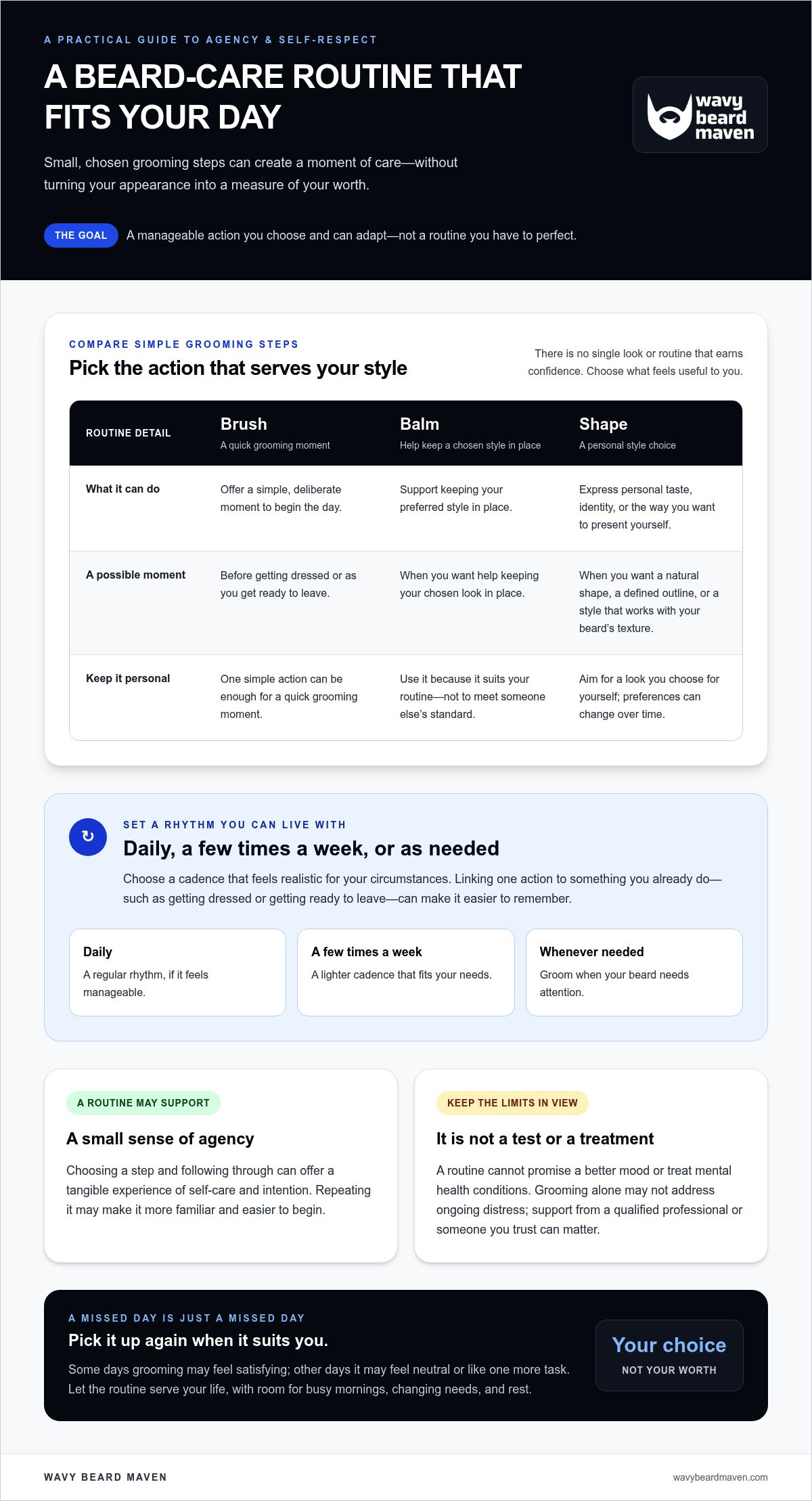
Keep the ritual yours. Some days you may have time for several steps; on others, one simple action may feel more realistic. A brush, for instance, can be enough for a quick grooming moment, while a balm may suit a routine focused on keeping your chosen style in place. If beard care isn’t meaningful to you, you don’t need to adopt it to prove discipline or build confidence. A useful habit supports your life. It shouldn’t become another standard you have to meet.
Beard style, identity, and self-expression
A chosen beard style can reflect taste, cultural expression, or the way you want to present yourself. That connection can make grooming feel personal rather than purely practical. You might prefer a natural shape, a defined outline, or a style that works with your beard’s texture. There’s no single look that earns confidence; the aim is to make choices that feel like yours.
How comfortable you feel can also shift with the setting. You may feel at ease among friends and more self-conscious in a new environment. That doesn’t mean your style has failed. Treat grooming as one form of self-expression, not a requirement to match an ideal or control every impression. Your confidence can change while your worth remains steady.
The Everyday Mechanisms: Agency, Routine, and Self-Respect
Self-efficacy is the belief that you can take an action you’ve chosen, especially when it feels manageable. A beard-care step won’t prove that you can control everything in life. It can offer a small, tangible experience of follow-through: you decided to brush, shape, or condition your beard, and you did it.
That’s one realistic way to understand how beard care builds confidence. Repeating a chosen step can make it familiar, so it takes less thought to begin. Over time, the value may be less about a dramatic change in mood and more about having a routine you can adapt to your day. Some people prefer a regular rhythm; others groom occasionally or keep things simple. The routine should fit your circumstances, not become a test you can fail.
How consistency can strengthen a sense of agency
Start with a step small enough to complete without turning it into a project. You might brush your beard before getting dressed or use beard balm when you want help keeping your style in place. Linking that action to something you already do, such as getting ready to leave, can make it easier to remember.
Choose a cadence that feels realistic: daily, a few times a week, or whenever your beard needs attention. If you miss a day, simply pick up again when it suits you. A break isn’t evidence of poor discipline or a lack of self-respect. A useful routine has room for busy mornings, changing needs, and rest.
Routine can provide a steady point in the day, but it can’t promise a better mood. Some days the same grooming step may feel satisfying; other days it may feel neutral or like one more task. Let it be an option, not a demand. Self-care can support your sense of agency, but it isn’t a substitute for mental health treatment. If you’re struggling with ongoing distress, grooming alone may not address what you’re experiencing.
When personal style supports self-expression
Shaping a beard can be a way to express personal taste or identity, but social expectations can influence how people feel about facial hair. Rather than chasing approval or a single ideal, decide what feels comfortable and meaningful to you. A satisfying look is one you choose for yourself, even if it changes over time.
You can refine your routine as your preferences shift. For ideas on caring for wavy facial hair, explore step-by-step beard-wave guidance and adapt what feels useful to your own style. Keep the principle simple: practice the habits that serve you, and leave room to change them.
Confidence Myths: What Beard Care Can, and Cannot, Change
A beard-care routine can be meaningful without being a cure-all. It may help you express your preferences, maintain a look you enjoy, or feel more intentional about your day. But it can’t guarantee confidence, resolve emotional distress, or make someone more worthy of respect. Hair texture, growth patterns, time, personal taste, and life circumstances all shape what grooming looks like in practice.
That distinction also answers a common objection: is grooming superficial? It depends on why you do it. Caring for your beard because you enjoy the process or like how a particular style reflects you can be personally meaningful. Feeling forced to maintain a look to meet someone else’s standard is different. The practice itself doesn’t determine its value; your reasons and experience matter.
Does grooming automatically make someone more confident?
No. A grooming routine may support self-expression, but a polished beard can’t guarantee a particular feeling. Some people feel confident with minimal grooming, a clean-shaven face, or no beard at all. If a style doesn’t suit your preferences or adds stress, changing it or stepping away from a routine is a valid choice.
Keep comparison in check, too. Curated photos and other people’s grooming standards don’t show the full range of hair textures, routines, or circumstances. Rather than measuring your progress against an image, ask whether your own approach feels comfortable and workable. The honest answer may change over time.
When self-care is not enough
Beard care is not a substitute for therapy, medical care, or crisis support. If anxiety, low mood, or other distress persists, feels overwhelming, or disrupts daily life, reaching out to a qualified mental health professional is a practical step. You don’t need to wait until you have a perfect explanation for what’s wrong before asking for help.
If you’re in the United States and facing an immediate crisis or danger, call or text 988 for the Suicide & Crisis Lifeline. Grooming can remain one small part of a broader self-care routine, but it shouldn’t carry the responsibility of addressing serious distress.
A realistic view of how beard care builds confidence leaves room for both its benefits and its limits. Let grooming serve a purpose you choose, whether that’s maintaining a style, enjoying a familiar ritual, or expressing your identity. If it starts to feel like pressure, scale it back. Confidence isn’t something you owe anyone through a particular appearance, and support for mental health can come from sources beyond grooming.
Build a Beard-Care Habit That Feels Manageable and Yours
A routine is easier to keep when it has a clear purpose and fits the day you actually have. Instead of building a long regimen all at once, make it personal and simple. Ask yourself what you want from the habit: a moment of care, a beard that feels easier to manage, or a way to maintain a style you enjoy. Then choose one action and a cue that helps you remember it.
- Choose one purpose. Name what you want the routine to do for you, such as helping you feel more put together or giving you a quiet pause.
- Pick one manageable action. Brush your beard, apply a product you already use, or take a moment to check how it sits.
- Connect it to a realistic cue. Try pairing the action with getting dressed, finishing your evening routine, or another moment that already happens in your day.
Start with one repeatable action
Keep the first step brief enough to feel doable, even on a busy day. It could be a deliberate grooming check-in before leaving home or a consistent care moment in the evening. Your schedule and needs may call for a different rhythm, so daily repetition isn’t the only measure of success. If you want practical ideas for shaping wavy facial hair, the complete beard-wave training guide can help you explore technique at your own pace.
Measure progress without chasing perfection
Notice more than the mirror. After trying your routine, ask whether it felt comfortable, whether it fit your schedule, and whether it helped you express your preferences. A simple note in a journal or a quick mental check-in can show what’s working without turning grooming into another scorecard. For brushing-specific technique, explore the beard brushing mastery guide and take only the steps that suit your needs.
Let the routine change when your circumstances do. A shift in schedule, a new preference, or a step that starts to feel like a burden are all good reasons to simplify, adjust, or pause. Consistency means returning to a practice that serves you, not forcing the same pattern every day. That practical, flexible approach is part of how beard care builds confidence: you’re learning to shape a habit around your needs, rather than chasing a perfect routine.
If a little structure would help you establish a starting point, use the free 7-Day Beard Wave Starter Routine™ Checklist as a guide. Treat it as a flexible resource, not a rulebook. Keep what feels useful, adapt what doesn’t, and build a routine that belongs to you.
Make Beard Care a Confidence Practice, Not a Requirement
Confidence doesn’t come with a required beard length, shape, or maintenance schedule. It grows from what feels meaningful to you, and that may include caring for your beard or choosing not to. Beard care can be one optional practice alongside relationships, rest, movement, and other forms of support. Its place in your life is yours to decide.
That’s the balanced takeaway from exploring how beard care builds confidence: a grooming habit may offer structure or self-expression, but it doesn’t determine your worth or guarantee how you’ll feel. Keep the steps that serve you. Let go of standards that turn personal care into pressure.
Keep the practice personal and sustainable
Choose a routine that fits your time, preferences, and beard. Your length, wave pattern, and use of products are personal choices, not measures of effort or character. If a step feels useful and comfortable, keep it. If it becomes burdensome, simplify it or pause. Consistency isn’t performing a routine perfectly; it’s returning to a practice when it makes sense for you.
A flexible approach leaves room for real life. Your schedule may shift, your style may change, and some days may call for less upkeep. You can adapt without treating every adjustment as a setback. Personal care should make space for your needs, not compete with them.
Explore guidance and community at your own pace
Wavy Beard Maven shares beard-wave education, step-by-step guidance, and a community-minded approach to grooming. The free 7-Day Beard Wave Starter Routine™ Checklist is an optional learning aid if you want a little structure as you develop a routine. The shop also offers beard oils, butters, brushes, balms, and wraps. Choose products according to your preferences, not as requirements for confidence.
Start with one choice: keep a step that feels right, adapt it to your day, or take a break. If you’d like to explore beard-wave education and grooming resources at your own pace, Explore Wavy Beard Maven. Let the practice support your self-expression and routine, while remembering that confidence and well-being can draw on many parts of life.
Choose a Routine That Moves With You
Your next step doesn’t need to be a full routine. Choose one small grooming action that fits your day, then notice whether it feels useful. Keep it, adjust it, or set it aside as your needs change. That kind of flexibility leaves room for confidence to grow without turning beard care into another standard to meet.
Understanding how beard care builds confidence starts with your own reasons, not someone else’s ideal. Let your style reflect what feels right to you, and remember that a grooming ritual is only one possible source of self-respect and steadiness. The aim isn’t perfection. It’s making choices with intention.
If you’re ready to explore ideas at your own pace, Explore Wavy Beard Maven’s beard-care guides and resources, including educational beard-wave guides and tutorials, the free 7-Day Beard Wave Starter Routine™ Checklist, and grooming products such as oils, butters, brushes, balms, and wraps.
Start with what feels manageable, and let your routine grow with you.
Frequently Asked Questions
Can beard care improve mental health?
Beard care may support a sense of routine or self-expression for some people, but it doesn’t treat mental health conditions. For example, a familiar grooming step might bring a little predictability to a hectic morning, though its effect will differ from person to person. If distress persists or interferes with work, sleep, or relationships, consider speaking with a qualified mental health professional rather than relying on grooming alone.
Does grooming help build confidence?
It can help some people feel more prepared or comfortable in a particular setting, such as a workday or social gathering. Thinking about how beard care builds confidence means focusing on your own experience: does your chosen style feel like you? Grooming can’t guarantee confidence, and a beard isn’t required for self-respect. Notice what feels good to you rather than using appearance to judge your value.
How can I make beard care part of a healthy routine?
Attach one simple action to a moment that already exists in your day. For example, keep your beard brush near your usual getting-ready space and use it as part of preparing to leave. You don’t need a shelf of products or a complicated sequence. If the habit starts competing with sleep or other priorities, shorten it or move it to a more convenient time.
What happens if I miss a day of grooming?
Nothing needs to happen, and there’s no grooming debt to repay. If you skip your usual care, continue whenever it fits again; you don’t need to double the steps or restart from the beginning. A missed day may simply reflect a busy schedule, travel, or a change in priorities. If the routine repeatedly feels hard to maintain, make it smaller or less frequent.
Is beard care a substitute for therapy or mental health treatment?
No. Grooming is a personal-care activity, not a way to diagnose or treat a mental health condition, and it shouldn’t replace professional care. If anxiety, low mood, or other distress continues or disrupts daily life, contact a qualified mental health provider. In the United States, call or text 988 for crisis support when immediate help is needed. Reach out even if you’re unsure how to describe what you’re experiencing.
Can a beard routine help when motivation is low?
A very small step, such as setting out your brush or taking a brief look at your beard before getting dressed, may feel more approachable than a full routine. It’s also okay to skip or adapt the step if it feels like added pressure. Low motivation affects people differently. If it persists or makes everyday tasks difficult, consider reaching out to a qualified professional for support.