September 9, 2026
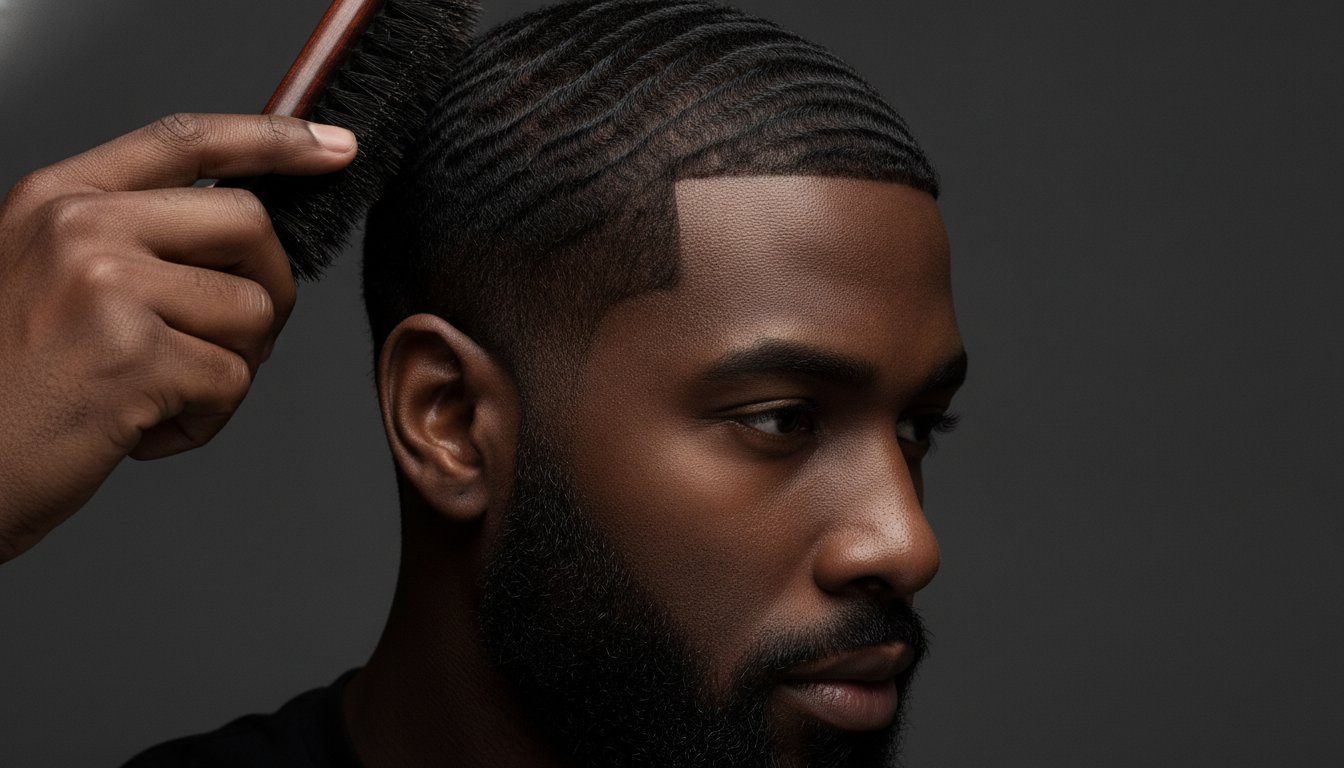
Why do some men settle for patchy ripples while others command attention with seamless, deep-sea textures that wrap perfectly from chin to sideburns? You have likely felt the frustration of seeing a wave pattern start on your chin only to disappear into a frizzy, disconnected mess on your cheeks. It is a common struggle, but the truth is that elite facial hair is not a result of luck. It is earned through a commitment to the craft and a deep understanding of your hair texture’s natural flow.
This 2026 professional guide will teach you exactly how to get 360 beard waves by mastering the precise brush angles and compression secrets that separate the beginners from the masters. We are moving beyond basic grooming into the realm of specialized wave-ology, where every stroke of your boar bristle brush serves a specific purpose. You will learn how to transform your facial hair into deep, connected ripples that reflect a lifestyle of personal discipline and pride.
We will break down the essential tools of the trade, from high-quality beard oils to the 7-Day Beard Wave Starter Routine™ Checklist. By the end of this guide, you will have a roadmap to achieve perfect connectivity and the specialized knowledge required to use beard wraps for maximum definition. Get ready to elevate your grooming routine into a powerful cultural statement.
Key Takeaways
- Learn to map your beard grain using the 4-Zone System to ensure your ripples flow naturally across your chin, cheeks, and jawline.
- Discover how to get 360 beard waves by utilizing a specific brush hierarchy, alternating between hard and soft boar bristles to train coarse hair fibers.
- Master the foundational training protocol by following the 7-Day Beard Wave Starter Routine™ Checklist to establish a disciplined daily grooming habit.
- Understand the critical role of specialized beard wraps in providing the compression needed to lock in your pattern and prevent frizz overnight.
- Implement the “Fresh Cut” strategy to maintain your length without sacrificing the connectivity and depth of your 360-degree ripples.
What Are 360 Beard Waves and Why Do They Require Mastery?
A 360 beard wave pattern is a continuous, ripple-like formation that flows seamlessly across the chin, cheeks, and jawline. This isn’t just about having a few scattered lines on your chin. It’s about achieving total connectivity. Most guys can get a ripple or two, but the 360 pattern requires intentionality at the “turn” points where the jaw meets the cheek. Understanding how to get 360 beard waves means recognizing that this is the peak of grooming discipline in 2026. It’s a cultural statement that says you value persistence over luck.
The foundation of this technique is adapted from the classic Waves (hairstyle), where the hair is trained to lay flat in a consistent direction. In the world of “wave-ology,” depth is earned through daily repetition. You must adopt the “Waver’s Mindset.” This means viewing your grooming routine as a ritual of self-improvement. If you skip a day, you lose progress. If you lack discipline, your waves will lack depth. Aesthetic results are the reward for your dedication to the craft.
The Anatomy of a 360 Pattern
To master the 360 look, you first need to identify the “crown” of your beard. For most, this is the chin or the soul patch area. This is the point from which all your waves will radiate. Your ripples must align perfectly as they travel from this center point toward your sideburns. If the angles are off even by a fraction, the pattern will look broken. You also need to maintain specific length. Unlike shorter styles, 360 waves require enough bulk to allow the hair to curl back into itself. Without sufficient length, you’ll never achieve the deep, 3D effect that defines an elite pattern.
360 Waves vs. Standard Beard Grooming
Standard grooming focuses on the external shape of the beard. You trim the stray hairs and call it a day. Wave-ology is different; it focuses on internal texture and fluid flow. You aren’t just combing to detangle. You are brushing to train the hair fibers to follow a specific path. Generic products often fail here because they don’t provide the specific hold required for 360-degree compression. Achieving this level of detail requires specialized tools like Beard Wraps and high-quality Beard Butters that soften the hair enough to be molded without losing structural integrity. Precision is the difference between a messy beard and a masterpiece.
The Science of Connectivity: Mapping Your Beard Grain
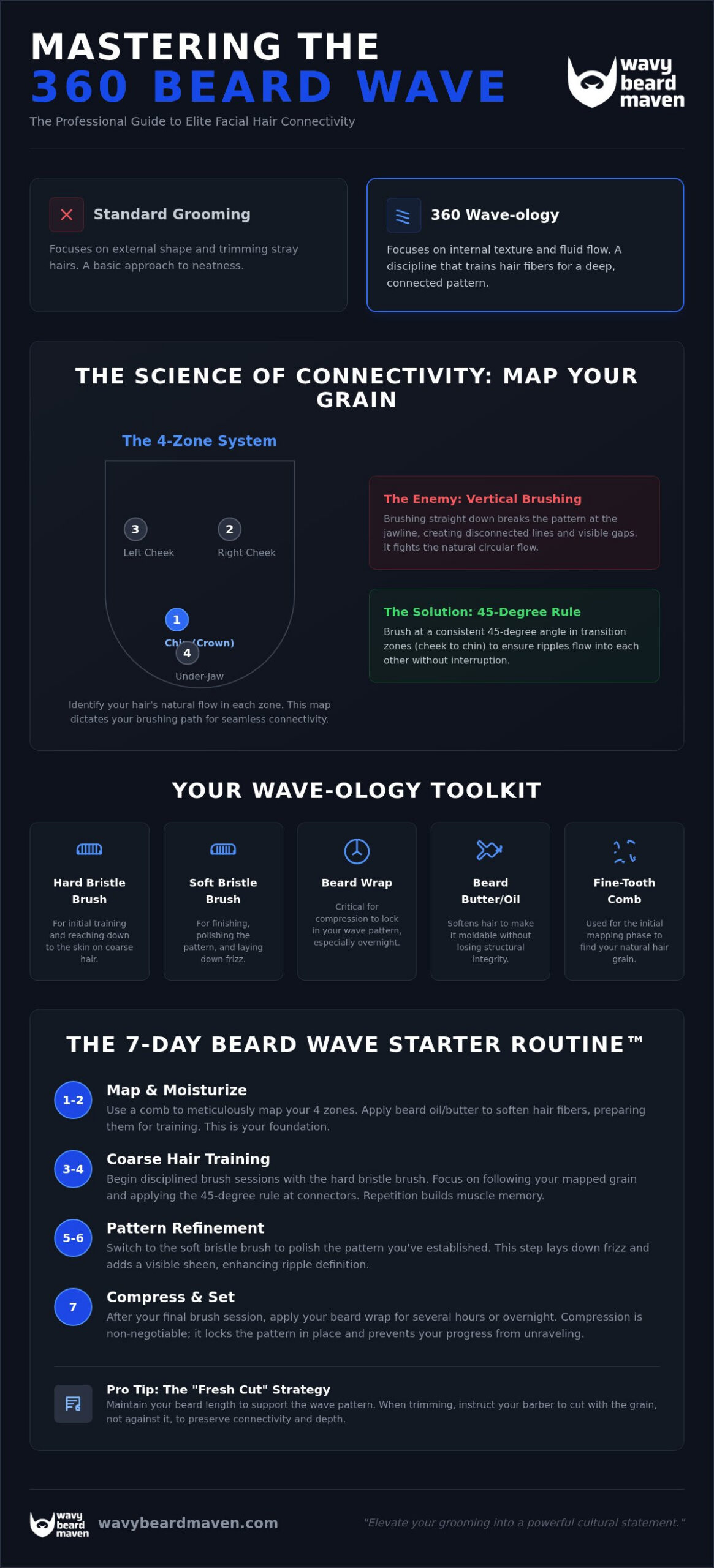
Mapping your beard grain is the non-negotiable foundation for every elite waver. You cannot guess where your hair flows; you must document it with surgical precision. We utilize a 4-Zone System to organize your training: the chin, the right cheek, the left cheek, and the under-jaw area. Connectivity is defined as the seamless transition of ripples between these facial zones. Without a clear map, your brush strokes are just random movements that lead to patches rather than patterns. Learning how to get 360 beard waves starts with this diagnostic phase.
Vertical brushing is the primary enemy of 360 connectivity. Brushing straight down might seem intuitive for standard grooming, but it actually fights the natural circular flow required for 360-degree ripples. It breaks the “turn” where your cheek meets your jaw, resulting in disconnected lines that never quite meet. This disruption creates visible gaps that ruin the fluid aesthetic of a master-level pattern. You must train your hand to follow the curve of your face rather than a straight vertical line.
Identifying Your Natural Flow
Grab a fine-tooth comb and stand in front of a high-quality mirror with good lighting. Gently comb your beard in different directions to see where the hair lays flat without resistance. You are looking for the “swirl” or the natural grain of each zone. Most men discover a downward slant on the cheeks and a horizontal flow across the jaw. This mapping phase is the critical first step in the 7-Day Beard Wave Starter Routine™. If you skip this, you are building your pattern on a broken foundation. You must understand that your hair’s growth direction dictates your brushing path.
The 45-Degree Rule for Connectors
Connectivity happens in the transition zones. To bridge the gap between your cheek and your chin, you must apply the 45-degree rule. Brushing at a consistent 45-degree angle allows the ripples from one zone to “flow” into the next without interruption. This technique prevents “forks,” which are inconsistent angles that break the ripple and ruin the 360 effect. By using specific Natural Beard Wave Methods, you work with your unique texture rather than against it. Precision in your angles ensures that your ripples remain deep and connected from every perspective. If you want to refine your technique further, you can master your mapping with our expert-led guidance. Every stroke counts toward the final masterpiece.
Essential Tools for 360 Wave Definition
Mastery requires more than just technique; it demands the right equipment. You cannot expect professional results from amateur tools. To truly understand how to get 360 beard waves, you must invest in a specialized kit designed for facial hair texture. Unlike scalp hair, beard hair is often coarser and grows in more unpredictable patterns. This means your tools must provide enough tension to move the roots while remaining gentle enough to prevent skin irritation. Using high-quality instruments is a sign of respect for the craft. A complete beard grooming kit for waves brings together the right brushes, butters, and compression tools in one disciplined system designed to maximize your pattern’s depth and connectivity.
The core of your arsenal is the Brush Hierarchy. You need both a hard and a soft boar bristle brush. Boar bristles are the gold standard because they mimic the natural structure of your hair, allowing for superior distribution of natural oils. These bristles don’t just sit on the surface; they penetrate the bulk to train the hair from the base. Additionally, you must use specific topical agents. Applying a high-quality beard oil for waves provides the necessary elasticity. Without this moisture base, your hair will be too brittle to bend into the deep, connected ripples you’re aiming for.
Hard vs. Soft Brushes: When to Use Each
A hard brush is your primary tool during the “wolfing” phase, which is when you grow your beard longer than usual to build depth. Its stiff bristles reach down to the skin, ensuring every fiber is being trained in the right direction. Conversely, a soft brush is for finishing. Use it at the end of your session to lay down the frizz and polish the top layer of the wave pattern. For a complete breakdown of which density suits your current growth stage, refer to our Soft vs Hard Brush for Beard Waves guide.
The Power of Compression
Brushing trains the hair, but compression locks it in place. A specialized Beard Wrap is far superior to a standard durag because it is contoured specifically for the face. It provides uniform pressure across the “turn” points we mapped in the previous section. This is a critical component of how to get 360 beard waves because it ensures your hard work doesn’t vanish while you move. The “Overnight Lock” is where the real progress happens. While you sleep, the wrap holds the hair in its trained position, preventing it from curling back into its natural state. Ensure your wrap is silk or satin-lined. These materials prevent moisture loss, keeping your hair flexible and your pattern crisp.
The 360 Training Protocol: Step-by-Step Execution
You have mapped your grain and secured your elite tools. Now, you must execute with surgical precision. The 360 training protocol is not a suggestion; it’s a systematic approach to curl manipulation that requires daily dedication. If you want to know how to get 360 beard waves with professional precision, you must treat every brush stroke as a calculated move toward total connectivity. This four-step process ensures your hair remains flexible, trained, and locked into a ripple formation.
- Step 1: The Foundation Wash. Begin with a sulfate-free wash. Standard soaps strip the natural oils that give your hair its elasticity. A specialized wash softens the hair fibers, making them receptive to training without causing breakage.
- Step 2: The Moisture Base. Apply your Beard Butter or Beard Oil while the hair is slightly damp. This creates “flexible” fibers that bend into waves rather than snapping. Moisture is the lubricant for the training process.
- Step 3: The 30-Minute Brush Session. This is the core of your discipline. Set a timer. You must spend equal time on all four zones identified in your grain map. Use consistent pressure and maintain your specific angles throughout the entire session.
- Step 4: The Compression Seal. Immediately after brushing, apply your Beard Wrap. This “freezes” the hair in its trained state. To ensure your waves stay locked in, grab our specialized Beard Wrap designed for maximum facial contouring.
The Brushing Angles for 360 Success
Precision is everything during your session. For the chin, brush straight down from the lip to the base of the neck. On your cheeks, move the brush at a slight downward angle toward the corners of your mouth to bridge the gap with the chin. For the neck area, brush forward from the ears toward the chin. This creates the “wrap-around” effect that defines the 360 look. Consistency in these angles prevents the formation of “forks” that disrupt the fluid flow of your ripples.
The Wolfing Phase: Building Depth
Wolfing is the intentional process of growing your beard longer than your usual style to train deeper waves. By adding bulk, you allow the hair to complete more “rotations,” which translates to more visible ripples. Managing the “scruffy” look during this phase is the ultimate test of discipline. You must increase your compression tension and brush time to keep the extra length laid down. Periodically perform a “wash and style” session to reveal your progress and check for any hidden connectivity issues. This phase is where true masters are made.
Maintaining Your 360 Pattern: Discipline and Community
Mastering how to get 360 beard waves is only half the battle. The true test of a waver is the ability to sustain that pattern over months and years. Success isn’t a destination; it’s a state of maintenance. Consistency always beats intensity in the world of wave-ology. Spending 15 minutes on your brush routine every single day is infinitely more effective than a two-hour marathon once a week. Your hair has a memory, and that memory is reinforced through daily repetition. If you slack, your curls will revert to their natural, chaotic state, and you’ll lose the deep connectivity you worked so hard to establish.
The “Fresh Cut” strategy is another essential component of maintenance. When you head to the barber in 2026, you must be specific. A barber who doesn’t understand waves can easily cut out your pattern by going too short or against the grain. Always ask for a “with the grain” cut and keep enough bulk to maintain the ripple. If you encounter “forks,” which are those annoying breaks in your ripple lines, return to your mapping. Forks are usually caused by inconsistent brushing angles. Focus your sessions on the specific area where the break occurs, using precise 45-degree strokes to reconnect the flow.
Daily Maintenance Rituals
Your morning starts with a refresh. Use a soft brush and a light application of oil to wake up the pattern and lay down any bedhead frizz. Protection is also vital. Environmental factors like high wind or extreme dryness can sap the moisture from your beard, making the hair brittle and prone to losing its shape. We recommend taking weekly side-profile photos. These images allow you to track your progress with a level of detail the mirror often misses, helping you spot emerging connections or areas that need more attention.
Leveling Up Your Routine
Once you’ve graduated from the 7-Day Beard Wave Starter Routine™, it’s time to enter advanced wolfing cycles. This is where you push your beard length to its limits to maximize ripple depth. You’ll need to incorporate more specialized beard brushes for waves to handle the increased density. This lifestyle is about more than just aesthetics. The discipline you apply to your grooming translates into every other area of your life. You are part of the Wavy Beard Maven movement, a community that views self-respect and precision as the ultimate goals for the modern man.
Command Your Pattern and Join the Movement
You now possess the technical blueprint required to transform your facial hair into a masterpiece of fluid motion. Precision mapping of the 4-Zone System and the disciplined use of specialized compression gear are the non-negotiable keys to total connectivity. By following a structured training protocol, you’ve moved beyond basic grooming into the elite practice of wave-ology. Mastering how to get 360 beard waves is a journey that rewards your daily patience with deep, connected ripples that command respect.
Don’t leave your results to chance. It’s time to solidify your routine and join a collective of men dedicated to the craft of self-improvement. Our community provides expert-led tutorials for all hair textures and specialized gear designed specifically for beard wave compression. Your dedication defines your results, and we’re here to support every brush stroke. Take the first step toward elite definition today.
Download the Free 7-Day Beard Wave Starter Routine™ Checklist and join thousands of men in the Wavy Beard movement. You’ve earned the knowledge; now it’s time to earn the waves. Keep your brush moving and your pattern locked.
Frequently Asked Questions
How long does it take to see 360 beard waves?
Expect to see the first signs of ripples within 4 to 6 weeks of consistent daily training. Achieving a full, connected pattern often takes 3 months of dedicated brushing and compression. This timeline depends on your unique hair growth rate and how strictly you follow your routine. Learning how to get 360 beard waves is a marathon. Results are earned through persistence and repetition. Stay disciplined to see your texture transform into deep ripples.
Can I get 360 waves with a short beard?
You cannot achieve deep 360 waves with a very short beard. The hair must be long enough to complete at least one full curl rotation to create a visible ripple effect. Most wavers find that a 1.5 or 2 guard length is the ideal starting point for training. Without enough bulk, the hair won’t have the structural integrity to bend into the wave pattern. Patience during the initial growth phase is essential for long-term success.
Do I need a special brush to get 360 waves?
Yes, a specialized boar bristle Beard Brush is required for professional results. Standard plastic combs or synthetic brushes lack the tension needed to train coarse facial hair from the root. Boar bristles are superior because they distribute natural oils and provide the specific grip necessary to mold your pattern. You should utilize both hard and soft bristles to handle different growth stages. Investing in high-quality tools is a non-negotiable step for any serious waver.
Why do my beard waves keep disappearing after I wash my face?
Your waves disappear because the hair hasn’t yet developed enough memory to hold its shape against water. When you wash your face, the hair fibers expand and return to their natural state. To prevent this, always apply a Beard Butter or oil after washing and immediately follow up with a Beard Wrap. Over time, consistent training will make the pattern more resilient. Until then, don’t let your beard air dry without a wrap.
How do I make my cheek waves connect to my chin waves?
Connectivity is achieved by mastering specific brushing angles at the transition points of your face. You must brush at a 45-degree angle where the cheek meets the jawline to bridge the gap between zones. Using a mirror to track your grain ensures that your strokes are consistent across the turn points. If your angles are off, the ripples will look broken. Focus on the flow from your chin outward to ensure a seamless wrap.
Is it possible to get waves in a coarse, coily beard?
Yes, coarse and coily hair textures are actually the best candidates for deep, defined ripples. The natural curl pattern of coily hair allows it to form tight, structured waves more easily than straight hair. You’ll need a hard boar bristle brush to penetrate the density of your beard and move the roots. With the right moisture base and consistent compression, coily hair can produce the most impressive results when learning how to get 360 beard waves.
Should I brush my beard wet or dry for waves?
You should always brush your beard when it is slightly damp and moisturized. Brushing a bone-dry beard causes friction and breakage, which ruins your pattern and damages the hair. Dampening the hair with warm water or a quality Beard Oil makes the fibers more flexible and receptive to training. This elasticity allows the hair to bend into ripples without snapping. Always follow your damp brush session with a Beard Wrap to lock in the progress.
How often should I ‘wolf’ my beard for 360 definition?
You should aim for wolfing cycles that last between 4 and 8 weeks. Wolfing is the practice of growing your hair longer than usual to build maximum depth and connectivity. During this time, you must increase your brushing intensity and compression to keep the added bulk laid down. Once your waves are deep and connected, you can get a trim with the grain to reveal the progress. Repeat this cycle to continuously level up your pattern.