September 18, 2026
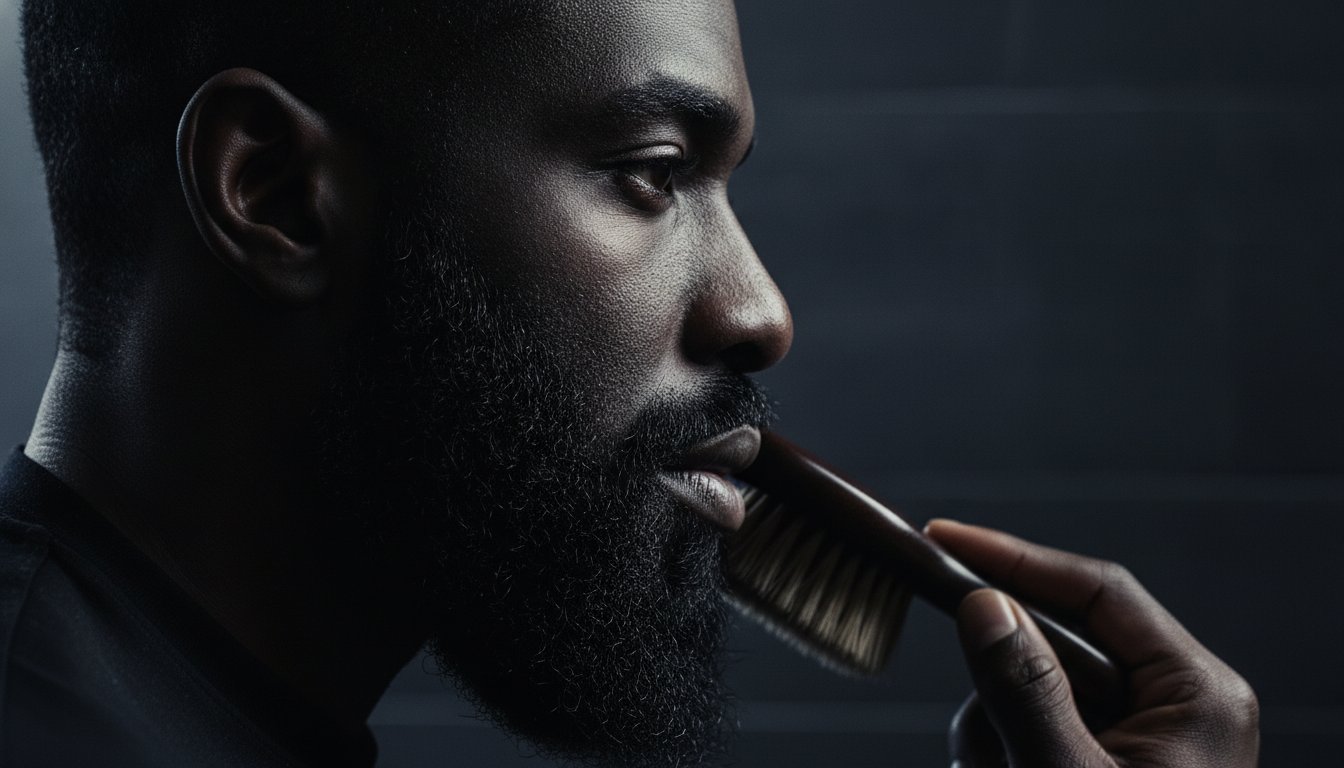
Your coarse beard isn’t unruly by accident; it’s a structural powerhouse designed to resist everything but the most disciplined routine. It’s frustrating when you apply heavy products only to have your facial hair flare out like a wire brush ten minutes later. You’ve likely felt the “stabby” sensation of fibers that refuse to yield, making your grooming feel like a losing battle rather than a point of pride. We understand that elite aesthetic results are earned through persistence. Your hair’s unique geometry, which is often twice as thick as scalp hair, requires a specialized strategy rather than luck.
This guide teaches you exactly how to make coarse beard hair lay down by mastering a precise sequence of deep hydration, directional brushing, and consistent compression. You’ll learn why 100% first-cut boar bristles are non-negotiable for penetrating those twelve cuticle layers and how silk wraps transform your profile overnight. We’re moving past basic maintenance into a movement of grooming mastery. We will explore the thermal science of hydrogen bond locking and the exact product layering protocol needed to force even the most stubborn, spring-loaded hair into a disciplined, flat profile that commands respect.
Key Takeaways
- Understand the unique protein structure and elliptical geometry of coarse hair that creates the “memory” causing it to flare outward.
- Apply the “Warm Water” rule to open cuticles, ensuring deep hydration is the foundation for all your training efforts.
- Master the specific mechanical brushing techniques for how to make coarse beard hair lay down by training follicles to follow a new downward direction.
- Utilize compression wraps as your secret weapon to physically force hair to set in a flat, disciplined profile while you sleep.
- Establish a consistent daily discipline routine that maintains hair texture and moves you closer to achieving deep wave definition.
Understanding Why Coarse Beard Hair Refuses to Lay Down
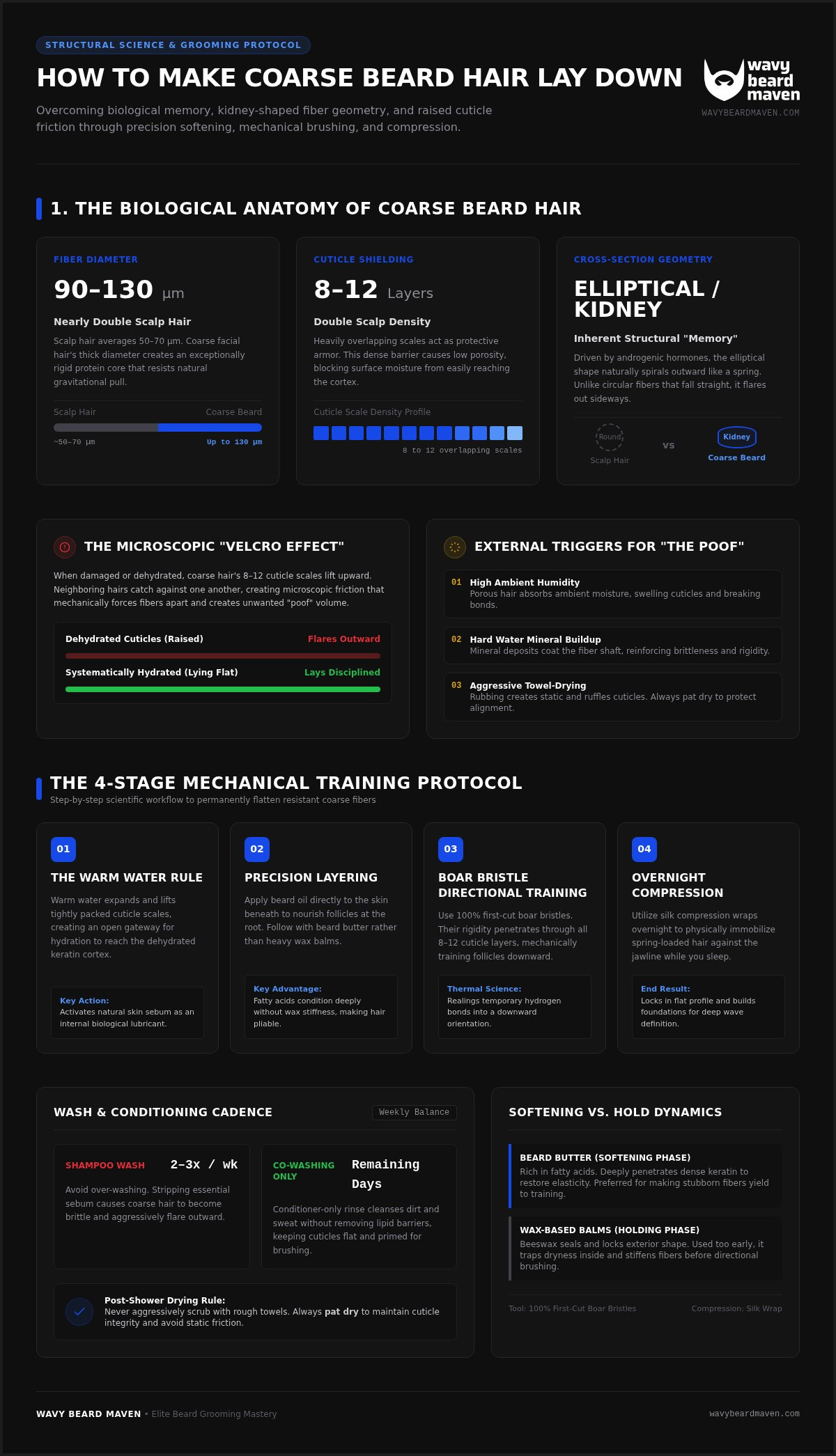
Coarse hair is a structural beast. It features a significantly larger diameter than scalp hair, often measuring between 90 and 130 micrometers, which is nearly double the caliber of the hair on your head. This thickness comes from a rigid protein structure that creates a natural “memory” within the fiber. Unlike fine hair that yields to gravity, coarse hair is often kidney-shaped or elliptical in cross-section. This geometry causes it to spiral and flare outward rather than falling flat. The biological development of beard hair is driven by androgenic hormones, resulting in a fiber that is inherently stiffer and more resilient. Simply applying a bit of oil won’t change this fundamental architecture. You aren’t just fighting dryness; you’re battling a structural preference for rebellion.
The cuticle is the hair’s outer armor. In coarse beards, this armor consists of 8 to 12 overlapping scales, which is nearly double the density found in scalp hair. When these scales are raised due to damage or lack of moisture, they create microscopic friction against neighboring hairs. This friction acts like Velcro, pushing hairs away from each other and creating unwanted volume. Standard softening products often sit on top of these scales without penetrating the core. To learn how to make coarse beard hair lay down, you must understand that surface-level greasiness is not the same as internal pliability. Mastery over your profile requires forcing these scales to lie flat through systematic hydration and pressure.
The Science of Hair Porosity and Texture
Hair porosity is the hair’s ability to absorb and retain moisture. Most coarse beards suffer from low porosity, meaning the cuticle scales are tightly packed and resistant to water. This prevents hydrating agents from reaching the cortex. When your hair feels “stiff,” it’s a sign of dehydration and lost elasticity. Brittle keratin stays locked in a flared position. You cannot train a fiber that lacks flexibility.
Environmental Factors That Trigger ‘The Poof’
Your surroundings often sabotage your grooming efforts. Humidity is a major culprit; high moisture levels cause the cuticle to swell and lift. Hard water mineral buildup also reinforces hair rigidity. Understanding these triggers is essential when figuring out how to make coarse beard hair lay down. Even your post-shower routine matters. Aggressive towel-drying creates static and ruffles the cuticles, ruining your progress. Stop rubbing your face with rough towels. Pat it dry to keep the cuticles flat. Consistency in these small details determines your profile’s discipline.
The Softening Phase: Prepping Coarse Hair for Discipline
Discipline begins with pliability. You cannot force a dry, brittle beard into submission. Hydration is the absolute foundation of the lay. If you want to know how to make coarse beard hair lay down, you must first master the softening phase. Start with the ‘Warm Water’ rule. Warmth expands the cuticle scales, creating a gateway for moisture and nutrients to penetrate the dense keratin core. This process is vital because it restores elasticity to the fiber. Your skin’s natural sebum oil is your best ally here. It acts as a biological lubricant that prevents the “stabby” sensation common in unmanaged beards.
Many beginners reach for heavy wax-based balms too early. While balms provide hold, beard butter is superior for the initial softening of coarse textures. Butter offers a higher concentration of fatty acids that deeply condition the hair shaft without the stiffness of beeswax. This makes the hair more responsive to mechanical training later in the routine. When the hair is soft, it yields to the brush rather than snapping back into its original flared position.
Mastering the Beard Wash and Condition Cycle
Over-washing is a common mistake that strips away essential oils. Limit your shampooing to 2-3 times per week. On other days, utilize the ‘Co-washing’ technique. This involves using only conditioner to rinse and refresh your beard. It maintains moisture levels while removing environmental debris. Mastering this balance is the first step in how to soften your beard for maximum wave definition. Consistent conditioning ensures the cuticle remains flat and smooth.
The Power of High-Quality Beard Oils and Butters
Precision application is key to root-to-tip health. Apply your beard oil to the skin beneath the hair first. This ensures the follicle is nourished at the source. Following the clinical advice in the American Academy of Dermatology’s beard care guide prevents irritation and folliculitis during this phase. Use the ‘L.O.C.’ method to lock in results. This sequence-Liquid (dampness), Oil, and Cream (butter)-creates a moisture seal that lasts all day. Wavy Beard Maven butters are specifically formulated for deep overnight conditioning, ensuring you wake up with hair that is ready to be trained. If you’re serious about results, consider starting with our beard wave starter routine to build your foundation.
Brushing Techniques to Train Stubborn Follicles
Brushing is the engine of the lay. It is a mechanical training process that goes far beyond simple detangling. By applying consistent pressure, you are essentially developing muscle memory for your facial hair. Over time, this repetitive action encourages the follicle to shift its growth direction. If you want to master how to make coarse beard hair lay down, you must treat your brush session as a non-negotiable discipline. For elite results, commit to a 15-minute daily session. This isn’t a quick pass in the mirror. It’s a focused, systematic routine that forces stubborn fibers into a unified, flat pattern.
Always brush while the hair is damp and saturated with product. Dry brushing coarse hair is a recipe for breakage and frizz. When your beard is hydrated, the keratin is flexible, allowing the bristles to guide the hair without resistance. This aligns with the American Academy of Dermatology’s beard care guidelines, which emphasize using tools to manage unruly growth while protecting the underlying skin. By brushing during the L.O.C. process mentioned previously, you lock the hair into its new orientation while the fibers are at their most pliable.
Selecting Your Weapon: Boar Bristle vs. Synthetic
Success depends on your tools. Synthetic bristles often slide over the surface of coarse hair, failing to reach the skin. You require medium-hard boar bristles to penetrate the dense layers of a thick beard. These bristles are stiff enough to move natural sebum from the roots to the tips, yet flexible enough not to damage the cuticle. Use a stiff brush for your primary training and a soft brush for the final finishing touches. For a deeper breakdown of tool selection, check out our Beard Brush for Waves: 2026 Brushing Mastery Guide.
The Strategic Brushing Angle for Maximum Lay
Your angle of attack determines your profile’s success. Use the “Down and Out” method. Start at the ears and brush in a smooth, continuous motion toward the chin. This follows the natural flow of the jawline and encourages the hair to lie flat against the face. If you encounter cowlicks or swirls, increase the frequency of strokes in those specific areas to override the natural growth pattern. Never brush upward. Brushing against the grain ruins your progress and forces the cuticle scales to stand up, creating the very “poof” we are trying to eliminate. This is the secret to how to make coarse beard hair lay down permanently.
The Secret of Compression: Using Wraps to Force Hair Flat
Compression is the secret weapon that separates casual groomers from true Mavens. While products provide the softness and brushes provide the direction, compression provides the permanent set. This is the final, essential step in learning how to make coarse beard hair lay down. It operates on the “Wet Set” principle. When you compress hair that is still slightly damp and saturated with high-quality beard butters, you are physically forcing the keratin to dry in a specific orientation. Once the hair dries under this pressure, it stays flat. Without this stage, even the most expensive oils won’t stop your beard from flaring out as the day progresses.
Nighttime represents the most critical window for your discipline. During sleep, your beard is prone to friction against pillows, which ruffles the cuticle and destroys your brush work. A wrap serves as a protective shield. It maintains the integrity of your pattern for six to eight hours of continuous training. If you aren’t wrapping, you’re losing hours of potential progress every single night. Consistency here is what creates a profile that remains sleek and disciplined from the moment you wake up. You’ve done the hard work of softening and brushing; don’t let it go to waste by leaving your beard exposed while you sleep.
Why Compression is Non-Negotiable for Coarse Hair
Coarse hair has a natural tendency to “poof” due to its thick diameter and rigid structure. Compression locks in the moisture you’ve applied, preventing evaporation and keeping the hair flexible throughout the night. Your body heat plays a vital role here too. The wrap traps natural warmth against the face, which gently softens the hair’s protein bonds. This makes the hair more receptive to the downward shape you’ve established. For a comprehensive breakdown of the best materials and techniques, explore our Beard Durag for Waves: 2026 Ultimate Compression Guide.
How to Properly Apply a Beard Wrap
Application requires a steady hand and a methodical approach. Start by ensuring your beard is brushed exactly how you want it to sit. Place your wrap over the chin, pulling it upward toward the ears to secure the cheeks. You must tie it firmly enough to apply pressure but loosely enough to avoid “beard dents” or skin irritation. If you want elite results, try the “Plastic Bag” method. Placing a thin layer of plastic under your wrap traps maximum heat and moisture, resulting in a superior lay and intense shine. Keep the wrap on for a 30-minute minimum if you’re in a rush, but overnight is the gold standard for mastery. Ready to elevate your game? Grab your professional beard wrap today and start training your beard the right way.
Maintaining the Lay: A Daily Discipline Routine
Mastery over your beard profile isn’t a one-time event; it’s a lifestyle of consistent maintenance. While the initial results of a single compression session are impressive, the long-term transformation of your hair’s texture requires a relentless commitment to the 24-hour cycle. Coarse hair has a long memory. If you miss even a single night of wrapping, those stubborn follicles will attempt to revert to their original, flared state. Experience shows that 21 days is the tipping point for coarse hair behavior. This is the period required for the hair’s protein bonds to truly accept their new downward orientation. Once you cross this threshold, you’ll find that figuring out how to make coarse beard hair lay down becomes an effortless part of your identity.
The “Cold Water Rinse” is a specialized secret for sealing your progress. After you’ve spent the night under compression, your cuticles are flat and disciplined. A quick splash of cold water in the morning acts as a thermal seal, locking those cuticle scales into place without the need for heavy heat. It provides a crisp, finished look that resists the humidity and environmental friction you’ll face throughout the day. This simple step ensures that the work you did overnight translates into a sleek, professional profile that lasts until sunset.
The 24-Hour Maintenance Cycle
Precision requires a schedule. Your routine should follow a logical progression to ensure you never lose ground:
- Morning: Carefully remove your wrap. Apply a few drops of beard oil to restore shine and follow with a light “touch-up” brush to align any stray fibers.
- Mid-day: Use a pocket comb for minor adjustments. Avoid aggressive brushing during this time, as you don’t want to disturb the pattern you’ve set.
- Evening: This is where the heavy lifting happens. Perform a deep 15-minute brush session with your boar bristle brush, apply your butter, and secure your wrap for the night.
Troubleshooting Pop-Ups and Flyaways
Even with the best routine, you might encounter “rogue” hairs that refuse to submit. Use the spot-treatment method by applying a small amount of high-hold balm directly to the problem area and using your thumb to press it flat for 30 seconds. This localized compression often forces the hair back into the pattern. For days when you need extra security against the elements, a professional-grade styler is essential. You can find the right tools for this in our Best Beard Balm for Hold & Styling: 2026 Wave Guide. Remember, every flyaway is just a training opportunity. Stay disciplined, trust the process, and your beard will eventually follow your lead.
Commit to the Discipline of the Lay
Mastering a coarse beard is a journey that demands persistence and the right tools. You’ve learned that aesthetic results aren’t about luck; they’re earned through a systematic approach to hydration, mechanical training, and overnight compression. By understanding the structural biology of your hair and applying the “Warm Water” rule, you’ve set the foundation for a profile that finally submits to your will. Brushing and wrapping aren’t just chores. They are cultural practices that foster pride and a collective identity among those who value precision.
This guide has given you the blueprint for how to make coarse beard hair lay down by mastering the 24-hour maintenance cycle. Now, it’s time to put that knowledge into action. Join a community of thousands of disciplined wavers who have mastered techniques for all hair textures using specialized products designed for compression and hold. The path to a sleek, flat profile is clear. Download the 7-Day Beard Wave Starter Routine™ Checklist to start your journey toward a disciplined, wavy beard. Your best beard is waiting for you to take the first step toward mastery.
Frequently Asked Questions
How long does it take for coarse beard hair to finally lay down?
Understanding how to make coarse beard hair lay down is a process that typically takes 21 days of consistent discipline. This timeframe allows the hair’s protein bonds to reform under the pressure of daily brushing and compression. While you’ll see immediate temporary results after your first session, permanent texture training is a marathon. Stay dedicated to the 24-hour maintenance cycle to ensure the follicles don’t revert to their original flared state.
Can I make my beard lay flat without using a durag or beard wrap?
Achieving a truly flat profile without a beard wrap is nearly impossible for coarse textures. While oils and balms provide some weight, they lack the mechanical force needed to override the hair’s natural memory. Compression acts as a physical mold that sets the hair while it dries. Without this essential tool, your beard will likely poof back out as soon as the styling products settle or you move throughout the day.
Does heat styling like a blow dryer help or hurt coarse beard hair?
Heat styling is a powerful tool when used with caution. Using a blow dryer on a medium setting helps soften the keratin bonds, making the hair more pliable for the lay. Always finish with a cold shot blast to lock the cuticles in their flattened position. However, excessive heat above 385°F can cause irreversible damage. Use heat to assist the training process, but never as a replacement for the hydration and compression steps.
Why does my beard hair stick out more after I wash it?
Your beard sticks out more after washing because the cleansing process strips away natural sebum and raises the hair’s cuticle scales. When these scales are lifted, they create friction against neighboring fibers, leading to increased volume and poof. This is why the softening phase is so critical. You must immediately follow your wash with a high-quality oil or butter to flatten those scales and restore the moisture necessary for a disciplined profile.
Is it possible to change the direction my beard hair grows?
You can’t change the biological direction of the follicle root, but you can certainly train the hair shaft to follow a specific path. Consistent brushing and compression create muscle memory in the fibers. By repeatedly forcing the hair into a downward orientation, you override the natural tendency to flare. This is how to make coarse beard hair lay down over time. It requires a relentless daily routine to maintain this new, disciplined direction.
What is the best brush for a thick, coarse beard?
The best tool for a thick, coarse beard is a 100% first-cut boar bristle brush. Unlike synthetic options, these natural bristles are stiff enough to penetrate through dense layers to the skin. They effectively distribute natural oils from root to tip while providing the mechanical force needed for training. Use a medium-hard brush for your primary sessions and keep a softer brush for finishing touches to ensure every fiber remains flat and unified.
How often should I apply beard butter to see results?
Apply beard butter at least once daily, preferably during your evening routine before you put on your wrap. Butter provides the deep conditioning and fatty acids required to keep coarse hair pliable. It acts as the primary softening agent that prepares the hair for compression. For beards that are exceptionally dry or stubborn, a light application in the morning can provide extra protection against environmental factors that trigger unwanted volume and frizz.
Will trimming my beard help it lay down flatter?
Trimming helps by removing split ends and excessive bulk that can cause the beard to look messy. Removing dead weight makes the remaining hair more responsive to your training tools. However, trimming alone won’t solve the problem of coarse hair sticking out. You must still master the sequence of hydration and compression. Use a light trim to maintain a clean silhouette while you focus on the mechanical training required for a permanent lay.