September 23, 2026
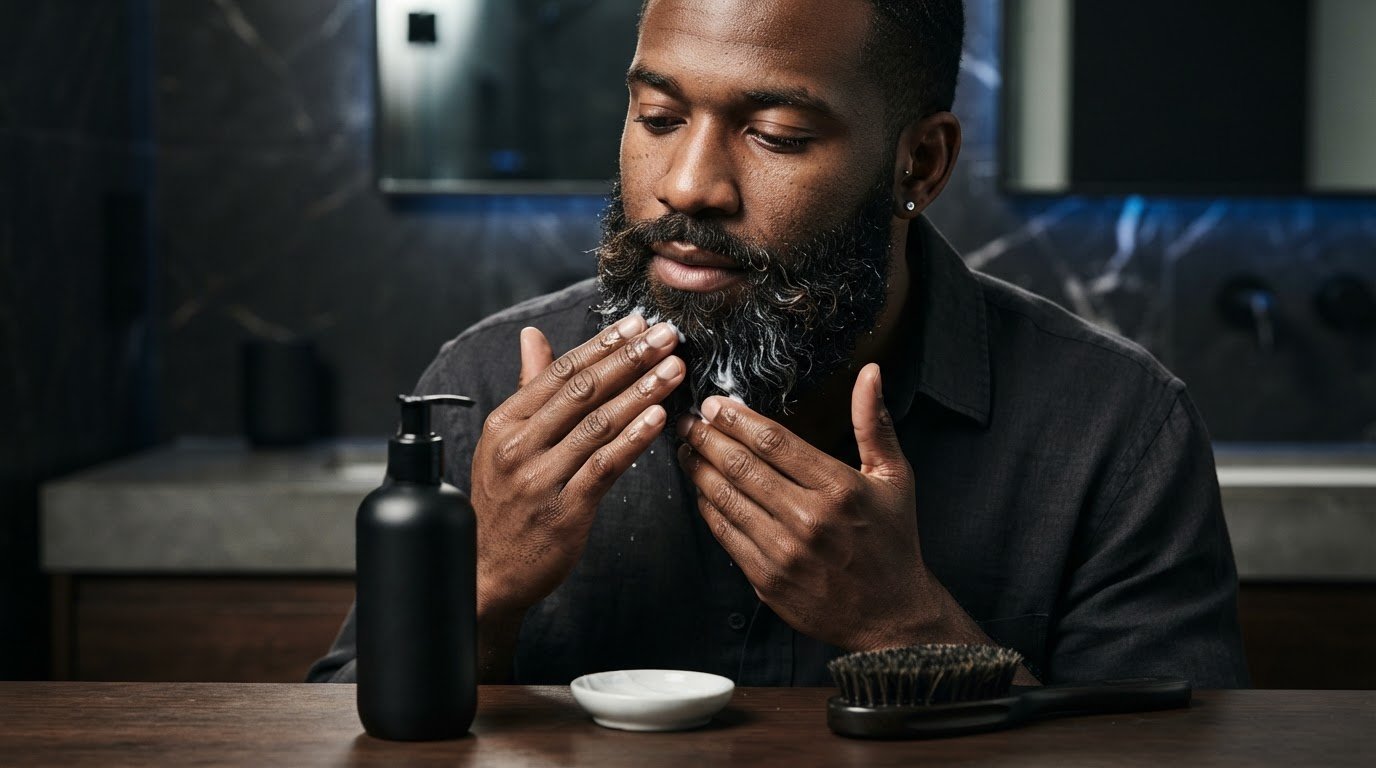
Applying daily beard oil to dry facial hair doesn’t moisturize it; it simply locks the dryness in. If you’re frustrated by a stiff, brittle beard that fights your brush and refuses to lay flat despite constant oiling, you’re not alone. Coarse facial hair has a porous structure that sheds water fast, and quick rinse-out washes don’t provide lasting hydration. That’s why integrating a specialized leave-in conditioner for beards is the critical first step to reviving parched whiskers.
True beard hydration requires water-based penetration sealed with nutrient-dense butters and oils. By mastering the mechanics of leave-in conditioning, you’ll conquer chronic brittleness, optimize hair elasticity, and establish a disciplined moisture-layering routine tailored to your specific curl pattern. We’ll break down the exact science of hydration versus sealing, show you how to choose the right formula for your porosity, and lay out the daily steps to achieve a softer, fully cooperative beard.
Key Takeaways
- Differentiate true hydration from sealing to understand why water-based moisture must penetrate coarse whiskers before any oil or butter is applied.
- Discover why an unrinsed leave-in conditioner for beards serves as the indispensable hydrating foundation beneath your beard oils and beard balms.
- Identify elite humectants like aloe vera and vegetable glycerin while cutting out heavy silicones and drying alcohols that cause product buildup.
- Master a disciplined four-step moisture-layering method to distribute hydration evenly from follicle to tip on damp facial hair.
- Learn how optimized strand elasticity enhances wave formation when paired with dedicated beard brush sessions and nighttime compression wraps.
What Is a Leave-In Conditioner for Beards and How Does It Work?
A leave-in conditioner for beards is an unrinsed, water-based emulsion formulated to deliver steady, sustained hydration directly to facial hair fibers throughout the day. Unlike standard rinse-out formulations, it stays on the whiskers, slowly releasing moisture instead of washing down the drain. While general hair conditioner was engineered historically to smooth the scalp’s delicate cuticle layers, facial hair requires a far more aggressive, persistent approach. Facial whiskers possess dense, overlapping cuticles that resist basic superficial treatments, making rinse-out products evaporate quickly and leaving coarse strands vulnerable to rapid dehydration within hours.
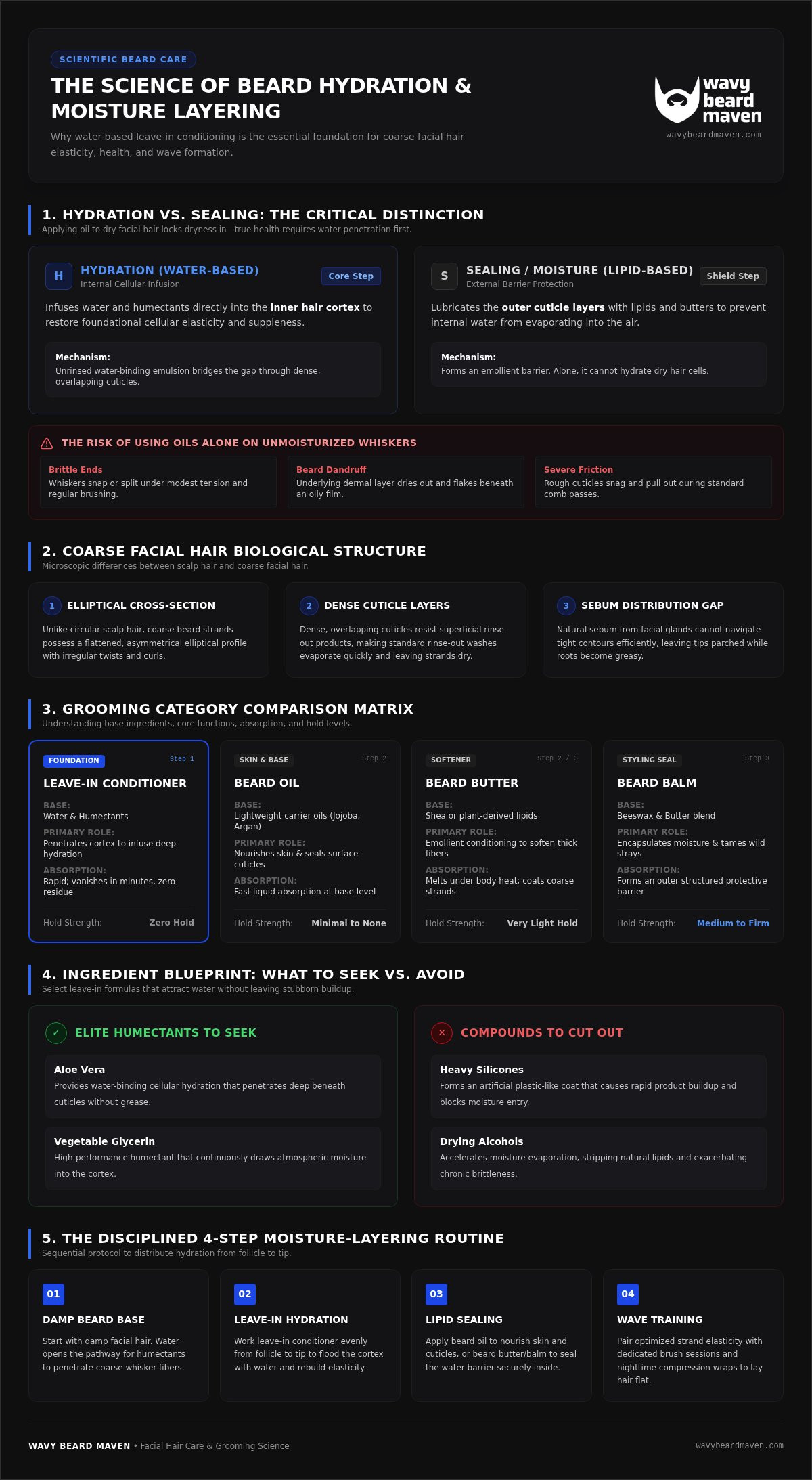
True hair health relies on an ironclad biological principle: water hydrates hair cells, while lipid compounds seal cuticles. Applying oils or heavy waxes to an unmoisturized beard simply traps dry air beneath an impenetrable barrier. A dedicated leave-in emulsion acts as that missing water-binding bridge.
Hydration vs. Moisture: The Critical Grooming Distinction
Most grooming guides treat “hydrating” and “moisturizing” as identical actions. They aren’t. Hydration refers strictly to infusing water into the inner hair cortex to rebuild core elasticity. Moisture, conversely, refers to lubricating outer cuticle layers with lipids to prevent that internal water from evaporating.
When you use traditional oils alone, you coat the exterior without quenching the interior. Chronic dehydration inevitably follows, showing up as:
- Brittle ends that split or snap under modest tension
- Beard dandruff (beard dry skin) caused by the underlying dermal layer drying out
- Severe friction that pulls hair out during basic comb passes
How Coarse Facial Hair Structure Demands Constant Conditioning
Facial hair differs fundamentally from the hair on your head. Under a microscope, coarse, curly beard strands feature a flattened, asymmetrical elliptical cross-section rather than a smooth, circular shape. Every twist, bend, and curl along this irregular shaft creates a structural hurdle.
Natural sebum produced by facial sebaceous glands cannot travel efficiently down these tight contours. The tips remain parched while roots become greasy. By utilizing a water-rich leave-in conditioner for beards, you flood these jagged bends with lightweight moisture, restoring cellular suppleness to wiry whiskers so they bend easily instead of snapping under pressure.
Leave-In Conditioner vs. Beard Oil, Butter, and Balm: The Comparison
Every grooming topical serves a distinct biochemical purpose. Confusing their roles leads directly to buildup, flaking, and wasted product. A specialized leave-in conditioner for beards acts as the internal hydrator, delivering water and humectants directly into parched hair shafts. Following established dermatologist-recommended tips for maintaining facial hair health means treating the skin and follicle structure as an integrated system, where each product builds upon the last.
Here is how the four essential categories compare across base ingredients, primary function, and hold:
- Leave-In Conditioner: Water and humectant base. Penetrates the cortex to infuse deep hydration. Zero styling hold.
- Beard Oil: Lightweight carrier oils (such as jojoba and argan). Nourishes underlying facial skin and seals surface cuticles. Minimal to no hold.
- Beard Butter: Shea or plant-derived lipid base. Delivers deep emollient conditioning to soften thick hair fibers. Very light hold.
- Beard Balm: Beeswax and butter blend. Encapsulates moisture while locking wild strays into place. Medium to firm hold.
Evaluating Texture, Absorption Rates, and Daily Functions
Leave-in conditioners absorb rapidly because of their lightweight, water-soluble viscosity. They vanish into the cortex within minutes, leaving zero oily residue. Liquid beard oils work at the base level, lubricating the skin and initial millimeters of growth to stop itching.
Nutrient-dense beard butters sit between lotions and balms. Their dense lipid structure melts under body heat, coating coarse strands to preserve all-day softness without stiffness.
Layering Dynamics: Choosing Between Balms, Butters, and Lotions
Stacking heavy waxes over dry whiskers is a recipe for product buildup. Beeswax seals whatever state the hair is in; coat a parched beard in wax, and you lock the brittleness inside. Always start with a hydrating leave-in conditioner for beards on damp hair, allow it to absorb, and then seal the cuticle.
When high wind or unruly growth demands disciplined structural control, layer the best beard balm for hold and styling over your hydrated foundation. If you want a structured blueprint that aligns every step of this process, check out Wavy Beard Maven for dedicated tools and routines built for coarse facial hair.
Key Ingredients to Seek (and Avoid) in Beard Leave-Ins
Your beard’s porosity dictates how it receives and retains hydration. Coarse facial hair typically features low to medium porosity at the dense base and high porosity at weathered tips. Picking the right leave-in conditioner for beards requires analyzing the ingredient deck to ensure it actually penetrates the cortex instead of merely glazing over damaged cuticles. Understanding the baseline difference between beard oil and balm helps clarify product weights, but evaluating raw emulsions requires an eagle eye for botanical hydrators over synthetic fillers.
Essential Hydrators and Penetrating Plant Actives
Premium formulas prioritize small-molecule humectants and fatty alcohols that slip past the cuticle scale. Look for these proven performance agents on the label:
- Vegetable Glycerin: A potent humectant that captures ambient air moisture and binds it deep inside the strand.
- Aloe Vera Juice: Replaces plain water as an active base, calming sensitive facial skin while normalizing pH balance.
- Panthenol (Pro-Vitamin B5): Infuses into the cortex, expanding hair diameter to improve tensile strength.
- Cetearyl Alcohol: A beneficial fatty alcohol (not a drying agent) that flattens lifted cuticle scales to soften wire-like prickliness.
- Hydrolyzed Wheat or Silk Protein: Microscopic protein fragments that patch structural fractures along high-porosity curl bends.
Harmful Additives That Sabotage Coarse Hair Health
Cheap formulations rely on heavy synthetic coaters to fake initial softness. The worst culprit is dimethicone, a non-water-soluble silicone. While it provides an instant slippery feel, it creates an impenetrable barrier that repels natural moisture, turning coarse hair increasingly brittle over weeks of use.
Short-chain drying alcohols are equally destructive. Ingredients like denatured alcohol (alcohol denat), SD alcohol 40, and isopropyl alcohol flash-evaporate, stripping away natural sebum and triggering sudden whisker breakage. Synthetic sulfates weaken the strand’s natural keratin bonds.
Practice disciplined label reading before purchasing any leave-in conditioner for beards. Inspect the first five ingredients. Water or aloe juice should claim the primary position, followed by plant-derived humectants and softening fatty alcohols. If harsh alcohols or silicones sit near the top, leave the bottle on the shelf.
How to Apply Leave-In Conditioner: The Disciplined 4-Step Routine
Precision matters. Slapping a handful of cream onto your beard without an intentional sequence wastes product and leaves dry patches untouched. Maximizing a leave-in conditioner for beards requires a repeatable, four-step routine that works with your facial hair’s natural growth pattern:
- Step 1: Cleanse with Lukewarm Water. Rinse thoroughly to open tight outer cuticle scales. Avoid scorching water, which strips natural lipids. Gently pat whiskers with a microfiber towel until damp, not dripping.
- Step 2: Dispense and Emulsify. Place a nickel-sized portion across your palms. Rub your hands together briskly to warm the emulsion, breaking down the water-soluble actives for immediate absorption.
- Step 3: Root-to-Tip Application. Work the cream into the beard using downward, grain-focused strokes. Ensure your fingertips reach past the surface to touch the skin and inner growth layers.
- Step 4: Seal and Distribute. Lock the water-based hydration in place using secondary lipids, then use dedicated grooming tools to align the hair fibers.
Executing the LOC Method for Maximum Moisture Retention
Textured facial hair responds best to the Liquid-Oil-Cream (LOC) framework. Your water-based leave-in serves as the “Liquid” phase. Before that moisture escapes into the air, apply a few drops of beard oil for waves directly to the damp whiskers. The oil acts as a hydrophobic barrier, trapping the leave-in humectants deep within the cortex. Finish with a small layer of butter or balm to smooth the outer cuticle scales.
Apply this sequence three to four times weekly if you have coarse, low-porosity hair. Men operating in arid climates or with high-porosity beards can repeat this sequence daily to keep brittleness from returning.
Mechanical Distribution with Boar Bristles
Fingers simply cannot reach every inner twist of a dense beard. Leaving distribution to your hands creates isolated pockets of moisture surrounded by untreated, brittle growth. You need firm mechanical action to pull the emulsion through stubborn curls.
Following the technique detailed in our beard brush for waves guide, pull a natural boar bristle brush through your beard along the grain. The varying bristle lengths separate tightly curled fibers, spreading the leave-in conditioner for beards evenly from base to tip while stimulating blood circulation at the follicle. Equip your station with tools designed for coarse hair to turn everyday maintenance into visible, lasting progress.
Integrating Leave-In Conditioner into Wave Training and Compression
Facial hair wave training is an exercise in structural discipline. When you train curly facial hair to lay into continuous, flowing patterns, you are physically manipulating the keratin matrix under sustained directional pressure. Stiff hair fights that manipulation. Dry whiskers resist compression, popping upward out of alignment or snapping under the strain of continuous brushing. Deep internal hydration makes coarse hair pliable, allowing it to stretch, shift, and set without breaking.
A high-performance leave-in conditioner for beards supplies the molecular flexibility required for uniform pattern formation. By infusing the cortex with water and natural humectants, you convert rigid, stubborn growth into supple, trainable grain. This foundational hydration directly shields your hair during rigorous mechanical training, ensuring daily brush sessions cultivate definition rather than surface damage.
Building Strand Elasticity to Unlock Defined Wave Patterns
Dry facial hair snaps or frizzes when forced into directional ripples. Elasticity determines whether hair holds a defined curl or shatters under mechanical force. When learning how to get beard waves, conditioning must precede every intensive brush session. Hydrated strands yield smoothly to the bristles, aligning along your jawline without snagging or fraying along high-stress curves.
Optimizing Compression with Beard Wraps
Compression locks the pattern in, but timing and moisture levels dictate your results. Over-saturating your facial hair right before securing a wrap creates a warm, soggy microclimate against your skin. This trap can lead to product souring, unpleasant odors, and microbial issues. Balance is key.
Apply your leave-in conditioner for beards, seal it lightly, and let it absorb until the beard feels damp and soft rather than wet. Once the topical penetrates, compress the pattern using a specialized beard durag for waves. The breathable fabric holds the hydrated grain firmly against the face overnight, setting uniform ripples while preserving the moisture balance established during your session.
Elite texture definition is earned through structured habit, not random application. Download the 7-Day Beard Wave Starter Routine™ Checklist to organize your brushing blocks, master moisture layering, and execute your compression schedule with absolute consistency.
Master Your Moisture Discipline
Facial hair excellence isn’t an accident. It’s the direct result of structured technique and consistent daily habits. By understanding that water hydrates the cortex while oils seal the cuticle, you eliminate the root cause of chronic brittleness. Incorporating an unrinsed leave-in conditioner for beards gives coarse whiskers the continuous water-based replenishment they need to stay elastic, soft, and receptive to training.
True progress happens when you pair intentional hydration with mechanical discipline. When you feed your hair humectant-rich emulsions, disperse them thoroughly with a boar bristle beard brush, and protect the pattern under nightly compression wraps, stubborn wire transforms into uniform texture. Stop relying on random guesses or single-product miracles. Elevate your grooming discipline with Wavy Beard Maven essentials and take control of your training with the structured 7-Day Beard Wave Starter Routine™ Checklist. Put in the work daily, trust the system, and watch your beard reach its full potential.
Frequently Asked Questions
Can you use regular scalp hair leave-in conditioner on your beard?
No, you shouldn’t use scalp leave-in conditioners on your facial hair. Scalp formulations often contain heavy silicones, synthetic fragrances, and film-forming polymers built for thinner, less sensitive skin. When applied to your chin and cheeks, those ingredients clog delicate facial pores and trigger breakouts. Dedicated leave-in conditioners for beards use lightweight, non-comedogenic bases designed specifically to soften thick hair fibers without irritating underlying skin.
How often should you apply leave-in conditioner to your beard?
Apply it three to four times per week if you have normal to coarse hair, or daily if your beard is exceptionally dry, porous, or exposed to arid weather. Observe how your beard responds over several days. If the whiskers feel soft and pliable, your frequency is dialed in. If you notice buildup or greasiness, dial application back to every other day.
Do you apply beard leave-in conditioner to a wet or dry beard?
Always apply it to a damp beard. Water opens the outer cuticle scales slightly, creating a pathway for the water-soluble emulsion to reach the inner cortex. Applying leave-in conditioner for beards to bone-dry hair leaves the product sitting on the surface, where it dries into a chalky film rather than infusing genuine elasticity into parched whiskers.
Should you use beard oil and leave-in conditioner at the same time?
Yes, layering them together forms the core of effective moisture retention. Treat your leave-in conditioner as the hydrating agent that delivers water into the hair shaft. Follow immediately with a few drops of beard oil, which acts as a protective sealant. The oil locks that hydration deep inside the cortex and stops dry room air from stripping away moisture.
Will leave-in conditioner help soften a coarse, prickly beard?
Yes, consistent application directly softens stiff, wiry hair textures. Prickly beards usually suffer from chronic internal dehydration, which makes the keratin shaft rigid and brittle. By delivering humectants and fatty alcohols directly into the hair fiber, leave-in emulsions restore natural suppleness. This makes the strands bend smoothly against your skin instead of scratching like steel wool.
Does leave-in conditioner cause beard acne or clogged pores?
A quality leave-in formula won’t cause breakouts if it’s free of comedogenic fillers and heavy mineral oils. Facial skin is thinner and more reactive than scalp tissue, so look for clean humectants like aloe vera and vegetable glycerin. Make sure you cleanse your facial hair properly before each session so old product doesn’t mix with daily sweat and sebum.
What happens if you leave too much conditioner in your beard overnight?
Over-saturating your facial hair before bed creates a soggy environment that weakens hair elasticity, a condition known as hygral fatigue. If you secure a compression wrap over a wet, overly saturated beard, the trapped moisture can sour overnight and encourage fungal growth. Always use a measured nickel-sized amount and let it absorb until damp before turning in.