September 4, 2026
What if the depth of your beard waves had less to do with your genetics and everything to do with your calendar? Many men start this journey with high energy but quickly fall into frustration when those crisp, deep ripples don’t appear overnight. You’re likely wondering, how long does it take to get beard waves before the pattern finally locks in? It’s a common struggle to feel like you’re brushing into a void without a clear map of the milestones ahead.
We believe that grooming is a disciplined art form, and you deserve a professional breakdown of the effort required for elite results. This guide promises to reveal the exact timelines needed to train your beard based on your specific hair texture and daily commitment. You’ll gain the confidence to push through the difficult growth phases and emerge with a refined, orderly pattern that commands respect.
We’ll walk through a week-by-week expectation of your progress, explore methods to speed up the training process using the 7-Day Beard Wave Starter Routine™ Checklist, and explain why compression tools like Beard Wraps are non-negotiable. By the end of this manual, you’ll have a clear vision of your path toward beard mastery and a pattern that reflects your dedication.
Key Takeaways
- Understand exactly how long does it take to get beard waves by identifying the specific milestones from the initial one-week foundation to the three-month mastery phase.
- Learn how your specific hair texture dictates the speed of your pattern formation and why coarse hair often yields the most defined results.
- Discover how strategic “wolfing” and the use of specialized Beard Wraps provide the necessary compression to lock in your hard-earned ripples.
- Master a daily routine of hydration and directional brushing to maintain pattern fluidity and precision throughout the growth process.
- Use the 7-Day Beard Wave Starter Routine™ Checklist as your foundational roadmap to hit your first major grooming milestones with confidence.
The Beard Wave Timeline: Setting Realistic Expectations in 2026
Attaining a crisp, elite pattern isn’t a matter of luck; it’s a matter of cumulative effort. Beard waves are the direct result of consistent hair training combined with strategic directional compression. While you might see initial movement in just a few days, achieving deep, locked-in definition requires weeks of steady discipline. When men ask how long does it take to get beard waves, they are often looking for a shortcut that doesn’t exist. For most practitioners, the journey from a standard beard to a waving masterpiece takes between four to twelve weeks, depending on your commitment to the process.
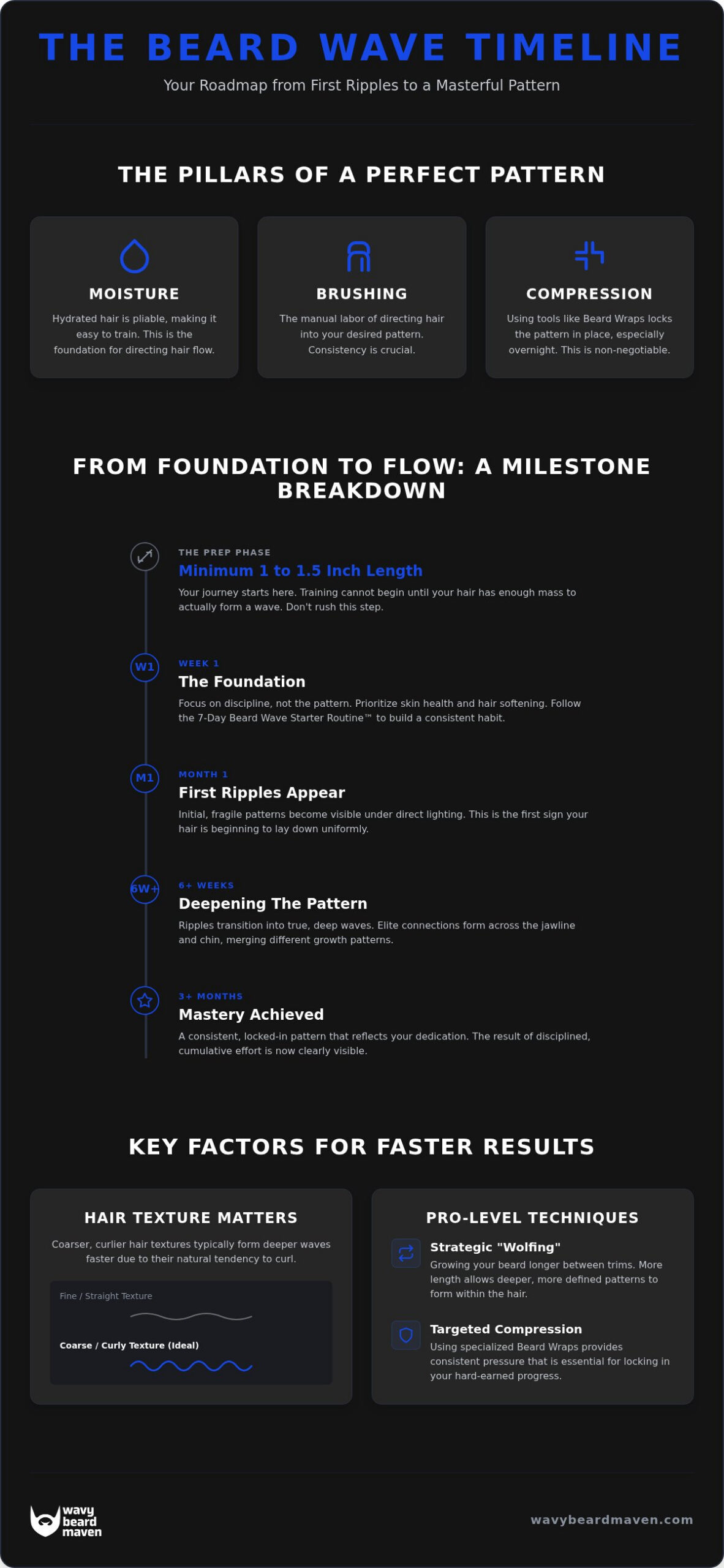
To succeed in this movement, you must master the three core pillars of the timeline:
- Moisture: You must keep the hair hydrated to make it pliable enough to lay down.
- Brushing: This is the manual labor of directing the hair into your desired pattern.
- Compression: Using specialized Beard Wraps locks the pattern in place while you sleep or go about your day.
Don’t fall for the instant result myth. Beard hair is significantly coarser and more stubborn than the hair on your head. It possesses a different cuticle structure that resists laying flat. Because of this, it requires more pressure, more product, and significantly more patience to submit to your will than scalp hair ever would. You are not just styling your hair; you are fundamentally changing the direction in which it grows.
The Difference Between Ripples and Deep Waves
There is a distinct difference between the ripple phase and deep waves. Ripples occur when your hair first begins to lay in a uniform direction. It looks promising under certain lighting, but the pattern is fragile and can disappear after a single shower. Deep waves represent a consistent, connected flow across your entire jawline and chin. While you might see ripples in week two, those elite connections often take six weeks or longer to solidify. You are training different growth patterns on your cheeks and chin to merge into a single, fluid aesthetic, which is the true mark of a master waver.
Why Your Starting Length Dictates Your Start Date
Your training cannot begin the moment you put down the razor. You need a minimum length of 1 to 1.5 inches before your hair has enough mass to actually wave. Attempting to force a pattern too early is a recipe for frustration and skin irritation. If your hair isn’t long enough to form a curl, it isn’t long enough to wave. Before you start counting the days on your timeline, ensure you have the foundation ready by following our how to start beard waves guide to prep your canvas correctly. Starting with the right length ensures your brush strokes actually catch the hair rather than just scraping your skin.
Milestone Breakdown: What to Expect from Week 1 to Month 3
Stop accepting “it depends” as an answer. While individual growth rates vary, the physiological process of hair training follows a predictable schedule. When you ask how long does it take to get beard waves, you are really asking for a roadmap to mastery. This journey is divided into four distinct phases that move from foundational skin health to elite pattern definition. Success is found in the transition between these phases, where your discipline turns a chaotic beard into an orderly masterpiece. You are not just waiting for hair to grow; you are actively sculpting a cultural aesthetic.
Week 1: The 7-Day Discipline Kickoff
Your first seven days are not about the pattern; they are about the person in the mirror. You must prioritize skin health and hair softening to prepare the canvas for the work ahead. This is where the 7-Day Beard Wave Starter Routine™ Checklist becomes your most valuable asset. During this phase, you are introducing high-quality beard oils to saturate the hair shaft, making it pliable enough for directional training. You aren’t just moving hair yet; you are training the habit of daily maintenance. If you can’t commit to a ten-minute routine now, you won’t survive the difficult wolfing phases that come later.
Month 1: Recognizing the First Ripples
By the end of the first month, you should begin to see the “ripple phase.” These are the initial signs that your hair is beginning to lay in a uniform direction. To see them, you often need specific lighting; try standing under a direct overhead light and tilting your head to catch the shadows on your jawline. The role of your Beard Brush is critical here. You must be consistent with your directional strokes. We recommend a minimum of 50 to 100 strokes per side, twice daily. This volume of repetition is non-negotiable if you want to force the hair to stay down. If you need a tool with the right tension, consider upgrading to a premium boar bristle Beard Brush to ensure every stroke counts toward your progress.
Weeks 4-8: The Connectivity Phase
This is where the magic happens. Your waves will start to align across different sections of your face. The gap between your chin and cheeks will begin to close as the pattern merges. It requires intense focus on your angles to ensure the brush strokes meet at the same point every time. This phase demands patience as you wait for the shorter hairs to catch up to the established pattern.
Month 3 and Beyond: Elite Definition
Once you hit the 90-day mark, the pattern is usually set. You have moved beyond training and into the maintenance phase. Your hair now remembers the direction, and the waves appear deeper and more connected. At this stage, your focus shifts to long-term “wolfing” and using Beard Wraps to keep the definition crisp as the hair gains length and weight.
Why Some Beards Wave Faster: Texture and Genetics
Your genetic makeup provides the canvas, but your discipline provides the art. While every man with a curly or coarse beard can achieve ripples, the biological starting point varies significantly between individuals. When you’re calculating how long does it take to get beard waves, you have to account for the physical resistance of your specific hair type. Genetics might determine your curl pattern and density, but they don’t determine your success. A man with “average” genetics and elite discipline will always outshine a man with “perfect” hair who lacks a routine. If your pattern keeps stalling despite consistent effort, it’s worth understanding the common myths behind why your beard won’t wave up and the technique fixes that can break through the plateau.
Hair density also plays a major role in the visibility of your progress. If your beard is sparse, the pattern will take longer to appear “connected” because there are fewer hairs to catch the light and create that shadowed ripple effect. You aren’t just training individual hairs; you are training a collective unit to lay in unison. The denser the beard, the faster those connections appear to the naked eye.
Coarse Hair vs. Medium Texture Timelines
The timeline for results is largely dictated by your hair’s diameter and curl strength. Each texture requires a different approach to moisture and weight to achieve a laid-back look.
- Coarse Hair (6-10 weeks): This texture is the most resistant to training. It requires significant weight from Beard Butters and constant compression to stay down. However, the reward is worth the wait; coarse hair produces the deepest, most defined waves in the community.
- Medium Texture (4-6 weeks): Medium hair is more pliable and responds faster to the Beard Brush. You’ll see ripples earlier, but you must be careful not to over-brush, which can lead to thinning if your tension is too high.
- Curly/Fine Texture (3-5 weeks): These beards wave the fastest because the hair is naturally prone to curving. The challenge here isn’t getting the waves; it’s keeping them from turning into a frizzy mess without proper hydration.
The Role of Porosity in Training Speed
Hair porosity is the ability of your hair to absorb and retain moisture, which is the foundational requirement for making coarse beard hair pliable enough to wave. If you have low porosity hair, your cuticles are tightly closed. This means your Beard Oils might sit on top of the hair rather than soaking in, making the hair feel stiff and resistant to the brush. You’ll need to use warm water or a hot towel before applying products to open those cuticles.
High porosity hair absorbs moisture quickly but loses it just as fast. If this is your texture, you’ll see fast results in the morning that disappear by noon. You must use heavier products like balms to seal that moisture in. Adjusting your routine based on porosity can shave weeks off your timeline by ensuring your hair is always in the optimal state for training.
Strategic Wolfing and Compression: Accelerating Formation
Wolfing is the intentional practice of growing your beard beyond its usual maintenance length to force the hair to lay down and form deeper connections. Most men fail because they trim too early, effectively resetting their progress just as the hair is gaining the weight needed to wave. If you want to know how long does it take to get beard waves to actually lock in, the answer is often “one wolfing session longer than you think.” By allowing the bulk to increase, you provide more surface area for the brush to train, creating a pattern that survives even after you finally cut back to your preferred length. This strategic combination of length and pressure is the ultimate answer to how long does it take to get beard waves, as it bypasses the plateau many beginners hit at the one-month mark.
The “Brush-Oil-Wrap” method is the gold standard for overnight progress. After your evening brush session using Beard Oil, you immediately apply a wrap. This sequence ensures that the hair is hydrated, directed, and then physically held in place while you sleep. Without this final step, your hair will frizz and revert during the night, undoing hours of hard work. You are essentially setting a cast for your hair to follow, turning every hour of sleep into an hour of training.
How to Wolf Your Beard Without Looking Messy
Maintain your discipline by keeping your neck and cheek lines sharp while the bulk of the beard grows. You aren’t growing a “wild” beard; you are growing a “trained” beard. Use a trimmer only on the perimeter to keep your appearance professional during this high-volume growth phase. Avoid touching the body of the beard at all costs. For a detailed breakdown of maintenance during this phase, study our guide on how to trim your beard without losing waves. Only when the pattern is visible through the thickest parts of the hair should you consider a “wash and cut” to reveal the definition underneath.
Compression: The Secret to Shaving Weeks Off Your Timeline
Compression is the non-negotiable force that turns ripples into deep waves. While brushing directs the hair, a Beard Wrap provides the constant pressure needed to train the cuticle to stay flat. You should wear your wrap for at least 30 minutes after every brush session and for the duration of your sleep. Specialized beard wraps are engineered for facial contours, providing even tension that a standard scalp durag cannot replicate. This targeted compression is exactly why some men see results in half the time of others. To take control of your formation today, secure your own specialized Beard Wraps and start locking in your pattern.
The Maven Method: A Daily Routine for Faster Results
To maximize your progress, you need a systematic approach that turns every hour into a training session. The Maven Method is a high-performance routine designed to compress the timeline from months to weeks. While you’ve learned the general answer to how long does it take to get beard waves, the actual speed of your results is directly proportional to your daily discipline. This isn’t just about grooming; it’s about a relentless commitment to the craft. By following a structured daily regimen, you ensure that your hair never has the opportunity to revert to its natural, chaotic state.
Your daily cycle should follow this elite progression:
- Morning Routine: Apply Beard Oil to a damp beard to lock in hydration. Follow this with your first 15-minute directional brush session to set the pattern for the day.
- Mid-Day: Perform a quick “Dry Brush” touch-up. This five-minute session reinforces the direction and prevents the hair from frizzing out during your daily activities.
- Night Routine: This is the most critical phase. Apply Beard Butter for deep conditioning and weight. Follow with a 20-minute compression session using your Beard Wraps before heading to bed.
- Weekly: Execute a “wash-and-style.” Cleanse the hair to remove product buildup, then brush the pattern into place while the hair is soaking wet and saturated with conditioner to reset the definition.
Essential Tools to Shorten the Wait
The quality of your equipment determines the quality of your ripples. A boar bristle Beard Brush is superior to synthetic alternatives because the natural bristles distribute your skin’s sebum and product evenly, providing the necessary grip to pull the hair flat. To maintain the “tack” needed for deep definition, incorporate Beard Balms into your rotation. These provide a heavier hold than oil alone, ensuring your waves don’t shift once you’ve brushed them into place. For those serious about mastery, the first step is to download the 7-Day Beard Wave Starter Routine™ Checklist to ensure your foundation is unbreakable.
Tracking Your Progress: The “Wave Check”
Motivation can wane when you’re staring at the same mirror every morning. To stay focused, take weekly progress photos under consistent lighting. This “Wave Check” allows you to identify “blind spots” where the pattern is breaking or where connections haven’t formed yet. Often, the jawline requires more attention than the chin. By analyzing these photos, you can adjust your brush angles to fix inconsistencies. Remember, you are the architect of this style. Consistency is the only variable you can truly control in the question of how long does it take to get beard waves to reach elite status.
Join the Wavy Beard Maven movement and get your 7-Day Checklist today!
Master Your Pattern and Command Respect
You now understand that elite beard waves aren’t a product of luck; they’re the result of a disciplined daily routine. Whether you’re navigating the initial foundation week or pushing through a long wolfing phase, your progress depends on the synergy of hydration, brushing, and compression. While the question of how long does it take to get beard waves depends on your unique hair texture, the timeline is always shorter for those who refuse to skip a session. We’ve built a community trusted by thousands of wavers nationwide, providing specialized tools designed specifically for the unique challenges of coarse facial hair. You have the knowledge to move from chaos to order. It’s time to master the discipline of elite grooming and reveal the pattern you’ve earned through persistence. Success is waiting for the man who stays consistent and follows the method.
Start Your Journey with the 7-Day Beard Wave Starter Routine™
Frequently Asked Questions
Can I get beard waves in just one day?
No, you cannot achieve a legitimate wave pattern in twenty-four hours. Real waves are the result of consistent hair training and structural memory, which takes time to develop. While you might temporarily flatten your hair with a heavy balm, it won’t be a locked-in pattern. Most men ask how long does it take to get beard waves because they want a quick fix, but elite results require at least two to four weeks of daily discipline.
Do I really need a beard wrap to see results?
Yes, compression is a non-negotiable pillar of the waving process. A specialized Beard Wrap provides the constant, even pressure needed to train your hair to lay flat and stay in formation. Without it, your hair will naturally frizz and curl back to its original state during sleep. Using a wrap for at least thirty minutes after brushing or overnight ensures your hard work actually stays locked into the hair cuticle.
How often should I brush my beard for waves?
Commit to at least two dedicated brushing sessions every day, once in the morning and once before bed. Each session should last between fifteen and thirty minutes of focused, directional strokes. Consistency is more important than total time; brushing for an hour once a week is far less effective than ten minutes every single morning. Use a boar bristle Beard Brush to ensure you are reaching the roots and training every layer.
Will trimming my beard ruin my wave progress?
Trimming the body of your beard too early will absolutely reset your timeline. You need bulk and length to form deep ripples, a process known as “wolfing.” If you cut the hair before the pattern is set, you remove the very hair you’ve been training. Limit your grooming to sharpening the neck and cheek lines. Only consider a “wash and cut” to reveal the pattern once you have achieved solid connectivity across your jawline.
Why are my waves disappearing after I wash my beard?
Your waves disappear after washing because water and shampoo lift the hair cuticle and allow it to return to its natural curl. To prevent this, you must master the “wash and style” method. This involves brushing your pattern into place while the hair is still wet and saturated with conditioner. Apply your Beard Wrap immediately after rinsing and keep it on until the hair is completely dry to lock the pattern back in.
What is the best beard length for waves to start appearing?
Most men see the best results when their beard reaches a length of 1 to 1.5 inches. If the hair is too short, there isn’t enough length for the curl to lay down and form a ripple. If it’s too long without training, it becomes a wild mass that is difficult to control. Achieving the right length is the prerequisite for asking how long does it take to get beard waves to show up on your face.
Can I get waves if my beard is patchy?
You can still train your hair if you have minor patches, but the pattern won’t look “connected” until you have sufficient density. Waves rely on the shadows created by neighboring hairs laying in the same direction. If you have significant gaps, focus on a healthy growth routine first. Use the 7-Day Beard Wave Starter Routine™ Checklist to maximize your hair health and fill in those areas before attempting to lock in an elite pattern.
Does beard oil actually help waves form faster?
Yes, Beard Oils are essential because they make coarse facial hair pliable. Dry hair is brittle and resistant to training, often snapping or frizzing under the brush. By saturating the hair with high-quality oils, you soften the cuticle and make it much easier to direct. This increased flexibility allows your brush strokes to be more effective, which directly accelerates the training phase and helps you see ripples much sooner than with dry hair. If you’ve been consistent with oiling and brushing but still find yourself asking why your beard won’t wave up despite your efforts, you may be falling for one of the common technique myths that silently sabotage your progress.