September 21, 2026
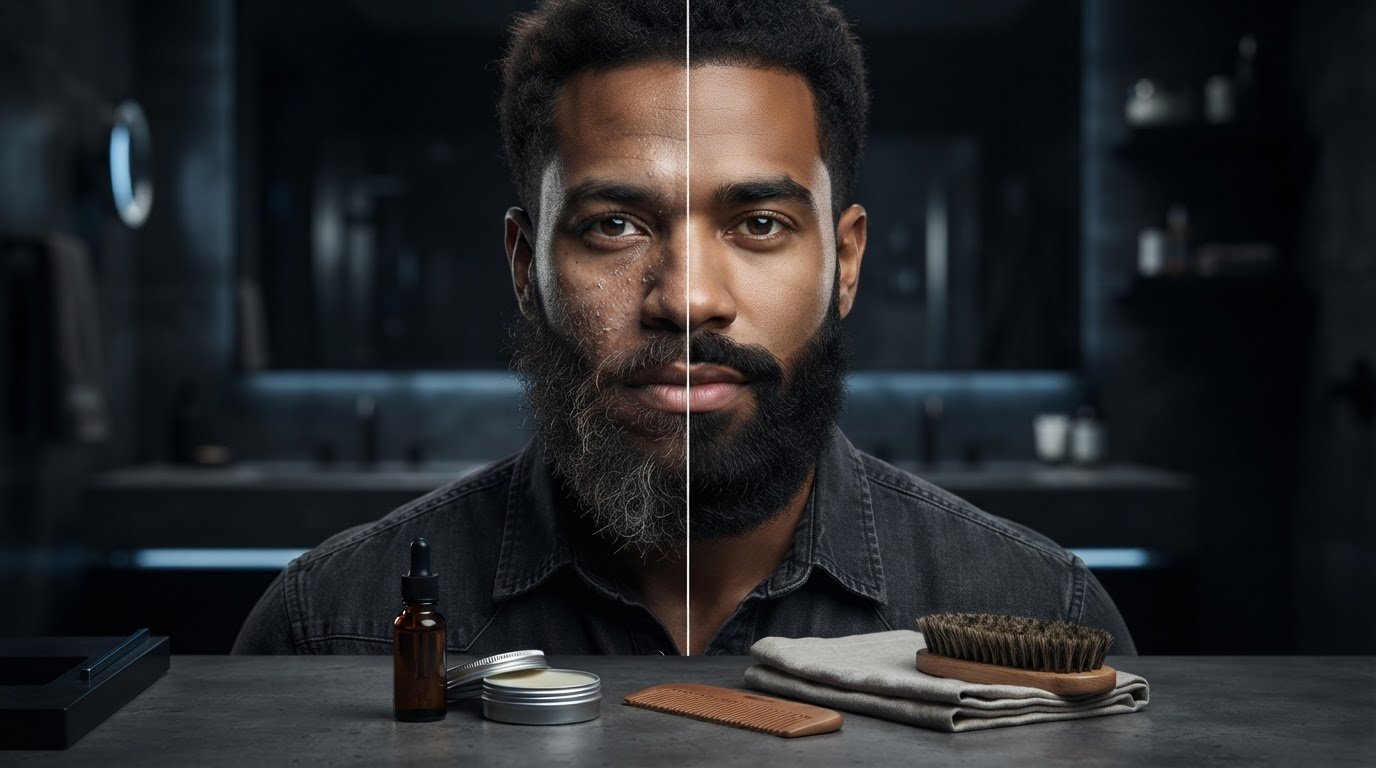
What if your brittle facial hair isn’t a genetic failure, but a compromised skin barrier crying out for discipline? When relentless itching, embarrassing flakes, and brittle strands snapping during regular brushing take over, you’re witnessing the unmistakable signs your beard is unhealthy. It’s completely natural to wonder whether your facial hair is permanently damaged or merely starved for deep hydration, especially when patchy growth and persistent irritation threaten your personal confidence.
Every dedicated grower encounters rough phases, but accepting substandard results is never the protocol. Lasting aesthetic pride is earned through consistent, deliberate maintenance rather than quick fixes or luck. In this diagnostic guide, you’ll learn to spot the subtle warning signs of cuticle distress, stop breakage using targeted conditioning methods, and restore structural vitality to coarse textures. We’ll break down the differences between simple surface dryness and deeper barrier distress, then lay out the disciplined routine needed to build a softer, resilient beard.
Key Takeaways
- Spot the unmistakable signs your beard is unhealthy early, from wire-like texture to persistent flaking beneath the hair.
- Uncover the biological root causes of damage, including lipid depletion from harsh detergents and the natural limits of facial sebum production.
- Test your strand elasticity to accurately distinguish temporary surface dehydration from severe cuticle distress.
- Execute a step-by-step rehabilitation protocol using gentle clarifying techniques alongside functional beard oils and butters to restore deep moisture.
- Establish a daily maintenance discipline and sanitize your grooming tools regularly to protect your gains and prevent recurring damage.
Key Signs Your Beard Is Unhealthy: Diagnostic Red Flags
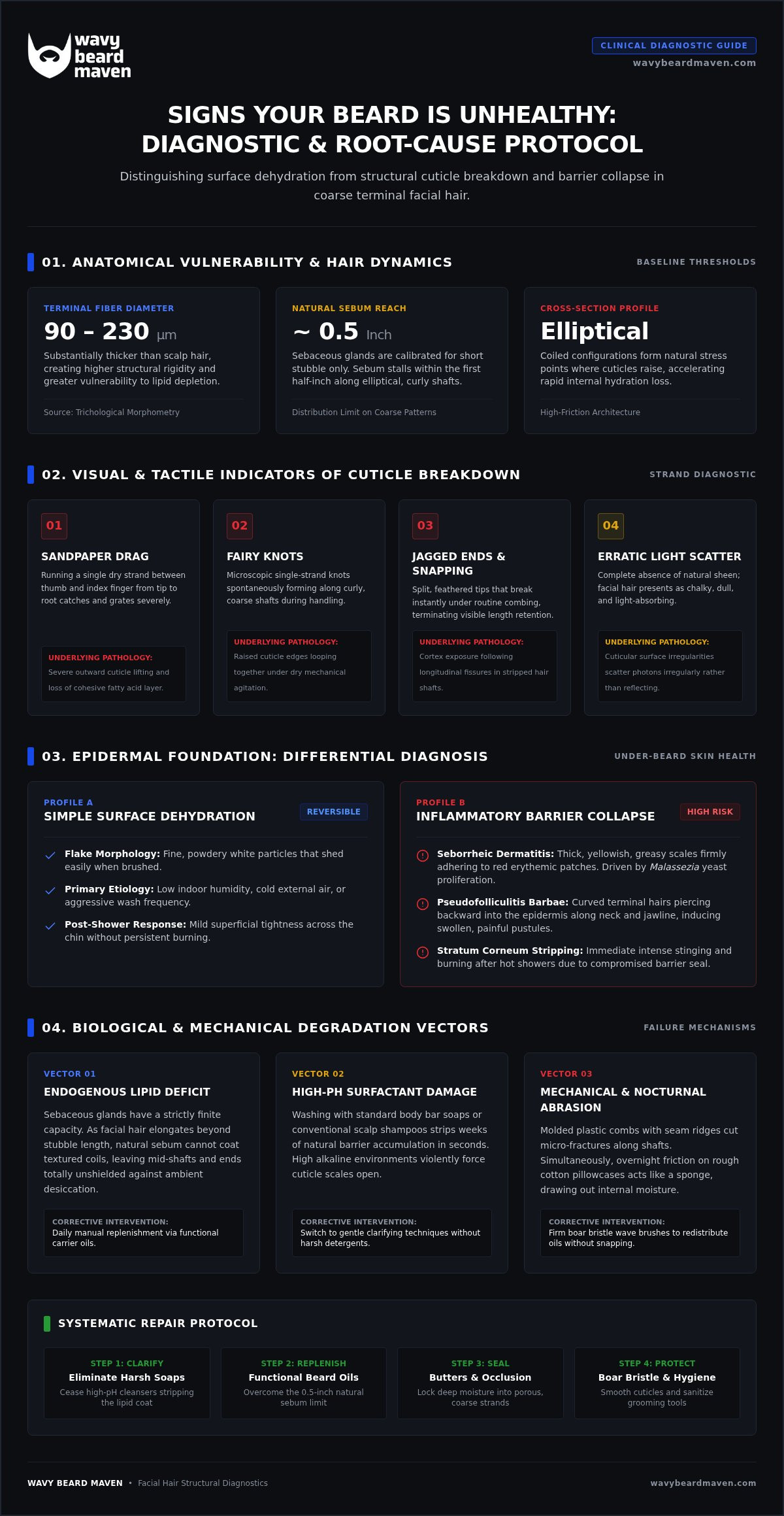
Diagnosing facial hair damage begins with separating surface dry spells from deep structural decay. Terminal facial hair measures between 90 µm and 230 µm in diameter, which makes it substantially thicker and structurally more fragile against lipid loss than scalp hair. When you notice brittle strands, rough patches, and persistent skin irritation, these are the frontline signs your beard is unhealthy. Dismissing them as simple genetics only accelerates hair loss and cuticle breakdown.
Visual and Tactile Indicators of Cuticle Damage
Run a single dry beard strand between your thumb and index finger from tip to root. If the hair catches, drags, or feels like sandpaper, you are experiencing severe cuticle lifting. Coarse, curly patterns frequently develop microscopic fairy knots (single-strand knots) that tangle during routine handling. Split tips follow quickly, creating jagged ends that snap under everyday combing and completely halt visible length retention. When cuticles lift and splinter, light scatters erratically across the beard rather than reflecting evenly, stripping away natural sheen and leaving your facial hair looking dull and lifeless.
Skin-Level Distress: Flaking, Redness, and Folliculitis
Healthy facial hair cannot exist on an inflamed foundation. Distinguishing between surface dehydration and genuine inflammatory distress dictates your entire repair protocol:
- Dehydrated flakes vs. seborrheic dermatitis: Fine, powdery white flakes indicate simple dry skin caused by cold air or aggressive washing. In contrast, thick, yellowish, greasy scales stuck to red patches indicate an overgrowth of Malassezia yeast.
- Follicular inflammation and ingrowns: Curved facial hairs often bend backward into the epidermis along the neck and jawline, triggering pseudofolliculitis barbae with swollen, painful pustules.
- Post-shower burning: Tightness and stinging immediately after hot showers signal a stripped stratum corneum that cannot retain baseline moisture.
Recognizing these clear signs your beard is unhealthy at the skin level protects your follicles before physical breakage becomes permanent. Your skin barrier governs hair health; treat the foundation first, and strand vitality will follow.
Root Causes of Beard Damage: Why Facial Hair Fails
Facial hair doesn’t deteriorate overnight. It fails because of physiological limits and flawed daily habits. Sebaceous glands produce a finite volume of natural sebum designed only to lubricate short stubble, not a full beard. As hair gains length, that endogenous supply falls short. Washing with harsh bar soaps or conventional scalp shampoos strips away the thin lipid barrier that remains. Consulting the American Academy of Dermatology’s beard care guide highlights how stripping the skin barrier directly sabotages follicular stability. When moisture escapes unchecked, the early signs your beard is unhealthy begin to multiply.
The Sebum Depletion Dilemma in Coarse Hair
Textured patterns face unique biological hurdles. Coarse, curly facial hair has an elliptical cross-section with natural twists and coils. Sebum cannot simply slide down the shaft; it stalls within the first half-inch, leaving mid-lengths and ends starved for hydration. When you wash with high-pH soaps, you wipe out weeks of natural barrier accumulation in seconds. Without manual replenishment through functional carrier oils, strands become porous, rough, and vulnerable to environmental heat and indoor dryness.
Mechanical Friction and Over-Manipulation Hazards
Everyday friction accelerates strand destruction when your grooming technique lacks control. Tearing through dry knots with cheap plastic combs creates microscopic fractures along the hair shaft. Selecting a firm boar bristle beard brush for waves prevents shaft snapping by smoothing the outer cuticle layers and redistributing sebum across every coil. Overnight friction matters just as much. Rough cotton pillowcases draw moisture out of the hair fiber like a sponge while you sleep. To protect your progress and lock in deep moisture, check out the specialized restoration tools at Wavy Beard Maven.
Healthy vs. Unhealthy Facial Hair: The Core Differences
Telling damaged facial hair apart from a thriving beard requires objective physical benchmarks. A healthy beard moves with flexibility, retains internal moisture, and lies uniformly across your jawline. Unhealthy strands behave erratically. They snap under tension, frizz into uncontrollable clusters, and resist basic styling. Knowing these baseline differences helps you catch the subtle signs your beard is unhealthy before structural damage leads to permanent patchiness.
Elasticity, Porosity, and Moisture Retention Benchmarks
You can verify strand integrity in seconds using a wet tensile test. Pluck a single shed beard hair, dampen it thoroughly with clean water, and gently stretch it between both hands. A well-hydrated strand stretches slightly before snapping back to its original length. High-porosity, stripped hair snaps immediately under minimal tension. Damaged hair also absorbs surface water instantly but loses that moisture just as quickly through cracked cuticles, leaving the fiber feeling brittle and dry within minutes.
| Evaluation Metric | Healthy Beard Hair | Damaged / Compromised Hair |
|---|---|---|
| Tensile Elasticity | Stretches slightly, returns intact | Snaps instantly under light tension |
| Cuticle Porosity | Smooth, seals moisture internally | Cracked, rapid water loss |
| Skin Foundation | Calm, supple, flake-free | Erythema, persistent flaking |
When the underlying follicle becomes infected rather than merely dehydrated, clinical symptoms appear. Reviewing clinical guidance on folliculitis symptoms and treatment makes it simple to separate bacterial pustules from surface mechanical friction.
Debunking the Myth: Coarse Does Not Mean Unhealthy
A common misconception leads many men to confuse natural texture with structural damage. Dense, wire-like hair is not unhealthy by default; it is simply thick and tightly coiled. Reaching for chemical straighteners or harsh relaxers strips the cortex, introducing severe weakness. Coarse facial hair thrives when supported by consistent hydration routines and controlled mechanical guidance. Maintaining that baseline elasticity is essential if you want to master how to get beard waves, as brittle hair cannot sustain trained wave patterns without breaking along the curvature.
Pay close attention to how your hair behaves during daily styling. If your beard resists all direction, breaks into fragments, and tangles into stubborn knots, you are dealing with classic signs your beard is unhealthy. Realignment starts with functional conditioning.
How to Rehabilitate Damaged Facial Hair Step by Step
Reversing structural fatigue is never about buying quick-fix miracle serums. It demands a systematic, five-step rehabilitation protocol. When you let the early signs your beard is unhealthy linger, cuticles stay flared and internal moisture vanishes. Reclaim control by working in a deliberate sequence: strip away residue, infuse hydration, seal the strand, and protect the gains.
The Cleanse and Hydrate Foundation
Execution begins at the basin with clean fundamentals:
- Step 1: Clarify buildup gently. Coarse hair easily traps environmental grit and stubborn styling wax. Use a gentle, sulfate-free cleanser to dissolve buildup without stripping away delicate facial lipids. Never scrub vigorously; press the lather through the hair with flat palms.
- Step 2: Saturate with lukewarm water. Scalding water shocks the skin barrier and forces cuticles wide open. Saturate your beard with lukewarm water or a clean liquid mist. Remember the cardinal rule: oil cannot moisturize dry hair. Water provides genuine internal hydration; oils merely lock that hydration inside.
Locking Moisture with Oils, Butters, and Compression
Once you infuse baseline hydration, mechanical sealing preserves the integrity of each strand:
- Step 3: Restore skin lipids with oil. Dispense several drops of lightweight beard oil for waves directly onto your fingertips. Work the oil down into the skin barrier and follicle bases first, then pull whatever remains outward through the lower third of the beard.
- Step 4: Smooth the cuticle with rich butter. Apply a dime-sized amount of dense beard butter through the mid-lengths and ends. High-grade plant butters melt on contact, filling microscopic cuticle fractures and transforming rough, wire-like bristles into pliable hair.
- Step 5: Lock in conditioning overnight. Sleeping on bare cotton pulls conditioning agents out of your beard within hours. Shield your investment before bed using a dedicated beard durag for waves or protective beard wrap to retain moisture, eliminate pillow friction, and train hair flush against the jawline.
Consistency turns these individual actions into visible restoration. Ready to reset your routine and eliminate damage for good? Take command of your daily grooming and order your essential restoration supplies from Wavy Beard Maven today.
Building a Long-Term Maintenance Plan to Prevent Relapse
Rehabilitating your facial hair is only half the battle; maintaining those results requires strict, daily adherence. Sporadic weekend conditioning cannot compensate for five days of environmental exposure and mechanical neglect. When routines slip, moisture drops, cuticles crack, and the unmistakable signs your beard is unhealthy quickly return. Protecting your hair demands a continuous maintenance loop that integrates morning hydration, nocturnal protection, tool hygiene, and precision trims.
The Daily Discipline Framework
Consistency separates temporary cosmetic relief from lasting structural transformation. Anchor your morning ritual around lightweight hydration to counter trans-epidermal water loss, then reserve heavier sealing butters and compression wraps for your evening wind-down. To eliminate guesswork and build an unbreakable rhythm, download and follow the free 7-Day Beard Wave Starter Routine™ Checklist. Audit your progress at the end of each week by checking skin elasticity, follicle comfort, and strand softness. For specialized tools engineered specifically for textured patterns, visit the Wavy Beard Maven grooming shop to equip your daily setup.
Trimming and Tool Maintenance Protocols
Physical tools directly influence strand longevity. Neglected equipment reintroduces dirt, rancid lipids, and microbes straight back into your hair, creating fresh irritation:
- Bi-weekly brush sanitation: Submerge your boar bristle brushes in warm water with a drop of clarifying wash every two weeks. Brushes accumulate oxidized sebum, shedding fragments, and trapped lint that strip away sheen if left unwashed.
- Targeted micro-trims every six weeks: Never tear through split ends with electric buzzers. Dull blades crush the hair shaft, accelerating longitudinal splits upward toward the root. Instead, use sharp Japanese steel barber shears to snip damaged tips strand by strand.
- Seasonal weight calibration: Shift your product density as local climates change. Swap heavy occlusive balms for lighter carrier oils during high-humidity summer months to prevent clogged pores, then reintroduce denser plant butters when indoor winter heating leaches ambient moisture.
Internal fueling supports this external routine. Terminal facial hair grows at roughly 0.3 mm to 0.5 mm per day, relying entirely on systemic nutrition to synthesize strong keratin chains. Drink adequate water, prioritize lean proteins, and support your skin barrier daily. When you combine internal nourishment with clean tools and methodical application, you keep the telltale signs your beard is unhealthy permanently at bay.
Restore Your Beard’s Strength Through Daily Mastery
Wire-like coarseness, persistent flaking, and snapping strands aren’t permanent genetic flaws. They are simply clear signs your beard is unhealthy and starved for lipid replenishment. Once you stop treating grooming as a sporadic chore and approach it as a disciplined craft, reviving your facial hair becomes an exact science. Gentle clarifying, targeted water infusions, and sealing with functional oils and butters will steadily rebuild your skin barrier and restore cuticle integrity.
Lasting transformation doesn’t come from quick chemical cover-ups; it’s earned through consistency. When you commit to a structured daily regimen formulated specifically for textured, wavy, and coarse patterns, your beard responds with softness, elasticity, and defined strength. Step into your routine with absolute intention. Rebuild your hair health with the 7-Day Beard Wave Starter Routine™ Checklist and take total ownership of your grooming journey today.
Frequently Asked Questions
How do you fix an unhealthy, brittle beard fast?
Fixing a brittle beard quickly requires immediately reintroducing internal hydration and sealing it with lipid-rich oils. Stop using harsh cleansers that strip natural sebum. Dampen your facial hair thoroughly with lukewarm water, apply several drops of lightweight beard oil to the skin, and coat the outer fibers with a dense beard butter. Protecting the hair overnight with a compression wrap eliminates friction, providing noticeable softening and reduced breakage within forty-eight hours.
Can a severely damaged beard recover without shaving it off?
Yes, most damaged beards can recover without shaving, provided the hair follicles remain alive and functional. While split ends require careful micro-trimming with sharp shears, parched cuticles and inflamed skin can be rehabilitated through strict daily care. Committing to routine hydration, protective overnight compression, and consistent sebum distribution will nurse stressed hair fibers back to strength, allowing fresh, resilient growth to gradually replace fragile lengths.
What does an unhealthy beard feel like to the touch?
An unhealthy beard feels scratchy, stiff, and abrasive, often resembling steel wool or dried straw under your fingers. When you run your fingers from tip to base, damaged strands catch, tangle easily, and offer sharp resistance. These tactile red flags represent unmistakable signs your beard is unhealthy and structurally dehydrated. Healthy coarse hair remains soft, bends smoothly under gentle pressure, and retains a supple, elastic bounce rather than snapping during daily handling.
Why is the skin under my beard itchy, red, and flaking?
Itchy, red, and flaking skin under your beard is usually caused by a compromised moisture barrier or an overgrowth of skin yeast. When sebaceous glands can’t produce enough natural oils to coat longer whiskers, facial skin dries out and cracks. Cleansing with scalding water or using harsh detergent soaps strips remaining lipids, triggering intense irritation. In other cases, an inflammatory reaction to Malassezia yeast causes greasy scales and persistent erythema that requires targeted care.
How often should I apply beard oil to repair damaged whiskers?
You should apply beard oil once or twice daily, prioritizing application immediately after cleansing while skin is still damp. Morning application locks in essential moisture and defends against environmental stress, while a light evening touch seals the hair shaft before sleep. If you are battling advanced signs your beard is unhealthy, stick strictly to pure carrier formulas that absorb quickly into the dermis without suffocating delicate facial pores or building heavy surface residue.
What is the main difference between beard dandruff and dry skin?
The main difference lies in flake appearance and the condition of the underlying skin. Simple dry skin produces tiny, powdery white flakes that shed easily without causing severe redness. True beard dandruff, linked to seborrheic dermatitis, creates larger, yellowish, greasy flakes that cling to hair shafts and sit atop inflamed, tender skin patches. Treating dry skin requires basic hydration, whereas genuine dandruff requires gentle clarifying and barrier-repairing regimens.
Can using the wrong brush damage your facial hair follicles?
Yes, using brushes with synthetic, rigid plastic bristles can scratch facial skin and yank hairs directly out of their follicles. Plastic bristles create high friction and snag coarse hair patterns, causing microscopic follicle trauma, root inflammation, and uneven patches. Switching to a firm, natural boar bristle brush protects your hair structure. Boar bristles flex around natural contours, lift away trapped debris gently, and distribute natural oils evenly from root to tip without causing mechanical breakage.